

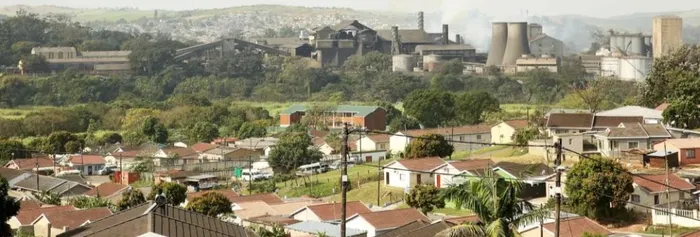
The Maidstone Sugar Mill.
Image: File
NORTH Coast sugar cane farmers express cautious optimism as the Maidstone Mill is set to reopen next month, following a tumultuous period of financial uncertainty and potential liquidation.
In February, the 134-year-old Tongaat Hulett Limited (THL), which had faced financial issues, announced its decision to seek provisional liquidation following a failed business rescue plan.
At the time, the company's business rescue practitioners (BRPs) announced that after exhausting all reasonable endeavours following a lapsed sales agreement, they had applied to the high court to discontinue the company’s business rescue proceedings and place it under provisional liquidation.
“This is an outcome the BRPs did everything in their power to avoid, fully aware of the profound impact on employees, growers, suppliers, creditors, clients and the many families and communities whose livelihoods depend on the company. However, the circumstances that ultimately necessitated this application arose beyond the control of the BRPs and within the constraints of their statutory duties under Chapter 6 of the Companies Act,” read the statement
According to the statement, THL entered business rescue in October 2022 following severe historic accounting irregularities, financial misstatements and governance failures under former senior management.
It further read that if a provisional liquidation order was granted by the high court, the Master of the high court would appoint a provisional liquidator, who would assume responsibility for overseeing the winding-up process, engaging with creditors, securing the company’s assets, and guiding the submission and adjudication of creditor claims.
The application for liquidation is expected to be heard this week.
Pratish Sharma, a fourth-generation sugar farmer in Isinembe, said they received a letter in early March informing them that the mill would reopen on May 27.
The letter also included the reopening of other sugar mills, including Amatikulu and Felixton.
“The letter was reassuring. However, there is still uncertainty as the hearing for liquidation is set to be heard this week. It is now at the discretion of the judge whether the liquidation will be granted or whether the business will continue in business rescue.”
Sharma, who is also a director of the SA Canegrowers Association, and chairperson of its branch, Maidstone Local Growers Council, said the association together with other interested parties, had intervened and would oppose the liquidation.
“As the growers, we are stakeholders in the business in the sense that we supply the raw materials, and if that business goes into liquidation we are going to be at risk. However, I am hopeful as there has been intervention from various stakeholders in trying to prevent Tongaat Hulett from undergoing liquidation.”
Keval Bodasingh, a fifth-generation sugar cane farmer in New Guelderland, KwaDukuza, said it was a bitter-sweet victory.
“On one hand, we are all relieved that we will be able to harvest our sugar cane and have the mill to supply to. But, on the other hand, there is a significant delay as we will be starting a month later. The mill was originally supposed to open in April, but then we were informed of the liquidation.
“This will now have a ripple effect as we will get paid almost two months later from when we start. If we had started on April 1, we would have received the first payment at the end of May. We get paid 30 days after the first month is completed. Now that we are starting at the end of May, we will have to wait until the end of July.
“The season which is generally between 35 to 40 weeks, is now only 30 weeks long due to the late start. This has a huge impact as we have to deliver the cane in a shorter space of time. We will have to increase staff such as cane cutters, and equipment such as tractors. It would also mean doing more loads a day. As a seasonal business, you cannot afford to lose one day.
“However, I am grateful we have a mill to crush our cane, and grateful that the various key stakeholders have joined forces to find ways to resolve the situation, and ensure a sustainable future for the industry,” he said.
Vyas Maharaj, a sugar cane farmer in Wewe, Tongaat, for the past 17 years, said he was relieved that the mill would reopen.
“My father, brother and I always had to get into the sugar cane industry as farming had been in our family for generations. We bought our first farm in 2009, and it was a flourishing business right up until the last season.
“It was definitely concerning when we were informed about the possibility of the company being liquidated. We immediately stopped our prepping to just try and safeguard our crop should the mill not open. But now, while I am optimistic, I am awaiting the outcome of the liquidation application to determine the next step,” he said.