

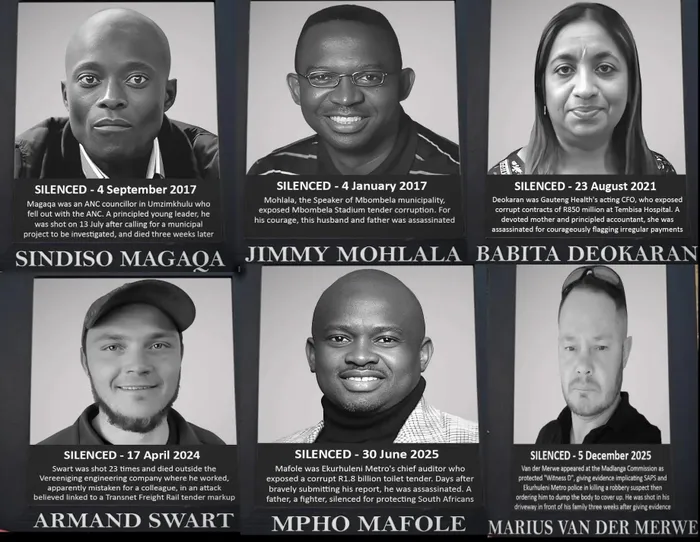
Under a campaign called 'They Have Names', Outa has compiled a list of some of those who were killed due to being whistle-blowers. The author says whistle-blowers are praised publicly, yet exposed privately.
Image: OUTA
EXPERTS weigh in on South Africa's proposed bill, highlighting both its potential and significant gaps in safeguarding whistle-blowers.
Devoshum Moodley-Veera, an integrity activist, said while the provisions set out in the proposed bill represent a step forward, it remained uncertain whether the movement was in the right direction.
“The continued absence of a central whistle-blower ombudsman, despite longstanding calls from civil society, combined with the proposal to channel whistle-blowing reports through the Witness Protection Unit, appears to me to be fundamentally misguided. Public trust in state institutions has been significantly eroded, raising serious concerns about the practical effectiveness of the mechanisms proposed in the bill.
“The Madlanga Commission failed to adequately protect witnesses and a similar pattern emerged during the Zondo Commission, where many whistle-blowers were forced into exile or went into hiding due to safety concerns. These failures highlight the State’s ongoing inability to provide meaningful protection. I do not believe that whistleblowers will be protected under this new legislation,” she said.
Moodley-Veera, a PhD student specialising in whistle-blower protection, law and ethics at Stellenbosch University, said some of the proposed changes, such as the introduction of incentives, the creation of a database, and sanctions for retaliation, appeared promising at face value.
“However, there is little clarity on how these measures will function in practice. Of particular concern is the imbalance within the bill. There are more provisions outlining circumstances under which individuals are not protected than there are provisions dedicated to the protection of whistle-blowers themselves. I find this to be quite worrisome seeing that this bill was supposed to be protective in nature to whistle-blowers.
“Furthermore, significant power remains vested in those who receive whistle-blowing reports, creating a risk of delayed or stalled investigations as observed for decades. The bill also imposes restrictive reporting channels, still requiring disclosures to be made to employers or legal practitioners. This is problematic, as legal practitioners often occupy a dual role. I believe more improvements are needed in this bill to actually protect whistle-blowers and not the perpetrators,” she said.
Adila Chowan, an advocate and whistle-blower, said she believed the bill reflected a strong foundation with critical gaps.
“The bill represents substantial progress compared to the current, inadequate Protected Disclosures Act of 2000. On the positive note, it proposes a comprehensive, proactive system rather than a reactive one.”
Chowan said while there was progress in the proposed legal framework, the reality on the ground shows the system was still failing.
“On the same day the bill was launched, a former elite police officer, Matipandile Sotheni, was in court for the murder of whistle-blower Marius van der Merwe (Witness D). The fact that a suspect has been arrested and is being prosecuted, is a testament to law enforcement's ability to act. However, this case also reveals the immense challenges.
“The bill came too late for him. Mr van der Merwe was killed in December 2025, just four months before this bill was launched. His death is a stark reminder of why the bill was necessary. The trial has already seen bizarre complications, with the accused publicly rejecting his own lawyer and claiming he never gave instructions. This is a classic tactic to delay proceedings, and suggests ongoing efforts to subvert justice.
“My view is that while the bill creates the tools for safety, progress in ensuring it is not yet proven. The proof will be in the resourcing of the Witness Protection Programme and the unwavering prosecution of those who harm whistle-blowers. In addition, my hope is that this bill will break the cycle of tragedy and empty promises that have defined whistle-blower protection in South Africa,” she said.
Ben Theron, chief executive officer of The Whistleblower House, said the bill was a big step forward.
“Extending witness protection to whistle-blowers and their families is one of the most important developments. It recognises the level of risk involved in speaking up. It also strengthens legal protection, and better reflects the reality that whistle-blowers and their families face retaliation.
“Making it a criminal offence to expose a whistle-blower’s identity is another important step, given the consequences that confidentiality breaches have had in the past. But the issue is not only protection in law. The issue is whether that protection is applied fast enough to prevent harm. In cases where whistle-blowers have been threatened or killed, the gap has not been the absence of laws. The gap has been slow response and weak co-ordination. This bill strengthens the framework, but it will only make a difference if it changes how quickly institutions act,” he said.
Wayne Duvenage, chief executive officer of Organisation Undoing Tax Abuse (Outa), said while they welcomed the bill, Parliament must strengthen it to ensure the protection of those who exposed corruption.
“We acknowledge that there are important improvements in the bill, as it broadens protection beyond traditional employees, extends safeguards to related persons such as family members and associates, strengthens confidentiality, creates a clearer reporting and investigation framework, and introduces stronger remedies against retaliation. These are meaningful reforms and reflect long-standing concerns raised by the Zondo Commission and subsequent anti-corruption reform efforts.
“However, the key question is not whether the bill is better than the current law on paper. The real question is whether it will protect a whistle-blower in practice when they are up against a powerful employer and a politically-connected network, or an institution with money, lawyers and influence.
“On that test, Outa believes the bill still falls short in that it does not ensure that the proposed mechanisms to protect whistle-blowers will be properly resourced. We need an independent whistle-blower protection mechanism with the power to receive disclosures, co-ordinate investigations, provide rapid-response protection, support high-risk whistle-blowers and their families, and ensure that any retaliation is dealt with swiftly and decisively,” he said.
Duvenage said Outa further believed that support for whistle-blowers should not depend only on the remote possibility of a later financial award after conviction.
“South Africa should establish a dedicated support fund to assist whistle-blowers who suffer retaliation, loss of livelihood, or threats to their safety because they acted in the public interest.”
Rakesh Deokaran, the brother of slain whistle-blower Babita Deokaran, said the bill was “long overdue”.
Babita, who was the chief director of financial accounting at the Gauteng Department of Health, was killed on August 23, 2021.
It is alleged that a hit was put on the mother of one after she blew the whistle on fraud and corruption at the Tembisa Hospital in Gauteng
Three days later, six men were arrested and charged with murder, attempted murder, conspiracy to commit murder, and possession of an unlicensed firearm and ammunition.
They have since been sentenced. However, the search for the “mastermind or masterminds” continues.
“It is better late than never, but the bill could have possibly saved my sister had it been passed into law years ago. Our family will never know, but the question now is: will it guarantee the safety of the next whistle-blower? We can only hope so.
“Our family still want the mastermind or masterminds behind our sister’s killing to be arrested and face the consequences. There needs to be accountability. I believe whistle-blowers should be paid for risking their lives. While some may say fighting fraud or corruption isn't about money, whistle-blowers have families, and in some instances, they are the breadwinners. Should something happen to them, their families should be compensated,” he said.
The bill is now open for public comment until May 14. Email comments to [email protected].