

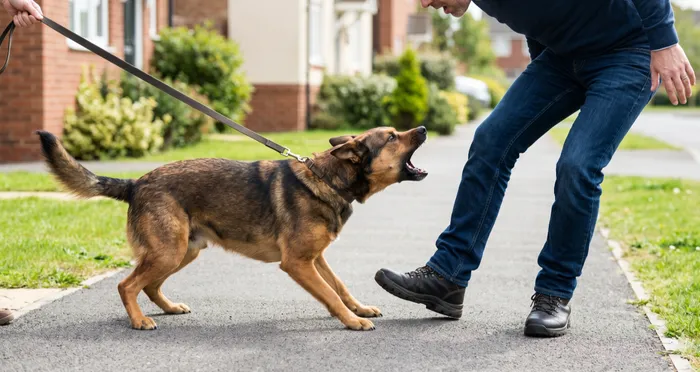
A lower court initially accepted that the dog attack triggered a chain of events leading to the fracture and held Shaun Errol Bergstedt liable. Unhappy, Bergstedt appealed the ruling.
Image: Google Gemini
The Western Cape High Court upheld an appeal in a dog bite case, determining that a man's fractured ankle was not the result of a dog attack, thus absolving the animal's owner of liability.
The court narrowed the matter to a single legal question: whether the bite from a dog owned by Shaun Errol Bergstedt caused the fractured ankle suffered by William Henry Rhode.
The court ultimately found that it did not, concluding that the fracture resulted from Rhode’s own fall after the dog had already been secured.
The case stemmed from an incident in which Bergstedt’s dog escaped from his property and bit Rhode on the ankle. Both parties agreed that the bite occurred and caused two puncture wounds.
However, Rhode later claimed the incident also led to a fractured ankle and sought damages of about R350,000. A lower court initially accepted that the dog attack triggered a chain of events leading to the fracture and held Bergstedt liable. Unhappy, Bergstedt appealed the ruling.
On appeal, the High Court focused squarely on legal causation. During the trial, Rhode conceded under cross-examination that the fracture was caused by a misstep off a sidewalk rather than by the bite itself. Despite this concession, the trial court had ruled in his favour, reasoning that the dog attack set in motion the events that ultimately led to the fall and injury.
The appeal court found this approach flawed, pointing to two critical issues. First, it held that Rhode had effectively changed his case. He originally pleaded that the bite itself fractured his ankle, but the trial court based its decision on a different theory - that the attack triggered a chain reaction leading to the injury.
The High Court said this shift was impermissible within South Africa’s adversarial legal system, where courts must decide disputes based on the issues raised in the parties’ pleadings.
Second, the court noted the absence of medical or expert evidence linking the bite to the fracture. It highlighted that Rhode did not mention a broken ankle in an affidavit filed just eight days after the incident. The fracture was only formally raised three years later when damages were claimed.
Another key element of the appeal centred on the legal doctrine of novus actus interveniens, which refers to a new intervening act that breaks the chain of causation. The court accepted Bergstedt’s account that after the dog confronted Rhode, the owner chased the animal back onto the property. Only once the dog was no longer a threat did Rhode step backward, misstep on the edge of a drain, and fall.
The judges concluded that the fall - caused by Rhode’s failure to keep a proper lookout - was an independent intervening act. In legal terms, it was too remote from the dog bite to hold the owner responsible for the fracture.
The High Court ruled that while the dog bite caused puncture wounds, it did not legally cause the fractured ankle. The earlier finding of liability for the fracture was set aside, and Rhode was ordered to pay the costs of the appeal.