

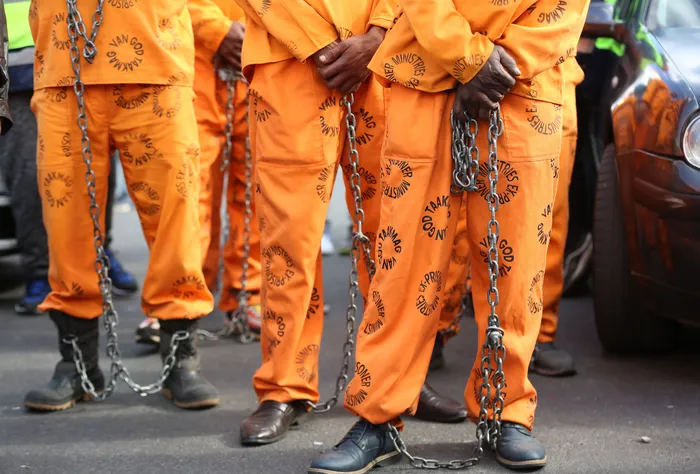
Minister of Correctional Services Pieter Groenewald reveals alarming staff shortages in South Africa's correctional services, highlighting the impact on safety, security, and service delivery in prisons, and outlining recruitment strategies to address the crisis.
Image: Bheki Radebe
Minister of Correctional Services Pieter Groenewald reveals alarming staff shortages in South Africa's correctional services, highlighting the impact on safety, security, and service delivery in prisons, and outlining recruitment strategies to address the crisis.
He was responding to a parliamentary question from MK Party Member of Parliament (MP) Lungisani Shangase, who asked what steps had been taken to address staff shortages and how they impact service delivery and safety within correctional facilities, IOL reported.
In his reply, Groenewald said: “staff shortages within the Department of Correctional Services (DCS) create a compounding effect where security risks and service delivery failures reinforce one another.”
He added that the impact is felt across several areas, including “Compromised Safety and Security resulting in the breakdown of custodial control.”
He also said there is “Erosion of rehabilitation Services under the the ‘Care’ and ‘Development’ programs intended to reduce recidivism,” as well as “Operational and Infrastructure Decay caused by high vacancy rate of engineers and facilities management.”
Groenewald further stated that “Correctional Officials” shortages result in “Security lapses, delay in emergency response, contraband and inmate violence.”
He said shortages also affect “Medical Services,” leading to “Poor healthcare access and increased unnatural deaths,” and “Social Services,” resulting in “Reduced rehabilitation and higher recidivism rates.”
In addition, he warned that facilities management shortages contribute to deteriorating infrastructure and failed security technology.
Groenewald also noted broader systemic pressure, stating that staff shortages have a direct impact on safety and service delivery in a system already under extreme pressure due to overcrowding, making conditions unsafe for both inmates and officials.
To address the challenge, he said the department has begun recruitment drives, including the Correctional Services Learnership Programme.
He said the department “has begun large-scale recruitment drives, including plans to recruit and train entry-level correctional officials through the Correctional Services Learnership Programme from 2025 right through 2030.”
He added that “thus far a total of 2 543 learners have been enrolled in the 2025/26 financial year as part of the ongoing efforts to develop a pipeline of 12,500 entry-level correctional officers by 2030.”
“The Correctional Services Learnership Programme is the primary source of new correctional official,'' he said.
Groenewald also stated that the department “advertised 1,187 posts, of which 505 have been filled.”
He said recruitment is being focused on scarce and critical skills due to budget constraints, including medical doctors, psychologists, social workers and engineers.
He added that the department is implementing an e-recruitment system because “manual, paper-driven processes are a major bottleneck in the recruitment value chain.”
The department is also implementing workforce planning to forecast retirements and resignations to reduce vacancy rates, and is working with the Department of Health to place psychologists and pharmacists in correctional facilities.