

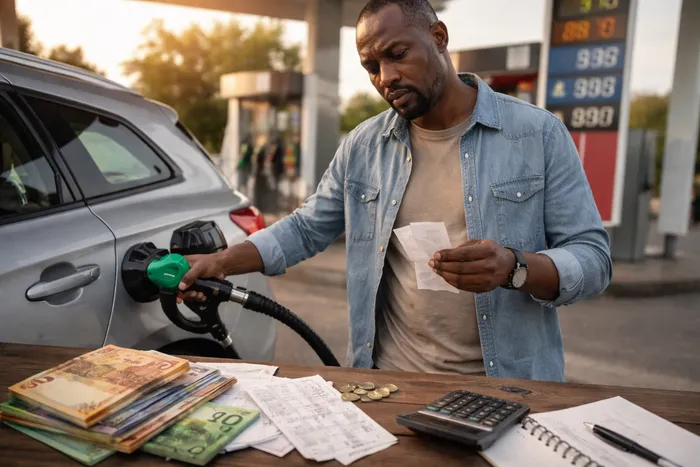
Fuel price increases are hitting South Africans where it hurts most, in their monthly budgets.
Image: Sora
The ongoing war in the Middle East has led to a dramatic rise in global fuel prices, prompting several countries to implement temporary tax breaks to alleviate the financial burden on consumers.
Oil prices rose by up to 46% in the space of a month, with countries such as Germany, Australia, Canada, Ireland, Spain, Ghana, Portugal and South Africa having introduced various temporary tax breaks to help soften the blow.
In South Africa’s case, that relief came in the form of a R3-per-litre temporary reduction in the General Fuel Levy, which will come under review at the end of April.
This led to lower-than-anticipated fuel price increases on April 1, with petrol increasing by R3.06 per litre and diesel going up by between R7.37 and R7.51.
This raised the price of 95 Unleaded to R22.53 at the coast and R23.36 inland, while the wholesale price of diesel rose to R25.35 and R26.11 respectively, with inland retail prices landing in the region of R28 to R29.
But how expensive is fuel in our country compared to other nations around the world?
Data from GlobalPetrolPrices.com shows that South Africa ranks 75th out of 170 surveyed countries when it comes to petrol affordability.
Countries that enjoy the world’s least expensive fuel include Libya and Iran - oil-producing nations where state subsidies and minimal taxation result in petrol prices of just 39 cents and 47 cents per litre respectively.
Russia also enjoys significantly cheaper petrol than most other countries, at R14.50 per litre, as does India (R17.73) and the USA (R19.21).
Joining South Africa in the middle of the list are Brazil (R22.11), China (R22.93) and Australia (R23.67).
Among South Africa’s neighbours, Zimbabwe has the most expensive petrol, at R36.45, and Malawi, at R67.79.
But the one place in the world where you don’t want to fill your tank is Hong Kong, where residents pay a brutal R67.60 per litre.
On the diesel front, it appears other countries are providing greater subsidisation during the oil price crisis as South Africa ranks 109th out of 170 countries for affordability. Diesel prices are economically imperative as transport costs have a direct knock-on effect for general inflation.
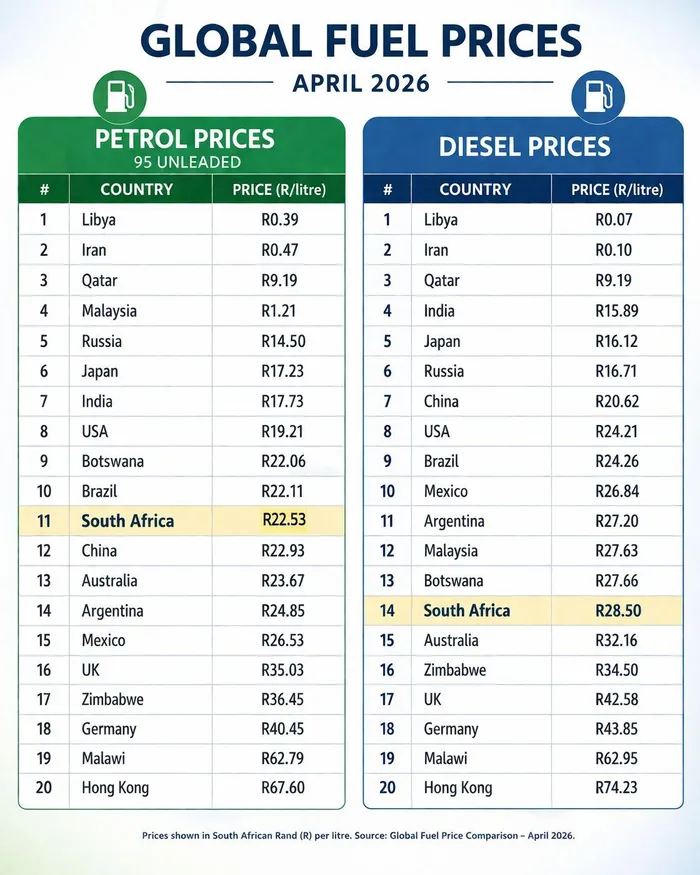
South Africa's petrol and diesel prices versus other countries.
Image: Jason Woosey / ChatGPT
In mid-April, Brent Crude oil was trading around the $95 per barrel mark, significantly down on its early April peaks of around $120, but still significantly higher than its February average of $69.
These price spikes make it difficult to predict May’s fuel prices in South Africa, but current trendlines suggest we could see another petrol rise in the R1 to R2 region while diesel could increase by another R5 to R6.
There are many reasons why oil has not subsided to the lows seen earlier this year, chief among them being the failure of ceasefire negotiations between the US and Iran.
From a structural perspective, the energy market remains on high alert due to the Strait of Hormuz’s critical importance, through which approximately 20% of global crude oil supply passes. Any disruption, even temporary, could generate a significant imbalance between supply and demand, potentially triggering new spikes in international prices,” says Antonio Di Giacomo, Senior Market Analyst at XS.com.
“This situation is compounded by an already strained global environment, including production constraints from OPEC+, relatively tight inventory levels in some developed economies, and resilient demand despite signs of economic slowdown in
certain regions. These factors reinforce the short-term bullish bias in crude prices.
“Additionally, financial markets have begun to price in a higher geopolitical risk premium, reflected not only in crude oil but also across other energy assets. This dynamic tends to amplify price movements, contributing to episodes of heightened volatility such as those observed at the start of the week,” Di Giacomo added.
IOL Motoring
* Disclaimer: Although every effort was taken to ensure the accuracy of the comparative data in this article, global fuel prices do fluctuate, sometimes weekly, and some of the stated prices are based on averages and estimations.