

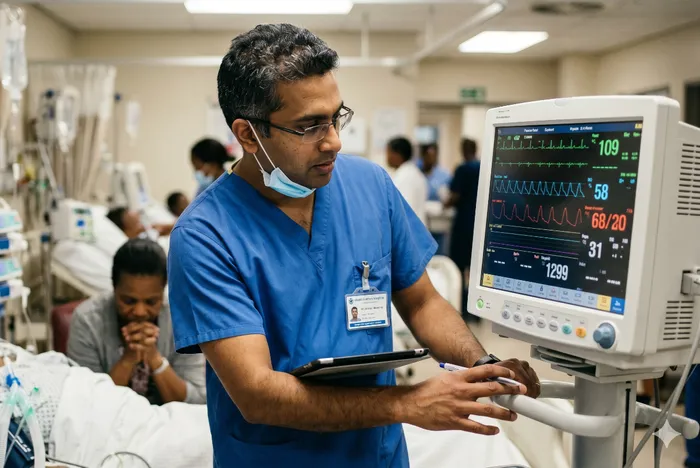
As the law stands, health practitioners who assist patients in dying will face the consequences before the Health Professions Council of South Africa (HPCSA) as this is regarded as unethical.
Image: Google Gemini
DignitySA is set to challenge the constitutionality of the current prohibition on physician-assisted suicide and euthanasia for terminally ill patients in the Gauteng Division of the High Court.
They are asking the court to declare the current blanket prohibition unconstitutional and invalid.
While DignitySA will turn to the Pretoria High Court, palliative care doctor Suzanne Walter and her patient Diethelm Harck more than five years ago lodged a similar application before the Johannesburg High Court.
This application was stayed after Harck and Walter gave evidence before the main proceedings had kicked off in light of their medical conditions. It is not clear at this stage if and when their legal challenge to legalise euthanasia in South Africa will continue.
DignitySA has meanwhile filed its own application, in which mention is made about Harck’s plight and that of others in the same position.
The organisation will ask the court to declare the common law of medical assistance in dying unlawful as well as that the declaration of invalidity should be suspended for 24 months to allow Parliament to bring the law on medical assistance in dying in line with the Constitution.
Willem Landman, director of DignitySA, made it clear in court papers that medical assistance in dying should only be afforded to qualifying patients who suffer a terminal condition, whose suffering is unbearable and who is capable of making an informed request and giving voluntary consent to this.
As the law stands, health practitioners who assist patients in dying will face the consequences before the Health Professions Council of South Africa (HPCSA) as this is regarded as unethical.
Consequently, any patient who chooses medical assistance in dying, places the medical practitioner who assists them at risk of being found guilty of unethical practice and even facing a murder charge or at least losing their medical licence.
At the moment, there is no lawful justification for a medical practitioner who provides medical assistance in dying - whether it is on the informed request of the patient or out of compassion by the medical practitioner to ease suffering.
“The right to put an end to intolerable suffering, to regain control over one’s body and to die with dignity is something the courts can no longer avoid,” Landman said in pointing out that the right to bodily and mental integrity was contained in the Constitution.
According to him, the South African health care system is already equipped to deal with decisions of this kind and will be able to implement appropriate and safe medical assistance in a dying regime.
Harck and Walter both stated in their earlier application their wish to end their lives when they felt they could not handle their illnesses anymore. As in the case of DignitySA, they also wanted to pave the way for other South Africans to be able to do the same.
Walter was diagnosed with multiple myeloma in 2017, while Harck was diagnosed with motor neuron disease in 2013.
“It is my choice to decide when I will be leaving this earth. Not being able to (legally) do so is extremely disappointing. That is why I am here, as I want the law to change,” Harck told the court at the time.
The HPCSA, which is also cited as a respondent in the latest legal challenge, and which is yet to file opposing papers, during the earlier application said doctors who took the oath and prescribe to the medical code of conduct should not be willing to kill their patients.
They said it was a patient’s choice not to be further treated, but there was no choice in being actively assisted in dying.