

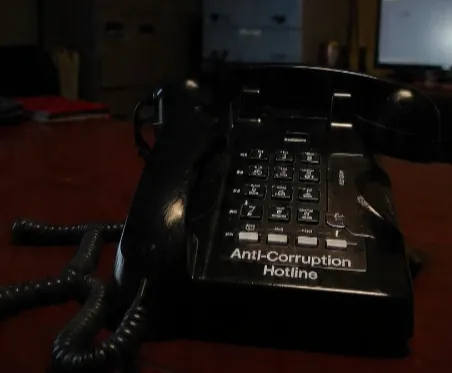
IOL put a range of government emergency and support hotlines to the test over the first three weeks of April to see how quickly they respond. The results varied widely.
Image: Meta AI
South Africa's anti-corruption hotline, designed to empower whistleblowers, is under scrutiny after a test call went unanswered for 20 minutes before the line dropped, raising concerns about its effectiveness.
IOL put a range of government emergency and support hotlines to the test over the first three weeks of April to see how quickly they respond. The results varied widely.
The SA Police Service emergency number, 10111, was answered within one to seven seconds across four test calls made at random.
Ambulance and fire services on 10177 responded in between 21 and 42 seconds over two calls.
The SA Depression and Anxiety Group hotline picked up within three seconds, Childline SA answered in five, and the Gender-Based Violence Command Centre answered in 41 seconds.
But the National Anti-Corruption Hotline, 0800-701-701, did not answer at all.
Reporters eventually hung up after 18 minutes and 22 seconds on hold.
In a follow-up two weeks after the initial call, reporters phoned again on Monday and once again hung up after 20 minutes.
The hotline is run by the Public Service Commission (PSC) and was established in 2004.
It was set up to allow the public to report allegations of corruption, fraud and misconduct in government departments, municipalities and other public bodies.
Responding to questions from IOL, the PSC attributed the failures to system overload and technical breakdowns.
"The primary challenges experienced by the National Anti-Corruption Hotline include capacity constraints, when all callers are engaged with whistleblowers, which sometimes leads to callers abandoning their calls," a PSC spokesperson said.
"Unreliable connectivity: downtime from SITA side does cause National Anti-Corruption lines going down whenever that happens."
SITA, the State Information Technology Agency, is the government body responsible for providing IT infrastructure and connectivity to public sector departments.
It was established in 1999 to consolidate and coordinate the state's IT resources.
If SITA's systems go down, any service that relies on its infrastructure goes down with it.
The PSC said work was under way to fix the problems.
"SITA is currently attending to connectivity issues to ensure more reliable connectivity," the spokesperson said. The PSC is also collaborating with the UNODC to provide support to make the NACH more effective and efficient and in line with international standards. Recruitment process to fill vacant positions is at advanced stage, this will capacitate NACH to be fully efficient and effective."
The UNODC is the United Nations Office on Drugs and Crime, which has been working with the government on anti-corruption efforts since 2001.
SA has a long and often deadly history when it comes to whistleblowing.
Babita Deokaran, the acting chief financial officer at Tembisa Hospital who exposed large-scale procurement irregularities within the Gauteng health department, was assassinated outside her home in Johannesburg in August 2021.
Six men have since been jailed for her murder.
Jimmy Mohlala, the speaker of the Mbombela Local Municipality, was shot dead outside his home in January 2009 after exposing alleged tender irregularities linked to the construction of the Mbombela Stadium for the 2010 FIFA World Cup.
His killing remains unsolved.
In March 2025, community activist Pamela Mabini was shot and killed outside her home in Gqeberha.
In February this year, Human Rights Watch said the scale and frequency of attacks on whistleblowers raised serious concerns about their safety and protection in SA.
The organisation noted that President Cyril Ramaphosa had committed during his 2026 State of the Nation Address to introducing a Whistleblower Protection Bill in parliament, repeating a pledge first made the year before, but the bill has not been passed.
Dr Simon Howell, a criminology researcher at the University of Cape Town, said he was perturbed by the findings.
"It is obviously concerning that a national hotline for corruption is not manned or attended to, and that the call was ultimately never answered," he said.
"It may be indicative of a broader issue, which is that corruption is often spoken to and gestures are made towards it, but it's not followed up with significant levels of action. The corruption hotline not being manned may be an example of that logic. One would hope that in future it is at least attended to, and that calls are actually taken and dealt with seriously."
Anti-crime activist Yusuf Abramjee said it was concerning.
"A corruption hotline that does not answer calls is worse than useless," he said.
"It creates the illusion of accountability while failing to deliver it. It undermines trust in the system and government cannot claim to fight corruption while its reporting channels are effectively inaccessible. It signals either poor resourcing, weak oversight, or a lack of urgency in handling corruption reports. None of those are acceptable for a frontline accountability tool."
According to official statistics, more than 300,000 calls reporting allegations of corruption and maladministration have been made to the hotline since it was launched.
Tip-offs provided by whistleblowers have led to the investigation of more than 24,000 cases of corruption, fraud and other crimes by government departments and law-enforcement agencies.
In the first quarter of the 2021/22 financial year alone, the PSC received 337 corruption-related cases through the hotline.
Of those, the PSC investigated 35 involving appointment and procurement irregularities, while the rest were referred to government departments or law-enforcement agencies.