

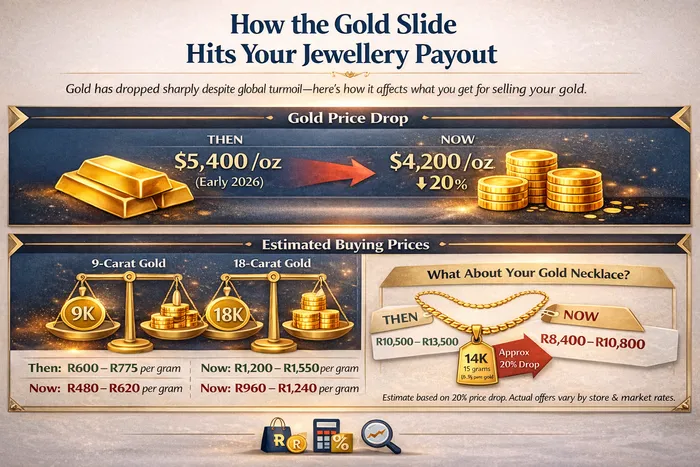
An indicative change in the value of your precious metal.
Image: ChatGPT
Gold’s recent slide is defying expectations – and it is starting to show up in what South Africans can get for everyday items like jewellery.
Since the Iran war began, gold has declined sharply to below $4,200 an ounce, despite the kind of geopolitical uncertainty that would typically boost demand for the safe-haven asset, according to Morningstar.
Valerio Baselli, senior international editor for Morningstar EMEA, said “when missiles began flying over Iran on 28 February, markets’ reaction followed a familiar playbook: Oil prices spiked, equities fell, and investors rushed, at least initially, into safe havens. Gold, the oldest refuge of all, surged above $5,400 per ounce within days.”
Yet, “despite the war dragging on with unmitigated fury,” the gold price stalled for several weeks before falling sharply to below $4,200, wrote Baselli.
Not so safe
This was despite its status as a safe-haven metal. The decline has been driven by rising inflation expectations and higher energy risks, which have reduced the appeal of non-yielding assets such as gold, said Trading Economics. “The precious metal remains down nearly 10% since the onset of the war,” it said.
While these movements play out globally, they are filtering down to local buyers and sellers.
Gold-buying shops in South Africa generally purchase jewellery in any condition, with prices ranging from about R600 to R775 per gram for 9-carat gold and between R1,200 and R1,550 per gram for 18-carat gold, based on recent local store reports.
However, those prices were recorded earlier this year when gold was trading closer to $5,400 an ounce.
Worth less
If gold has fallen by roughly 20% to current levels below $4,200, a similar proportional adjustment suggests that current buying prices could be materially lower, assuming exchange rates and dealer margins remain broadly unchanged.
On that basis, indicative buying prices could fall to roughly:
These are estimates and actual prices will vary by store, daily market movements and valuation methods.
What consumers receive also depends heavily on purity and weight.
A typical gold necklace weighs between 10 and 20 grams, with many common chains averaging around 15 grams, according to jewellery website Pompeii3. But only a portion of that weight is gold.
The math
A 15-gram necklace made from 14-carat gold contains about 8.75 grams of pure gold, meaning payouts are based on that lower figure rather than the total weight.
Using earlier price ranges, such a necklace could fetch between roughly R10,500 and R13,500.
Applying the same estimated decline in gold prices, that payout could drop to around R8,400 to R10,800, depending on the buyer and pricing spreads.
Even then, sellers are unlikely to receive the full underlying value, as dealers apply margins to account for refining, resale and risk.
Outlook looks better
The result is a widening gap between global prices and what consumers receive at street level.
Despite the recent decline, the longer-term outlook for gold remains supportive.
J.P. Morgan said the broader environment remains favourable, with the potential for gold prices to rise to as much as $6,300 an ounce by the end of 2026.
“Gold is far more compelling in this environment, so we’re certainly keeping our focus there,” shared Raymond Eyles, CEO of Brahman Capital Management.