

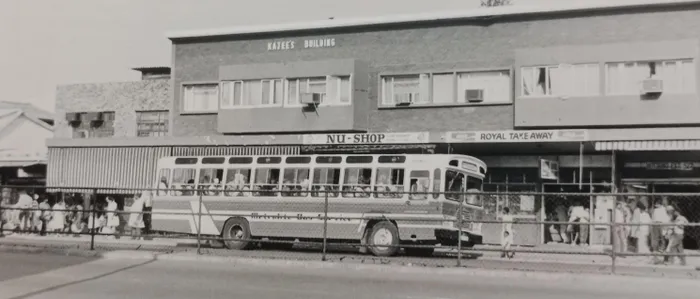
Back then, a bus ride was never just a journey. It was a small community on wheels.
Image: SUPPLIED
FOR nearly 25 years of my life, I depended on public transport. I took the old Royal Passenger Service buses through Mayville, the municipal green buses to Shallcross, and whatever else was available to get to school, university, work, and to visit friends.
Back then, a bus ride was never just a journey. It was a small community on wheels. You got to know the driver, who sometimes knew your stop better than you did, and fellow passengers who shared stories, gossip and occasionally snacks, though always with a degree of caution. You learnt quickly: accept the samoosa, but ask questions later.
Today, public transport is still a shared experience, but the camaraderie has been replaced by endurance.
Under apartheid’s Group Areas Act, many families were uprooted from areas close to work and pushed into distant townships. Places like Chatsworth, Phoenix and Shallcross became home, but work remained far away.
That legacy still defines our daily commute. For many South Africans, getting to work is not a short trip; it is a logistical exercise requiring patience, timing, and sometimes faith.
Transport is not just about getting from point A to point B. It is about opportunity. If you cannot get to work, you cannot earn. If you cannot reach school, you cannot learn. If you cannot move easily, you cannot progress.
History tells us this clearly. The Romans built roads to strengthen an empire. Colonial powers built roads across Africa, but largely to extract resources, not to empower people.
Today, in a democratic South Africa, our transport system should serve the people first.
Instead, decades of underinvestment and mismanagement have left us with a system that is, at best, unpredictable.
Buses do not always arrive on time. When they do, passengers sometimes look at them the way one looks at a rare animal in the wild, with surprise and cautious excitement.
Minibus taxis, which carry the majority of commuters, remain a lifeline. But they are often overcrowded. At peak hour, getting into one can feel like trying to close an already overpacked suitcase. Personal space disappears, and one learns advanced skills in balancing, breathing, acrobatically paying one’s fare, and exiting with Olympic precision.
Yet, despite the discomfort, millions rely on them daily. That alone should tell us something: this is not a luxury system, it is a survival system.
Perhaps the greatest loss has been the decline of passenger rail. There was a time when trains were reliable, affordable, and widely used. Today, much of that system is only slowly being rebuilt.
In the meantime, our roads carry the burden. The highways between Johannesburg and Durban are filled with heavy trucks transporting goods. These trucks are essential, but they also slow traffic, damage infrastructure, and increase the risk of accidents. Anyone who has driven behind a convoy of trucks knows that patience is not just a virtue, it is a requirement.
If rail was functioning properly, much of this freight could move more safely and efficiently.
A strong passenger rail system would also give commuters a real alternative to taxis and private cars.
Then there is the private car. Every morning, long lines of vehicles crawl along our roads, many carrying just a single driver. Each car is a small island of comfort, but together they form a sea of congestion.
If public transport was reliable, many of these cars would happily stay at home. Instead, we sit in traffic, listening to the radio and wondering whether the traffic report will bring relief, or simply confirm what we already know.
President Cyril Ramaphosa recently addressed these issues at the national transport conference, emphasising that transport was central to economic growth and daily life. He is correct. When transport works, the country moves. When it fails, everything slows down, sometimes including the bus you are waiting for.
There are plans to shift more freight from road to rail, bring in private investment, and rebuild infrastructure. Passenger rail is slowly returning, and new trains have been introduced. These are encouraging signs.
But the real question is simple: when will commuters feel the difference?
At a conference, the discussion is about policy and investment. At a taxi rank in Durban or Soweto, the question is far more direct: “is it coming?”
We need urgency. Not just promises, we need progress.
Rail must be restored as the backbone of both freight and passenger transport. The taxi industry, which carries millions, must be supported but also better regulated to ensure safety and fairness. Buses must be reliable. Roads must be maintained.
And above all, commuters must be treated with dignity. No one should spend hours each day simply trying to get to work.
When transport fails, it is the poor who suffer the most, spending a significant portion of their income and time just to earn a living. This is not merely an inconvenience; it is a barrier to equality and a drag on the economy.
South Africa has the plans. It has the vision. There are even signs of progress.
But without urgency, those plans remain just that, mere plans.
People are not asking for perfection. They are asking for something far simpler: buses that arrive, trains that run, taxis that are safe, and roads that do not test both patience and suspension systems at the same time.
Fix that, and we do more than improve transport, we restore dignity, unlock opportunity, and give millions of South Africans something they have long deserved:
A reliable journey to a better life.
** The views expressed do not necessarily reflect the views of IOL or Independent Media