

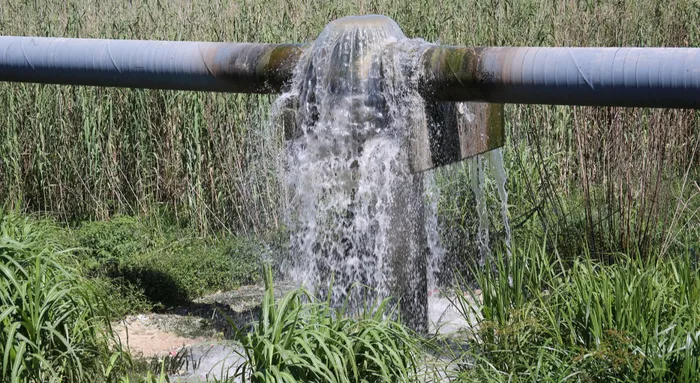
In the 2023/24 financial year, the municipality lost R2 billion, and R2,9 billion in the 2024/25 financial year.
Image: Tumi Pakkies / Independent Newspapers
The eThekwini Municipality has appointed a water loss control engineer to address R4.9 billion in non-revenue water (NRW) losses over the past three years.
In the 2023/24 financial year, the municipality lost R2 billion, and R2,9 billion in the 2024/25 financial year.
The municipality stated that the approximately 50% water loss arose from ageing and deteriorating infrastructure, uncontrolled and unplanned rapid rural expansion, and illegal connections.
Vishal Poona, an engineer and former director at Joat Group – a South African water management company – was introduced to the eThekwini Executive Committee (Exco) on Tuesday.
He has been tasked with setting up a team to deal with NRW.
At the Exco meeting, the municipality highlighted the ongoing challenge of demand outpacing available supply. This situation is compounded by the reduction in bulk water volumes supplied by uMngeni-uThukela Water (UUW), implemented at the discretion of the Department of Water and Sanitation, as part of broader water curtailment measures.
Deliberating on ways to reduce NRW, eThekwini Mayor Cyril Xaba suggested that the municipal Water Directorate should urgently install bulk meters in all informal settlements to get statistics on consumption and the estimated loss in rand for each settlement.
Xaba said it was about time the directorate started accounting for where the losses were emanating from.
He called for a review of all standpipes in the communities and settlements, which, in certain areas, could be used as car washes. He said that where homes received a piped water supply, there was no need for standpipes.
“Burst pipes cost the city money as we lose water from leaks, must send plumbers for repairs, and sometimes need to use water tankers, which is also inconvenient for the community,” he said.
Xaba said uMngeni-uThukela Water had put its “foot down” and won't lift the curtailment until the municipality addressed NRW.
Yogis Govender, DA councillor and Exco member, requested a detailed graph on where the water was being lost.
“We have requested this repeatedly. Are we losing water from pipes, water tanker filling points, the informal settlement, and in which area?” she asked.
Nkosenhle Madlala, ANC Exco member, called for all points where water was being dispensed to be metered, including municipal water tanker filling points.
Madlala suggested they be guarded and only accessed by municipal officials. He also called for flat-rate billing for informal settlements and rural areas.
Throughout the country, trading services were in distress, prompting the National Treasury to launch an incentive-based reform programme amounting to R54 billion over six years.
The eThekwini Municipality received R476 million for the 2025/26 financial year towards its Water Turnaround Strategy (TAS) and to improve the efficiency of the directorate.
The municipality reported that it has now begun replacing old asbestos cement pipelines with new pipes made from modified polyvinyl chloride. Approximately R2.6 billion will be spent over five years to replace 890 kilometres of water pipes.
Within five years, the municipality intends to invest R25 billion in Public-Private Partnership initiatives. The two new regional wastewater treatment facilities, which will cost R2,1 billion to build in the 2027/28 financial year, are the first significant projects. In five years, the municipality intends to replace 160,000 water meters for R1.1 billion.