

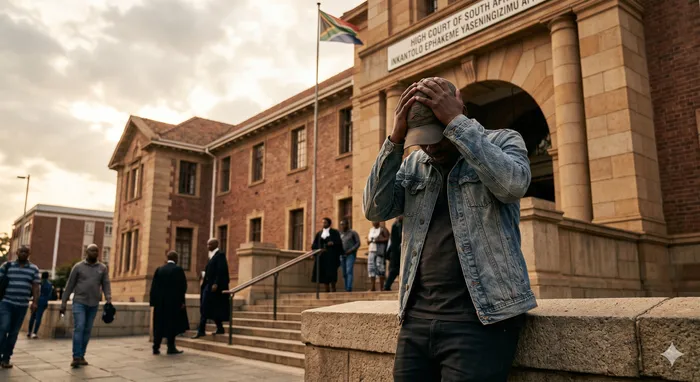
Despite his acquittal, the court found that the police and prosecutors acted lawfully and reasonably based on the evidence available at the time.
Image: Google Gemini
A man, exonerated after nearly 19 months in prison for a double murder, has had his R17 million damages claim dismissed by the Western Cape High Court.
The High Court ruled against Vuyisa Eric Njikelana, who had sued the Minister of Police and the Director of Public Prosecutions, claiming unlawful detention and malicious prosecution following his 2015 arrest.
The saga started after Njikelana was arrested in June 2015 in connection with the mob killing of two men in Witsand, Atlantis. He remained in custody until March 2017, when he was granted bail, and was ultimately acquitted of all charges in December 2017.
Despite his acquittal, the court found that the police and prosecutors acted lawfully and reasonably based on the evidence available at the time.
The case centred on whether Njikelana’s detention after his first court appearance was unlawful and whether the prosecution against him had been malicious.
Judge Matthew Francis concluded that the arresting officer had reasonable grounds to suspect Njikelana’s involvement in the murders. At the time of the arrest, investigators had obtained a statement from a co-accused directly implicating him, alongside other witness accounts placing him at the scene.
The court emphasised that the law does not require certainty before making an arrest - only a reasonable suspicion based on available information.
Njikelana also argued that prosecutors acted improperly by opposing his bail and misleading the court. However, this claim was rejected.
Evidence showed that prosecutors relied on several factors to oppose bail, including the seriousness of the charges, witness statements implicating him, and the fact that he was already out on bail in a separate rape case at the time of his arrest.
The court further found that Njikelana did not have a fixed address, contrary to his claims, and that all relevant information - including evidence that did not implicate him - had been disclosed to the bail court.
“The plaintiff has failed to establish that the bail court was misled,” the judgment noted.
On the claim of malicious prosecution, the court ruled that Njikelana failed to prove that prosecutors acted without reasonable cause or with intent to harm.
Although the case against him ultimately collapsed due to unreliable witnesses and evidentiary challenges, the court held that the prosecution initially had a reasonable basis to proceed.
The judgment stressed that a failed prosecution does not automatically mean it was malicious. A key factor in the ruling was the court’s assessment of Njikelana’s credibility.
Judge Francis described him as an unreliable witness whose testimony contained contradictions and inaccuracies. Under cross-examination, Njikelana admitted that several claims in his lawsuit -including that police stormed his home and failed to inform him of the reason for his arrest - were false.
He also conceded that he had been present at the scene of the killings, contradicting earlier statements that he had not been involved.
In the final order, the court dismissed all claims and ordered Njikelana to pay the legal costs of both the police and the prosecution, citing the complexity of the case and the extensive evidence involved.