

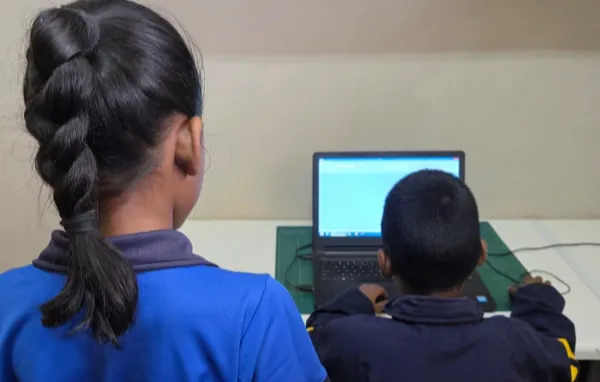
Fambel Primary School pupils using a laptop.
Image: Supplied
In a community where access to modern technology remains limited, one primary school is taking bold steps to ensure its pupils are not left behind.
Fambel Primary School has launched an ambitious initiative to establish a fully equipped “Future-Ready Tech Lab,” aimed at introducing coding, robotics, and critical Fourth Industrial Revolution (4IR) skills to its pupils.
For many pupils at the school, exposure to technology has been minimal. Few have ever written a line of code, built a robot, or experienced the problem-solving power of digital tools.
Yet, according to school’s principal Pam Subrayan, their curiosity remains boundless.
“Our pupils are eager, curious, and full of potential, but they have not been exposed to the technologies that will define their future careers,” said Subrayan.
“With the right support, we can bridge the digital divide and give our children a real chance to compete in the 4IR economy.”
The school has already secured sponsorship for high-end laptops and projectors, as well as professional shopfitting. However, critical components such as electrical infrastructure, furniture, WiFi connectivity, air conditioning, and robotics kits are still needed to bring the lab to life.
Once completed, the lab will transform an underutilised space into a vibrant learning hub featuring dedicated zones for coding, robotics assembly, testing, and quiet digital study. It will also host after-school coding clubs, robotics workshops, and digital literacy programmes with resources that are virtually non-existent in the surrounding community.
Subrayan, who has led the school for less than a year, said the idea for the lab was sparked by a moment that underscored the stark digital divide.
“One day, a child asked me, ‘Ma’am, is a robot like a washing machine?’ That broke my heart, not because the question was silly, but because it showed how completely disconnected our pupils are from the technology shaping their future,” she said.
“I realised that if we don’t bring 4IR skills to them, they will never know what they’re missing.”
The proposed lab will align with South Africa’s CAPS Coding and Robotics curriculum for Grades R through 7.
Pupils will begin with block-based coding and simple robotics kits, progressing to more advanced programming languages such as Python.
Beyond technical skills, the programme aims to cultivate problem-solving, critical thinking, collaboration, creativity, and digital safety awareness.
“A large majority of our pupils do not own a computer or a laptop. For many, a smartphone screen is the only digital interface they access and even that is rare. When we first brought in the sponsored laptops, some pupils didn’t know how to turn one on. This is the technology void we are attempting to close.”
She said research showed that early exposure to robotics and coding could significantly boost interest in STEM subjects. The school believes the lab will not only prepare pupils for high school but also equip them with essential skills for a rapidly evolving job market.
“Computer literacy is no longer a ‘nice to have’, it is the new reading and writing. Without it, our pupils will be locked out of most jobs and further education. With it, they can compete, create, and even lead.”
The school plans to initially run the lab using trained teachers, supported by volunteer tech professionals from the community. Teachers have undergone upskilling workshops, with the long-term goal of appointing a dedicated coding and robotics facilitator.
For Subrayan, the vision extends beyond technical training.
“We want a child who has never seen a robot to build one, debug it, and watch it move. We want them to stop saying, ‘I’m not smart enough for computers,’ and start saying, ‘Let me try again.’ This lab isn’t just about skills, it is about shifting self-belief. That is the real gift.”
Fambel Primary is now calling on local businesses, foundations, and technology companies to partner in completing the lab. If funding is secured promptly, the school hopes to have the facility operational within a short timeframe.
“Our children are counting on us and we have resolved not to let them down,” she said.
The initiative has also received strong backing from the School Governing Body. Its chairperson, Yegesh Chetty, emphasised the long-term impact of the project.
“Without this lab, our children will continue to be left behind. Sponsorship won’t just equip the lab, it will unlock futures, spark innovation, and create a generation of problem-solvers.”