

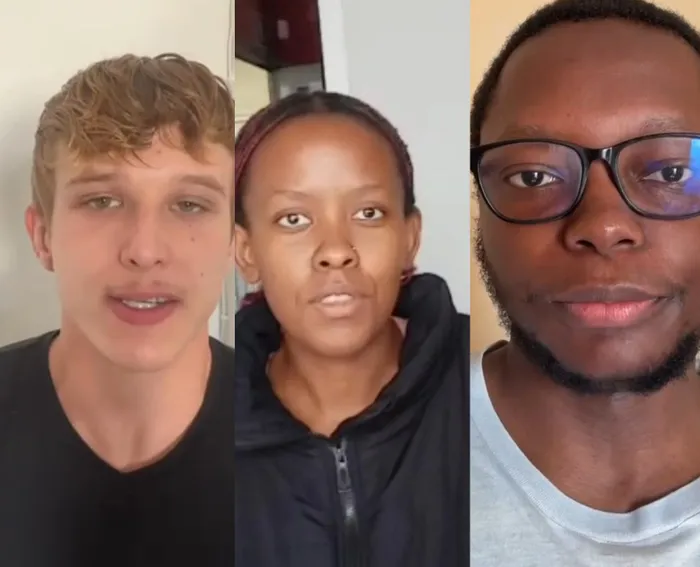
As South Africa marks Freedom Day, a day rooted in the country’s first democratic elections and the promise of equal opportunity, IOL spoke to young people from sharply different walks of life to explore what freedom looks like nearly three decades on.
Image: SCREENSHOT
As South Africa celebrates Freedom Day, we hear from four young individuals from diverse backgrounds about their interpretations of freedom nearly 30 years after the end of apartheid.
- Mukhethwa Dzhugudzha, 25, reflected on both the gains and the gaps.
"Freedom Day, April 27, 1994, this was a victory for all black South Africans. It ended a system that legally denied black people their dignity, and this should be celebrated. But let's not pretend as if the freedom we received in 1994 was complete," he said.
However, he argued that political rights alone did not transform everyday realities.
"What we got was political freedom, the right to vote. What we did not receive is economic freedom," he said.
He added that there was a "missing piece of the puzzle" for many young people navigating poverty, unemployment, and inequality.
According to Stats SA, unemployment among young people aged 15 to 34 remains deeply entrenched, with the most recent Quarterly Labour Force Survey for late 2025 showing a youth unemployment rate of 43.8%, meaning almost half of young people who are actively seeking work are unable to find it.
In practical terms, this translates to roughly 5,8 million young South Africans without jobs, highlighting the scale of exclusion facing a generation still coming of age in a democratic society.
Dzhugudzha questioned the lived meaning of freedom.
"Because inheriting freedom on paper is not the same as experiencing freedom in your daily life. You can vote, but you can't find a job. The struggle didn't end in 1994. It evolved. It moved from laws to systems, from segregation to inequality, from political exclusion to economic exclusion."
- In contrast, Noluthando Cele, 20, said freedom for her meant the right to act, speak, or think as she pleased.
"Freedom for me means being able to do what I wish with my life without any systemic constraints."
She added that she felt fortunate in her circumstances.
"I am grateful to have been born after the fall of apartheid. I have had the opportunity of studying where I wanted. Previously, they would not have allowed black students here."
The young woman acknowledged generational differences in opportunity: "Compared to my parents, I have a lot more options and choices."
Cele also expressed appreciation for those who came before her.
"I appreciate all the freedom fighters who fought for me to have basic human rights."
- For Anele Ndawonde, 26, freedom has not been fully realised in many aspects of South African life.
"Freedom Day is a reminder of the past, the struggle, and what was done in order for us to be liberated. It also is a reminder to me that we are not truly liberated until we are all living in dignity," she told IOL.
She added that everyone's human rights have yet to be fully realised, especially for black people.
"We are historically disadvantaged. It is also a reminder that we have an unemployment crisis, a housing crisis, a femicide crisis, and that our freedom is not truly complete until all are living in dignity, and until all are living safely."
- Peiter Kriel, 22, offered a hard-hitting reflection on inequality and what he believed still limited true freedom in South Africa today.
"It's 2026 and South Africa is one of the most unequal countries in the world," he said.
He pointed to what he described as deep structural divides in society.
Kriel argued that inequality was visible in everyday life and outcomes.
"When we look at the statistics, when we look at the facts, the Gini coefficient [(a measure of income or wealth inequality within a population) of South Africa is astonishing."
According to Wits University, the nation's commonly cited around 0,65 to 0,67, the world's highest.
Another key pressure point shaping the experiences of young South Africans is access to higher education funding, particularly through the National Student Financial Aid Scheme (NSFAS).
While the scheme remains the primary support mechanism for students from low-income households, it continues to face growing strain as demand increases and administrative delays persist.
Many students report uncertainty around allowances, delayed payments, and registration blocks due to outstanding fees, leaving some unable to fully settle into academic life despite qualifying for support.
Kriel added that this imbalance affects living standards and opportunity.
"It shows that the standard of living of the ordinary South African is rather poor compared to many countries in the world, specifically in parts of the Western Cape where inequality is rampant and can sometimes even be seen from space."
The three young voices reflect a generation navigating a complex reality in which democratic gains are widely acknowledged, yet lived experience remains shaped by unemployment, inequality and unequal access to opportunity.
While some speak of the expanded choices and rights made possible since the end of apartheid, others stress that freedom cannot be measured by political rights alone if economic conditions continue to exclude millions.
Their reflections converge on a shared understanding: that the promise of equality is still unfolding, and that the meaning of freedom today is inseparable from the ongoing struggle to ensure dignity, opportunity and fairness for all.