

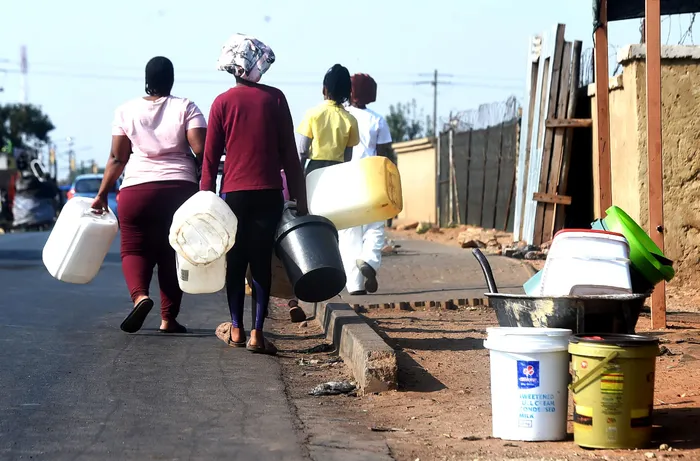
Three decades on, for millions of South Africans that hard-won freedom is no longer some abstract political ideal. It’s a tangible, daily fight for survival, often defined by the presence, or, more often, the crushing absence of a running tap.
Image: Itumeleng English/ Independent Newspapers
The year 1994 became a turning point in South Africa's history, marking the end of apartheid and the beginning of a new era for human rights.
The new Constitution was a declaration of freedom, enshrining the right to vote, dignity, and equality. Crucially, Section 27 explicitly guaranteed every citizen access to sufficient food and water.
Three decades on, for millions of South Africans that hard-won freedom is no longer some abstract political ideal. It’s a tangible, daily fight for survival, often defined by the presence, or, more often, the crushing absence of a running tap.
Today, this new struggle finds its most powerful, deep expression in the water crisis, which is fast turning personal frustration into a political weapon.
The death of Junaid Anand Naidoo, who collapsed and died two years ago while fetching water in Durban's Trenance Park area, is a heart-wrenching example of this ongoing crisis.
His passing in April 2024, tragically just weeks after his protest against water shortages at City Hall, did not become the turning point his family and the community had so desperately yearned for.
“We here in the Trenance Park area still have water issues. It's become a lifestyle in this area now... no water,” said Anwar Dawood, the family's spokesperson.
Dawood expressed frustration that the attention on their difficult situation was short-lived. He referred to Senzo Mchunu, the then Minister of Water and Sanitation, who visited and made promises shortly after, only to then disengage.
The family’s private grief is now linked to a wider political despair gripping communities across the country.
“Most of the people don’t even want to vote. That's how it is. They're fed up,” Dawood explained.
Dawood struggles to convince neighbours that voter apathy only perpetuates the crisis, yet he admits the fight has taken its toll.
“I’m also a very tired person regarding this issue. Very, very tired. The water crisis has morphed from a logistics problem into a 'very deep political' issue.”
Chanell Kanhai, a mother of three and home business entrepreneur from Mount Vernon in Durban, who runs a hairdressing salon and a bakery from her house, is tired of the excuses.
“It’s very frustrating; this has been going on for years now,” Kanhai said.
"When they complain, the standard answer from the municipality is poor infrastructure.”
She dismisses this response with weary indignation.
“We are tired of hearing the same story over and over again. They keep patching here and there, and when it bursts again and we complain, we hear the same poor infrastructure story again.”
Without water, her salon cannot offer facial treatments, manicures or pedicures, she said.
“I have to cancel client bookings when there is no water, and a cancelled client results in no income,” Kanhai said, adding that baking orders are also jeopardised.
“If I cannot bake in time for an order, then again I have to decline the client request.”
The constant unreliability means clients who book at the last minute are forced to take their business elsewhere, resulting in a loss of income.
“It’s very frustrating as I take a huge knock at the end of the day,” Kanhai said, further explaining that beyond the income loss, the impact on her children's lives is severe.
“My kids cannot wash up after playing or eating or even take a shower after a long day at school,” she said.
When asked about the upcoming election, Kanhai said that this issue was definitely going to affect the way she voted.
Jessica Graca was forced to move out of the Bruma area in Johannesburg due to ongoing water shortages.
“I have recently moved out of the area due to no water in the morning for one full year, and this will most definitely affect my vote,” she says.
In a social media video shared before her move, a frustrated Graca offered a political ultimatum to the governing party.
“I am done…I cannot wait to move out of the Bruma area…How would you feel if you’re paying an enormous amount of money in rent to stay in a certain place and you’re paying for water, rates and taxes... This water situation is getting out of hand.”
In a prior video, she made a plea to fellow voters: “Dear South Africa…please don’t vote the ANC in, not municipal, not for our government ever again. Choose any other party... let's try something different because this is not working.”
This sentiment is echoed by community leaders who have seen decades of political promise evaporate into dry taps.
David Ratladi, president of the IBCM (Inwoners Baagi Civic Movement) in Tshwane, declares that for his community, the votes will be an exercise in demanding real leadership.
“Water tankers will never be a solution for service delivery,” Ratladi said. “All political parties equally, have failed us residents and voters.”
The core of the matter, as Kanhai articulates, is a profound change in the national psyche: “The meaning of freedom in South Africa has shifted from political liberation in 1994 to the expectation of basic service delivery today.”
The South African Human Rights Commission (SAHRC), which has called for the ongoing water crisis to be declared a National Disaster, highlights how the failure to provide water undermines all other constitutional gains.
The SAHRC has noted that the lack of water at schools “negatively impacts educational outcomes,” and disproportionately affects women and girl-children, “compromising the attainment of gender equality”.
In 2026, the SAHRC noted a significant downward trajectory in water management. Their findings reveal the drivers of the crisis: “insufficient attention and allocation of budget for the maintenance of water infrastructure,” “high levels of water losses,” and “the lack of skilled personnel in water units.” The systemic failures are pronounced at the municipal level, the very sphere “charged with delivering water to households.”
Further reports from the SAHRC on wastewater systems paint a picture of an environmental and health catastrophe. The 2025 Green Drop Report showed that 47% of wastewater systems were in a critical state, “meaning that almost half of the wastewater systems in the country are at risk of discharging partially treated or untreated water into rivers and the environment.”
The Blue Drop Report also flagged that almost half of water supply systems were in the high-risk microbiological quality category, meaning communities face an “immediate detrimental health risk.”
For the community of Ga-Rankuwa in Tshwane, this collapse is an undeniable reality.
Tshepo Matlaela, a community leader and activist, describes how the water pressure has dropped, making simple tasks difficult, and points to the dilapidated infrastructure, including a “skeleton basis” water treatment plant in Klipgat.
“The condition of the water treatment plant in Klipgat is appalling. The infrastructure is dilapidated,” he states. Matlaela highlights the environmental crime of sewer pipes “dipping into the river,” contaminating the Turani River.
For Matlaela and his constituents, the daily struggle translates directly into political frustration.
“People are tired of going to cast their votes,” he says, adding that their next community shutdown will determine whether they participate in the elections at all.
However, he also holds on to the democratic ideal, motivated by the fact that voting “gives us the power to change the status quo, to change those who think they're in power, those who are not listening to the demands of the people.”