

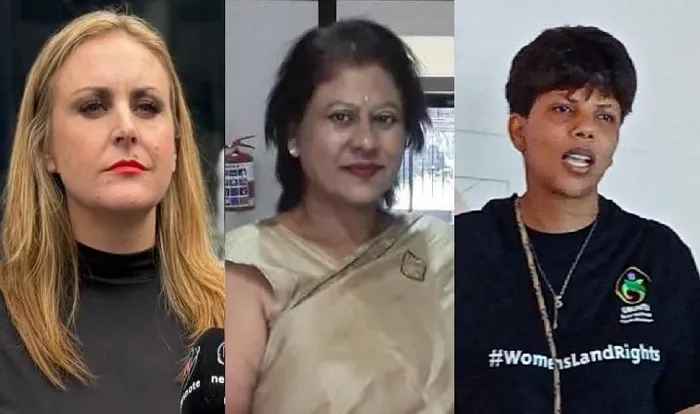
Women are leading change in South Africa's local governance, with (from left) Jacqui Uys breaking barriers as a mother and politician, Andisha Maharaj embodying grassroots activism for environmental justice, and Wendy Pekeur championing equality by securing land rights and fighting for women's empowerment.
Image: Supplied
While South Africa's transition to democracy is frequently depicted through the stories of prominent national leaders, the true driving force for change, especially within local communities, is increasingly found in the political power exercised by women as voters, as elected councillors, and as dedicated grassroots activists.
Women aren't just passively accepting democracy; they are actively on the frontline, tackling deep-seated obstacles and achieving crucial breakthroughs that are fundamentally reshaping local governance.
Statistics from the Electoral Commission (IEC) for the 2024 National and Provincial Elections (NPE) underscore this foundational role: 55% of the total registered voters were women, continuing a well-entrenched trend.
Furthermore, 58% of the voter participation on election day came from women, solidifying their dominance at the polls.
While women’s presence in national and provincial legislatures is significant, 45% of parliamentarians and 44% of ministers are women, this parity does not always translate to the coalface of local government, where only 38% of members of local deliberative bodies are women, according to UN Women.
This gap shows the difficulty in translating election success into real, effective leadership at the local level.
The political world is very difficult for women, especially mothers, a point made strongly by DA chief whip Jacqui Uys.
Her journey into politics was driven by an “activism for a better future,” but she quickly ran into systemic hurdles, particularly around motherhood.
“I have often been advised to be less feminine in order to be taken seriously, something I explicitly refuse to do,” Uys states.
Detailing the most significant barrier, Uys said, “The biggest was motherhood; politics does not keep office hours and your vote cannot be proxied if you cannot attend. As such, with both my pregnancies, I did not take maternity leave and had my first 12-hour council meeting when my baby was 9 days old.”
Uys has built her career “with babies on the hip,” and her personal breakthrough is tied to her political mission: “I have dedicated my political career to bring the change about normalising a mother working with her children close by.”
For Uys, removing the remaining barriers requires legislative change, not just personal resilience.
“Laws should change to provide for a proxy vote or legalise virtual votes so that mothers who want to go to parliament do not need to choose between going to parliament or having kids,” she insists.
Uys said through the years there have been many successes, both while in government and opposition.
"I believe, however, my biggest success is currently unfolding, exposing a ring of corruption that has captured various service departments syphoning money out of the municipality with the ANC Deputy Executive Mayor at the centre of it all."
Beyond the council chambers, community activists are the essential bridge between residents and the often-obstructive machinery of local government.
Andisha Maharaj, a long-time activist from Ottawa near Verulam in KwaZulu-Natal, embodies this tireless agency.
Her activism, ignited by personal tragedy and environmental outrage, is a decade-and-a-half-long battle against municipal indifference.
Maharaj’s earliest breakthrough was an explosive moment of environmental protection. Incensed by scrap yards dumping used oil into a local stream that feeds the oHlanga River, she took pictures and videos, leading to the formation of the Ottawa Environmental Forum in 2008.
Her achievements are measured in basic rights delivered: “The Phoenix Sewer Purification Plant, the daily stench, flies, and mosquito infestation in the area were brought under control through persistent communications with officials.”
More recently, her opposition to the establishment of the Desalination Plant with the La Mercy Rate Payers organisation resulted in a game-changing victory: “La Mercy won. No desalination. This has to be my game-changing achievement with other residents. We had been going up against the Municipality, Umgeni Water, and the CSIR.”
When asked about the barriers for women, Maharaj points inward. “It's a woman's way of thinking that forms her biggest barrier. Women need to overcome their baseless fears. Women need to embrace everything she experiences. She needs to jump out of her box.”
This call to radical self-belief is echoed by Wendy Pekeur, founder of the Ubuntu Rural Women and Youth Movement, based in Elsenburg on the outskirts of Stellenbosch.
Pekeur’s journey began with her experience as a seasonal farm worker earning a meagre R150 per week in 1997, which quickly sensitised her to systemic labour inequalities.
Her activism is defined by monumental collective achievements. As the first general secretary of the Sikhula Sonke farmworkers union, Pekeur led a global trade justice campaign that compelled Scandinavian monopolies to adopt a code of conduct for purchasing South African wine.
This campaign directly led to “paid maternity leave on farms, provident funds, high keys for children, and beautiful other benefits,” she recalls.
Since founding Ubuntu in 2012, her movement has continued to score crucial victories, including stopping “more than 2,000 evictions from farms” and ensuring the successful prosecution of perpetrators in GBV and femicide cases.
Pekeur’s ultimate personal and political achievement lies in her fight to secure the land rights for her community at Elsenburg, a battle rooted in the legacy of her grandfather, a level one worker who was evicted after 46 years of service.
“Everybody is still in their homes as a result of that work,” she confirms.
For Pekeur, elections are crucial, but the focus must be on who is elected.
“We need more women in positions of leadership, not any woman, a woman with a feminist gender lens, a woman that's going to be there, not for the money or the job of the car... They'd love people more than money. They'd love people more than power or fame.”
The advice offered by these leaders to young women considering politics or activism is unanimous: be principled, and be resilient.
Jacqui Uys advises: “Live in principle, make decisions based on principle. This will ensure that you always have good judgement. Judgement is the only thing separating a good politician from one who erodes their integrity.”
Andisha Maharaj calls on young women to recognise their inherent power: “Realise your strengths... The greatest journey is taking birth and arriving in this world alone. Face the reality of not having anyone to hold your hands and ask oneself, What do I need to do to survive? That power is dormant in all women.”
Women voters, councillors, and activists are not just participating in democracy; they are actively shaping it. Their political determination is evident in their struggle against patriarchy, municipal resistance, and the challenges of balancing public service with motherhood.
Despite ongoing obstacles to equitable local leadership, their advances in governance, labour rights, and environmental justice prove a core truth: the full engagement of women benefits and progresses the entire community.