

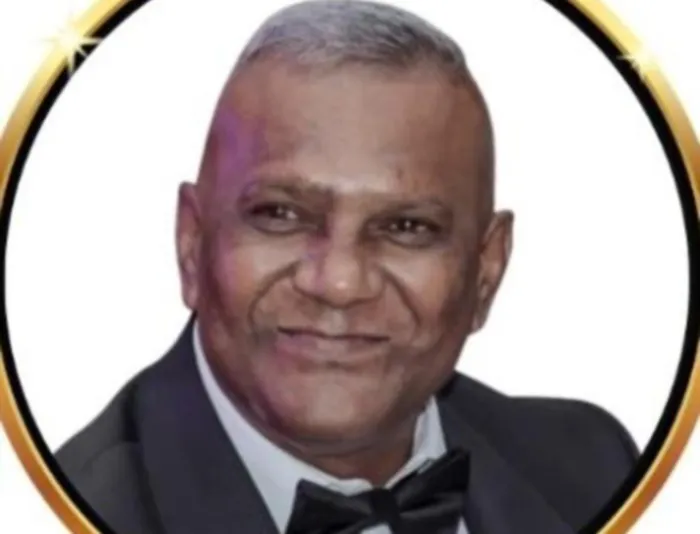
Shunmogam Dorsamy “Shan” Govender.
Image: File
The children of a Richards Bay man who was shot and killed at his workplace, sought relief in the Durban High Court after the mortuary refused to release his body following a dispute between themselves and his domestic partner.
Shunmogam Dorsamy “Shan” Govender, 66, of Brackenham, was shot at the Mondi Richards Bay Mill allegedly by an employee, who thereafter turned the gun on himself on April 8.
His funeral was due to be held on April 11, but was postponed after the mortuary refused to release his body without a court order.
This followed a dispute between Govender's domestic partner and his children, all of whom wanted his body released to them.
His children – Allister Lional Govender, Chantel Naidoo, Yvonne Naidoo and Edwin Lional Govender – brought an urgent application against the office of the KwaZulu-Natal Health MEC and Shunmogam’s partner, Loshini Naidoo.
Allister, in his founding affidavit, said urgent application was sought for final relief concerning the lawful authority to control the release of the Shunmogam's body, and to make and implement his funeral and cremation arrangements.
He asked the court to interdict and restrain the mortuary from releasing Shunmogam’s body to Loshini, any funeral undertakers or parlours, or any other person acting on her instructions.
Allister said the “controversy” arose when he and his siblings applied for the release of Shunmogam’s body, leading to a dispute over who was entitled to sign the release documentation and/or burial order as his next-of-kin.
“The dispute has, however, now crystalised more broadly into a dispute as to who holds the burial right itself, including the right to determine the manner in which the deceased is to be buried or cremated, and where his ashes are thereafter to be interred, immersed or scattered.
“The mortuary has, in light of that dispute, refused to release the deceased's body in the absence of an order of this ‘Honourable Court’,” he said.
Allister said Shunmogam had previously been married to their mother, and they divorced in February 2017. He said following the divorce, Shunmogam and Loshini commenced their relationship, but never married. Allister said attempts were made to accommodate Loshini.
He initially said there was a dispute between him and his siblings, and Loshini, concerning Shunmogam’s final rites and religious ceremonies.
Allister said Loshini was Christian, while he and his siblings were Hindu.
“That dispute was, at least in principle, resolved on the basis that, after the deceased had been prepared by the funeral undertaker, he would first be taken to the second respondent's (Loshini) residence so that she could perform her religious ceremony; thereafter to the applicants' (children) residence so that they could perform theirs; and thereafter the deceased would be transported for cremation.
“The applicants remain willing, should this Honourable Court grant the relief sought, to adhere to that arrangement in order to afford the second respondent an opportunity to mourn the deceased in a dignified manner,” he said.
Allister said on the morning of Shunmogam’s killing, he received a call from Loshini stating she could not get hold of him and that there had been an incident at Mondi.
“I proceeded to Mondi. When I arrived at Mondi, I was met by persons employed there who knew me to be one of the deceased's sons. They conveyed their condolences to me and I then learnt that my father had succumbed to his injuries.
“Certain of the deceased's personal effects, including his wallet and motor vehicle keys, were thereafter handed to me. Later on the same day, the second respondent requested that I make the deceased's wallet and identity document available for purposes of the completion/issuing of death certificate. Naturally, I acceded,” he said.
Allister said the next day, his sister, Chantel Naidoo, made arrangements with the mortuary manager, Mr Mbatha, for members of Shunmogam’s family to view his body.
“Upon our arrival at the mortuary, the second respondent and persons accompanying her were already present and were engaged in completing documentation. We met with Mr Mbatha, but when we requested to view the body, a dispute arose because the second respondent claimed to be the person entitled to deal with the release of the deceased's body.
“We disputed that claim and made it clear that the second respondent was not the deceased's spouse and that the deceased was survived by his four adult biological children,” he said.
Allister said on April 9 and 10, he and his siblings attempted to secure the release of Shunmogam’s body.
He said this included obtaining legal advice and their attorney accompanying them to the morgue in an attempt to facilitate the release of the deceased's body.
Allister said on April 10, Mbatha informed their attorney that Loshini claimed entitlement to deal with the release of Shunmogam's body, and to sign the required release notice as his next-of-kin, on account of her being his “common-law wife”.
He said their attorney explained that there was no concept in South African law of a so-called “common-law wife”.
Allister said at one stage it appeared that the body would be released to him and his siblings as Shunmogam’s biological children.
“That did not materialise because the second respondent persisted in claiming to be the person entitled to control the burial process, with the result that the mortuary adopted the position that it would not release the body without an order of this court.”
Allister said after the dispute arose, Mbatha furnished their attorney with a copy of the notice of death documentation utilised at the mortuary.
“The documentation reflects that the informant in Section D was recorded as the deceased's brother and that an identity document in the name of Govender Poobalan was used. The identity card supplied to the mortuary does indeed reflect a person bearing the same surname and forenames as the deceased's actual brother.
“However, the identity number and date of birth reflected thereon show that the card belongs to a different person, born on 27 October 1980, whereas the deceased was born on 27 June 1959. The card-holder is accordingly approximately 21 years younger than the deceased. The deceased's actual brother is older, resides in Durban, and was not in Richards Bay on 9 April 2026. He did not attend the mortuary to identify the body.
“The applicants do not presently know why this occurred, nor why the second respondent herself did not identify the body if she contends that she is the person entitled to control the funeral arrangements,” he said.
Allister said on April 13, their attorneys received correspondence from Loshini’s current attorneys of record.
“The parties sought to come to an agreement regarding the release of the body, but by the following day, it became evident that the parties had reached a stalemate. What the correspondence did, however, was to crystallise the true dispute between the parties.
“The dispute is no longer confined to the narrow issue of who may sign the release documents or burial notice. The second respondent has made it plain that she claims the burial right itself, including the right to determine where the deceased's ashes are to be taken and how they are to be finally disposed of,” he said
Allister said from the onset, he and his siblings had been prepared to accommodate a private religious ceremony by Loshini before they perform their own family rites and proceed with the cremation.
“The second respondent has, however, rejected any arrangement that does not recognise her as the person holding the burial right. That is a right which, in law, she does not possess. The second respondent now further contends that, even if the deceased's body is released, the ashes are to be scattered at Pelican Island in Richards Bay. The applicants do not accept that contention.
“It has long been the applicants' family tradition that the ashes of their deceased family members be immersed at the Clare Estate Crematorium in Durban, a Hindu facility designated for such purpose,” he said.
The court ordered that the office of the KZN Health MEC be interdicted and restrained from releasing Shunmogam’s body to Loshini or any funeral undertaker, funeral parlour or representative acting on authority of Loshini.
In addition, Loshini was interdicted and restrained from interfering with Shunmogam’s children’s burial rights, and representing herself as Shunmugam’s lawful next-of-kin for the purposes of the release of his body.
Shunmogam’s funeral was held on April 19.