

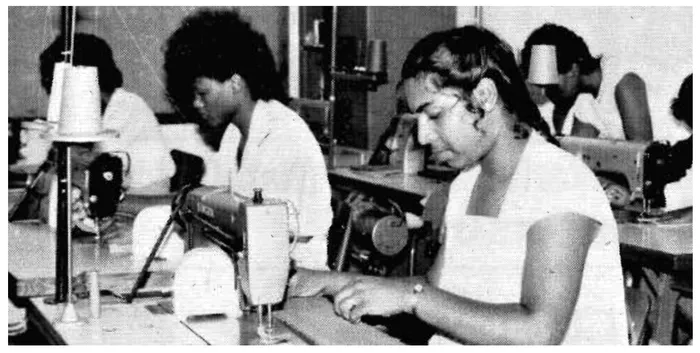
Working conditions inside factories were often very poor. Whirling fans kept workers cool in the hot summer months.
Image: Golden Jubilee Garment Workers Industrial Union brochure.
DON Ncube in The Influence of Apartheid and Capitalism on the Development of Black Trade Unions in South Africa notes that: “… race and class converged not only to polarise black and white workers, but to separate unions along racial lines, and to entrench a practice which conformed to the segregationist doctrine which already pervaded the fabric of the South African society".
It is generally accepted that there was no non-racial activism of any consequence other than the Communist Party of South Africa (CPSA) until the Three Doctors’ Pact was signed in 1947 by Drs Alfred Bitini Xuma, Monty Naicker and Yusuf Dadoo. They were the presidents of the ANC, Natal Indian Congress and Transvaal Indian Congress, respectively. That agreement formed a platform for united action, going into, among others, the 1952 Defiance Campaign, the 1955 Kliptown Conference that drafted the Freedom Charter, as well as the 1956 Treason Trial.
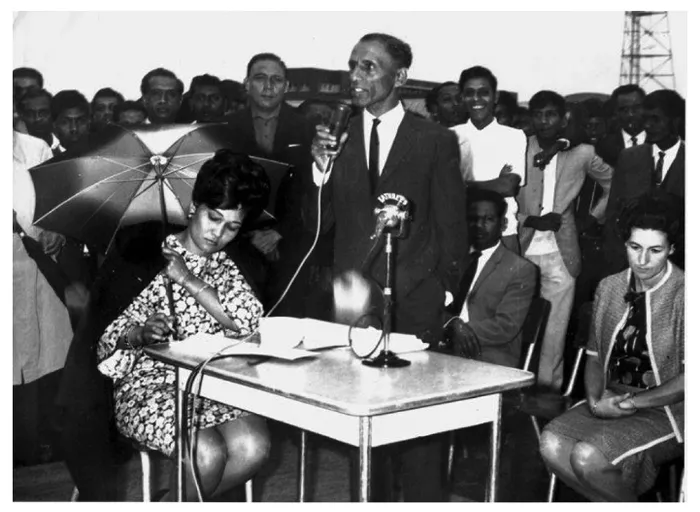
Hariet Bolton (seated on the right) at a factory workers' rally in Curries Fountain. She was married to Jimmy "JC" Bolton who formed the Garment Worker's Industrial Union (GWIU) in 1934. By the time he became general secretary of the GWIU, Indian women started to enter the industry in significant numbers while the number of Indian men employed in clothing factories, until then in the majority, started to decline.
Image: Peter Bolton Family Collection
It set the tone for non-racialism right up until the defeat of apartheid in our first democratic elections in 1994. Organised attempts to work together across racial lines with varying degrees of success go back much earlier. The first of these was the Industrial Workers of Africa (IWA), initiated in 1917 by members of the International Socialist League (ISL), and modelled on the Industrial Workers of the World (IWW) in the US.
Among the ISL militants in Durban were Bernard Sigamoney and Gordon Lee, who Lucien van der Walt notes: “... founded an Indian Workers Industrial Union in March 1917 ‘on the lines of the IWW’. Whilst ‘the Indian Workers Choir entertained the crowds by singing the Red Flag, the Internationale and many IWW songs’, plans were put in place to translate ISL materials into Tamil, Hindi and Telugu”.
In their seminal study, Indian Workers and Trade Unions in Durban 1930-1950, Padayachee, Vawda, and Tichman record that the ISL had already started working among Indian workers in 1915.
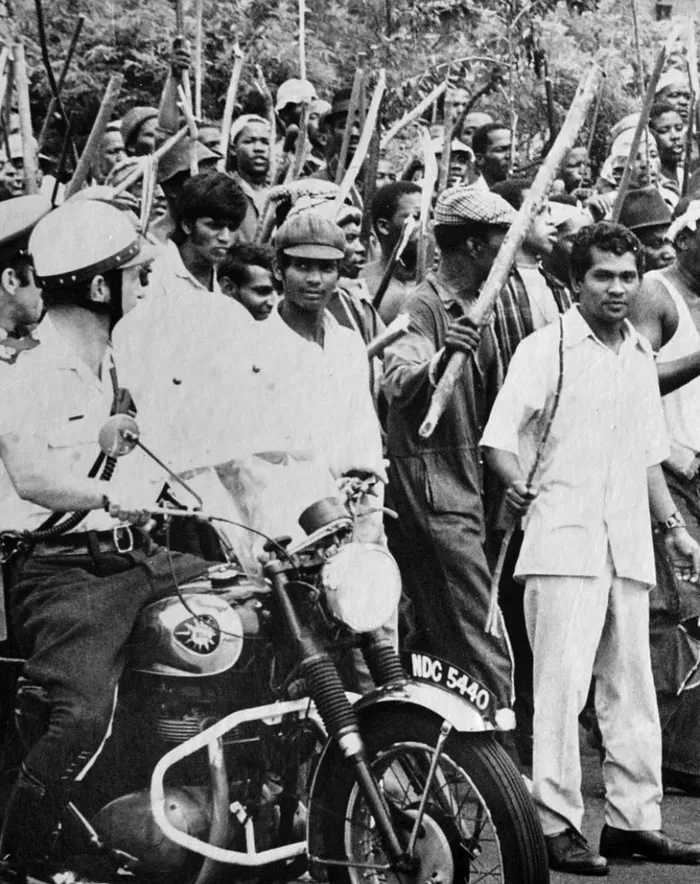
1973 Durban Strike.
Image: 1860 Heritage Centre.
In the Great Strike of 1913, the state and employers responded with extreme violence to the point of killing a yet unverified number of workers. In the absence of trade union organisation and with the aid of the army, the state crushed the strike, but not the rising militancy among workers.
Sigamoney was born in 1888. His grandparents were brought to Natal in 1877 as indentured workers. His grandfather, Francis, was a constable at a magistrate’s court, and his father, Emmanuel, a waiter.
Significantly, the Indian Workers Industrial Union (IWIU) was formed at least six months before the Great October Revolution in Russia that brought the Bolsheviks to power. It is also likely that it was the first trade union of black workers in South Africa.
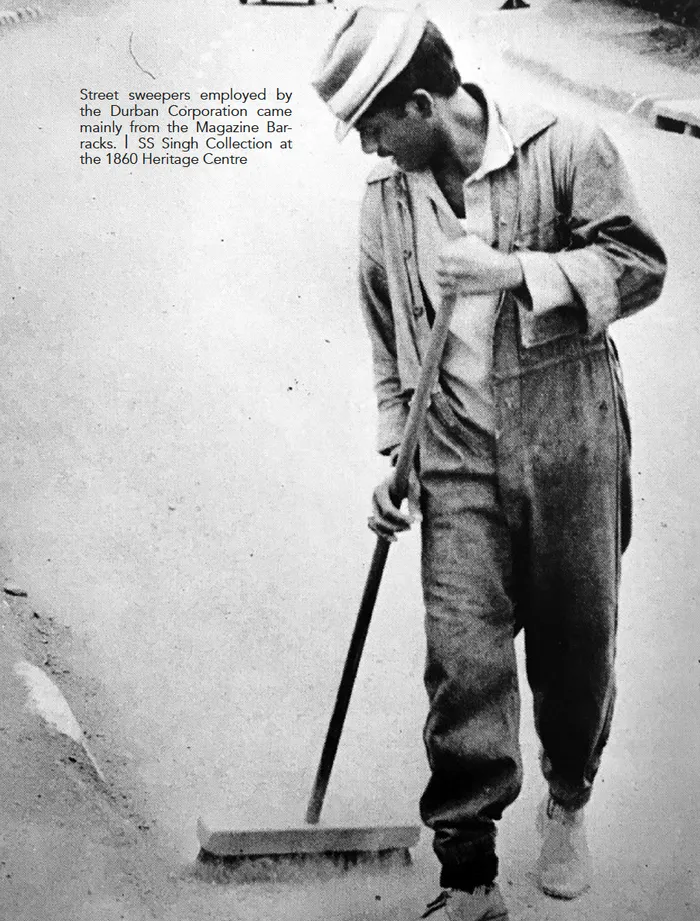
Street sweepers employed by the Durban Corporation came mainly from the Magazine Barracks
Image: SS Singh Collection at the 1860 Heritage Centre
In his study of the ISL-supported tobacco workers’ strike of 1920, Evan Mantzaris notes that Lee was the chairperson of the IWIU. Sigamoney was the union’s first general secretary. It is an interesting parallel that when the Congress of South African Trade Unions (Cosatu) was launched, the first general secretary to be elected by unified workers was of Indian origin, Jay Naidoo.
Writing in Zabalaza in 2014, Van der Walt also refers to Sigamoney chairing a major left-wing congress in 1917, and addressing the ISL conference in 1918.
He went on to say: “Sigamoney, the ISL and the IWIU supported IWIU waiters on strike in 1919, the 1920 strike by the independent Tobacco Workers’ Union, and the Indian furniture workers’ strike in 1921. Sigamoney was investigated by police for instigating the 1918 strikes by black African dockworkers, but was cleared”.
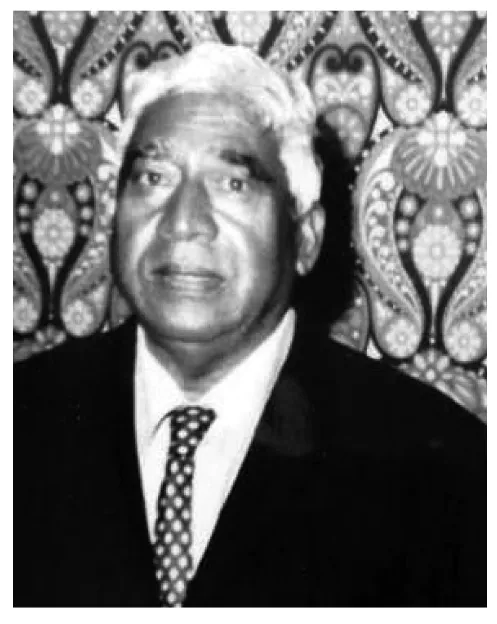
Veteran trade unionist Rungasamy Karappa (RK) Gounden, chairperson of the Durban Indian Municipal Employee's Society.
Image: Babs Govender Family Archives
The ISL had a powerful influence on the founding of the CPSA in 1921. Its initial membership was largely white, but it did draw in African, coloured, and Indian workers in the late 1920s and 1930s. Noteworthy among those activists were Curnick Ndlovu, RD Naidoo, Billy Nair, HA Naidoo, Vera, and George Ponen. The CPSA (and its later incarnation as the South African Communist Party) is the one organisation that can proudly stake a claim to never having had a racially-based membership.
In a tribute to the CPSA, organiser Johannes Nkosi, who was killed by police in Durban on December 16, 1930, journalist Arushan Naidoo noted: "The trade unionist met his death at the hands of local police at Cartwright’s Flats during a pass burning protest. The site is now a bustling long-distance taxi rank, carrying passengers as far afield as Johannesburg. In Nkosi’s day, it was where the circus set up at Christmas. The road leading from the bus rank opposite the Early Morning Market to the vicinity of Cartwright’s Flats is now called Johannes Nkosi Street.”
In the absence of a defined non-racial narrative, trade unionists, while mindful of the value of co-operation, did tend to organise in racial silos. One exception was the 13-week strike by Falkirk workers in 1937, where for the first time, Indian, African and coloured workers united against the bosses. The merchant-dominated South African Indian Congress gave considerable support to the striking workers, but it was AWG Champion of the Industrial and Commercial Workers Union (ICU), one-time president of the ANC in Natal, and a businessman who played a racially divisive hand.
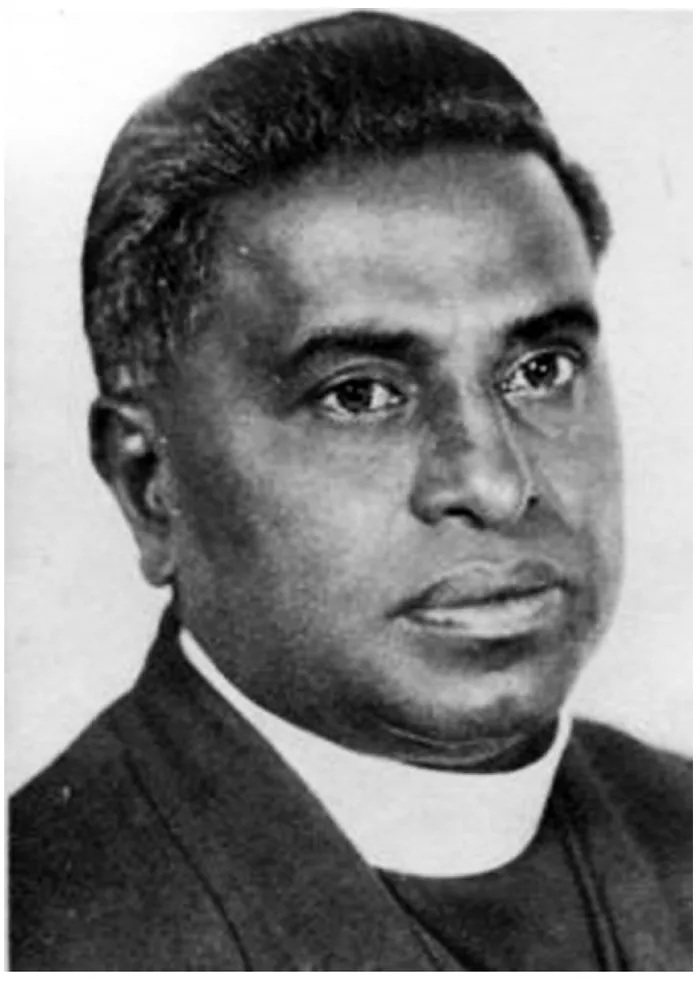
Bernard Sigamoney founded the Indian Workers Industrial Union in March 1917.
Image: 1860 Heritage Centre.
Shamim Marie, in a 1986 Worker Resistance and Culture publication, notes: “At one meeting, Champion told the African workers to go back to work and not to join the Indian workers who, he said, were nothing but shopkeepers and exploiters.”
Marie goes on to quote one of the Indian trade union organisers, then standing up and saying to the African workers: “You know why you are on strike. You know why the African, Indian and coloured workers who work together in this factory are united. Champion tells you that the Indian workers are shopkeepers. As far as we know, none of us here owns shops. The only one who owns a shop is Champion himself. He is the shopkeeper, and he is the exploiter.”
Champion and his henchmen were forced to the factory gate, half running.
Save for flashes of activism in the 1970s and 1980s, sadly, militancy among Indian workers has been on the wane since the 1960s. The reasons for that vary. The example set by Sigamoney and others in the very early days of trade union organisations has, however, left an indelible imprint on the history of workers in South Africa. It is an imprint that must be rekindled in the face of growing human rights abuses in the workplace.
In contemporary South Africa, the political influence of trade unions has waned, with some observers suggesting they have become too comfortable in elite environments, and less connected to poor workers. Increased vulnerability of workers has left many employees vulnerable to reduced wage increases and challenging work conditions.
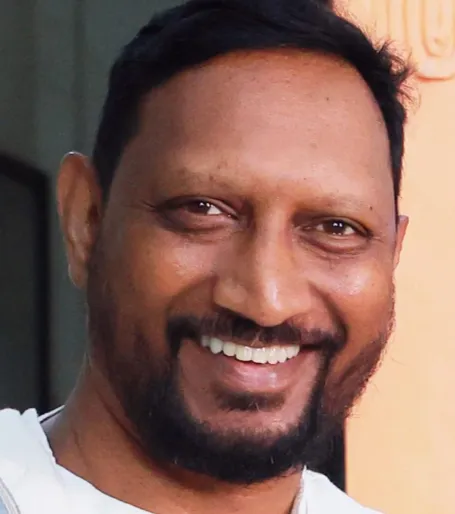
Selvan Naidoo
Image: File
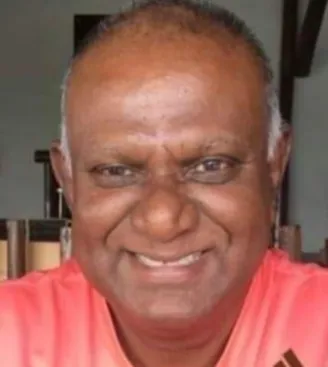
Play it again Sam Kiru Naidoo
Image: File
Selvan Naidoo and Kiru Naidoo are co-authors with Paul David and Ranjith Choonilal of the Indian Africans, available at https://www.madeindurban.co.za.