

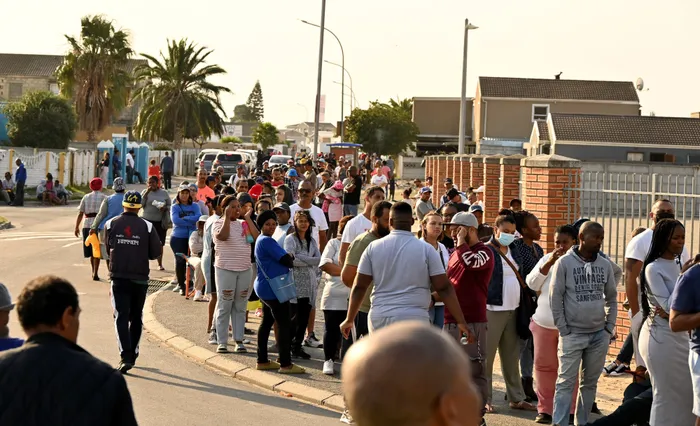
President Cyril Ramaphosa had on Thursday announced the election date, which would fall on a Wednesday.
Image: Ayanda Ndamane/ Independent Newspapers
The Electoral Commission of South Africa (IEC) assures that the upcoming local government elections on November 4 will not interfere with school proceedings, especially the final exams.
President Cyril Ramaphosa had on Thursday announced the election date, which would fall on a Wednesday.
In 2025, the national senior certificate (NSC) exams were held between October 20 and November 27.
Most schools, including those that will be used as voting stations, use holidays and weekends for extra classes to prepare pupils for the exams.
When asked about the possibility of elections disrupting exams, IEC spokesperson Kate Bapela said that before deciding on a suitable date, the IEC looked at the activities taking place around that time.
“Around that time, it would be the beginning of exams, and not a lot of our learners would be writing exams. We wanted to hold the elections before the exams are in full swing, which is why the first week of November is important, and also because the elections are only for one day. We vote and then leave the space of young people so they can enjoy writing without any disruptions,” said Bapela.
She said schools were more suitable for elections than community halls and churches, as they provided enough space for balloting.
“The schools also give bigger access to communities, as every community has schools, whereas churches and halls can be far apart.”
She said in some communities, there are five to six schools in one space, which made it easy for voters to walk in.
“The idea of us using schools is that we want our voters to just walk down the road to vote because we are reducing the crisis where people are saying voting stations are far. We have dealt with those things years ago, and the schools are the best places for us to use as voting stations, as schools are almost like part of the family and are more accessible than any public facility.”
She could not rule out that the IEC would use teachers to assist voters at voting stations.
“If it is possible, we need teachers if they are available. But you may be aware that when we recruit for an election, we publish in local communities. Once we finish the selection, we take a list of those people to the political parties in that area to confirm that we agree on the individuals assisting the voters,” Bapela said.
Basic education expert Professor Mary Metcalfe also did not believe that learning and teaching would be affected, as she said the election date would be six weeks before the end of the school term.
She said no NSC examinations were scheduled for November 4 or on November 3, which would be the day for setting up voting stations, or November 5, which would be for clearing up voting stations.
“Schools can schedule their internal assessment (Grades R to 11) for the remaining five weeks after the elections.
“Schools that are polling stations will need to be closed for the day of the election, and affected individual schools will make appropriate arrangements to minimise loss of learning time the day before and after the election. Some teachers may be involved in IEC activities, and the release of teachers for these duties will be managed at the school level,” said Metcalfe.
South African Democratic Teachers Union’s KwaZulu-Natal secretary Nomarashiya Caluza said prior arrangements would be in place since voting “is a national programme”.
“What we know is that this will be taken care of because even pupils, who are at the voting age, will need to vote. On that day, it will be a holiday for pupils to also be able to vote,” said Caluza.
During an interview with Cathy Mohlahlana of the SAFM’s National Briefing on Friday morning, Cooperative Governance and Traditional Affairs Minister Velenkosini Hlabisa said there was still enough time for the Basic and Higher Education departments to plan.
“During that week, they know how they are going to manage the examinations to allow fewer exam activities because it is a matter of planning. That is why we gave consultation at the beginning of last year, and we reached a consensus that if people knew early, they would all plan accordingly, as to how to ensure that there are fewer examination activities during that week to allow the public holiday.
“Comparatively, if you look at December, it would have been a challenge because people would have moved (for the festive season), and January is back to school, and there is much disruption.
“We had limited choices, and we had to look for the day that had fewer challenges if you plan for that particular day,” said Hlabisa.