

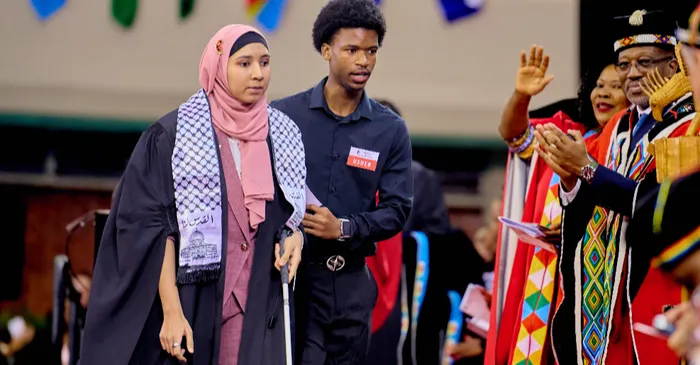
UKZN Vice-Chancellor Professor Nana Poku stands in ovation as Azraa Ebrahim walks the graduation stage.
Image: Sethu Dlamini
A visually-impaired student graduated at the top of her class, using her academic journey to challenge long-standing barriers and amplify underrepresented voices in higher education.
Azraa Ebrahim earned her Bachelor of arts honours degree in Religion and Social Transformation today with Summa Cum Laude distinction, achieving an average above 80% across all her modules.
Her latest accomplishment adds to a string of academic successes that have marked her as one of the province’s standout scholars.
Ebrahim first gained recognition in 2021 when she achieved the highest results among special needs schools in KwaZulu-Natal and placed second nationally. She later graduated Cum Laude with a Bachelor of social science, steadily building a reputation for both excellence and perseverance.
Born with Congenital Bilateral Optic Nerve Atrophy, a rare degenerative condition that limits her vision, Ebrahim has navigated university life with what she describes as “intellectual courage and purpose.”
“What began as an uncomfortable spotlight gradually became something I embraced,” she said, reflecting on the public attention following her earlier achievements.
“It gave me a platform to foreground the lived experience of being blind.”
Her honours research explored women-led khutbahs (sermons) and their role in advancing gender justice in South Africa.
Drawing from her own experience delivering a sermon at a community Eid gathering in 2024, she analysed four khutbahs and found they served as “sites of resistance and theological innovation”.
“My role is uniquely situated in that I embody the very research I am conducting,” she explained.
Ebrahim’s academic work is closely tied to a broader mission of representation.
She said the lack of visible role-models growing up became a driving force rather than a limitation.
“Growing up, I seldom encountered stories of Muslim women with disabilities excelling academically. That absence pushed me to become part of the change.”
Outside of her studies, she has presented at national conferences, travelled independently, and returned to her former school as a guest of honour. Despite ongoing accessibility challenges, she continues to advocate for inclusion in academic spaces.
“We want to be included, not just accommodated,” she said.
Ebrahim credits her success to the unwavering support of her family and mentors.
“They never allowed my blindness to become a ceiling. Their belief in me before I believed in myself shaped who I am today.”
Now pursuing a Master’s degree, her research will examine how disability is discussed in Islamic digital spaces and how such narratives affect Muslim women with disabilities.
“Let your strengths define your capabilities. I experienced true success when I stopped seeing my blindness as a barrier and instead transformed it into a weapon,” said Ebrahim.