

Eric Aptelgren
Image: Graphic: Chumani Mazwi
A recent report - titled "Trends and thoughts on the forthcoming 2026 local government elections" -has highlighted the possible strategy political parties will use to claim their seats ahead of the local government elections (LGE), scheduled for November 4.
According to the report, compiled by Eric Apelgren, the director and founder of The Mkhongi Circle and former head of the Department of International and Governance Relations at eThekwini Municipality, there is a strong trend indicating that political parties will “decampaign” one another in KwaZulu-Natal.
He said analysts expected KZN to be the most contested province ahead of the LGE with “heavy” decampaigning as parties actively targeted one another’s weak spots.
Apelgren said the likely key players would be the uMkhonto weSizwe Party (MK Party) versus the ANC and IFP.
“Analysts say the MK Party, backed by Jacob Zuma, is the dominant player in KZN and will aggressively contest ANC and IFP strongholds. The MK Party has already taken former ANC wards like eThekwini ward 10 and KwaDukuza ward 28 with 62% of the vote.
“The MK Party's provincial chief whip says they are ‘preparing to take over municipalities’, and ‘those who wrote off the MK Party are in for a surprise’. The ANC admits it has lost key wards to the MK Party and the IFP, with secretary-general Fikile Mbalula saying ‘we are a 17% party’ in KZN and ‘have lost important wards to the Zuma party’,” he said.
Apelgren said, however, that analysts noted the IFP continued to do well in northern KZN and was part of the current Government of Provincial Unity (GPU).
“Premier Thami Ntuli said the MK Party initially predicted the GPU would only last three months, but it had held. Still, the MK Party is pushing a no-confidence vote to collapse the GPU... seeking a new coalition with the EFF and the NFP (National Freedom Party) that excludes the ANC and IFP.”
Apelgren said the DA was expected to leverage its “bump” in turn-out in eThekwini and other metros.
“Analysis shows the DA has consistently outperformed the ANC in eThekwini since 2024, with a 9.1 point gap. The ANC’s first recovery objective will be to at least become the second biggest party in eThekwini. The DA and the MK Party have both won key wards in recent by-elections, including Mandeni ward 17, a former ANC stronghold taken by the MK Party.”
Apelgren said internal divisions would fuel attacks.
“Political analyst Zakhele Ndlovu from UKZN says no KZN party shows unity, and internal divisions will be a campaign issue. The NFP is embroiled in disputes over supporting the MK Party/EFF no-confidence motion.
"Another analyst warns that disbanding the KZN ANC leadership would be a ‘Christmas gift for the MK Party’. Analysts expect parties to use opponents’ instability to decampaign them – ‘divisions create an impression that a divided party cannot hold its councillors accountable’.”
Apelgren said control risks forecast that KZN would have coalition governments because no party was likely to win outright.
“Far more than any other province, KZN is defined by identity politics, which is why the MK Party, despite internal battles, remains a factor. Expect decampaigning around Zuma’s legacy, with some ANC protesters already saying, ‘This Zuma legacy must fall’.”
In the report, Apelgren also looked at how analysts and recent trends suggested independent civic ratepayer organisations and independent candidates might perform in eThekwini across different communities in the LGE.
He said in “Indian” areas such as Chatsworth, Verulam and Isipingo, independents had a shot due to “service delivery anger”.
“Water, electricity, roads and sewer collapses hit these areas hard. Voters often say ‘rates up, services down’. The ANC lost eThekwini ward 10 to the MK Party in a by-election, showing that loyalty is breaking.
“The Phoenix Ratepayers Association, Chatsworth civic associations and others already have databases, ward WhatsApp groups, and a track record of fighting billing issues. They don’t need party infrastructure,” he said.
Apelgren added that many residents felt the ANC took them for granted, and that the DA/IFP GPU had not delivered locally.
“A credible independent who lives in the ward can cut through.”
Apelgren said that in “white” areas such as uMhlanga, Durban North, Berea and Westville, independents had a shot due to a “rates revolt”.
“The eThekwini’s budget and tariff hikes, as well as service failures, mean active ratepayer bodies like the Umhlanga Ratepayers Association have high visibility.”
He said coalition fatigue also played a role.
“DA voters are frustrated that the DA is in a GPU with the ANC and IFP, but still can’t fix basics. They may ‘send a message’ via a local independent."
Apelgren said in “coloured” areas such as Wentworth, Austerville and Newlands East, an independent candidate might stand a chance due to the feeling of abandonment in the community.
“Communities say they are ignored by the ANC, and not a priority for the DA and IFP. Gang violence, housing and jobs dominate. Strong community structures exist outside parties. A respected teacher, pastor or nurse can pull votes.
“These wards swing hard when angry. They have gone ANC, DA, MF and NFP before. According to analysts, it may be very winnable if an independent unites civic, church and youth groups."
Apelgren said township areas such as uMlazi, Inanda, Ntuzuma and KwaMashu were the toughest for independents, but not impossible.
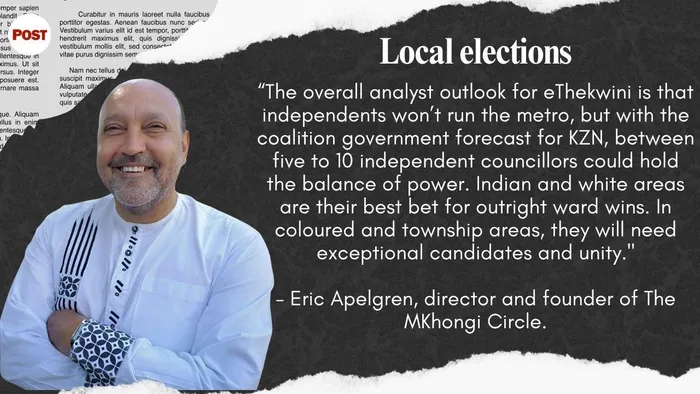
“The overall analyst outlook for eThekwini is that independents won’t run the metro, but with the coalition government forecast for KZN, between five to 10 independent councillors could hold the balance of power.
“Indian and white areas are their best bet for outright ward wins. In coloured and township areas, they will need exceptional candidates and unity,” he said.