

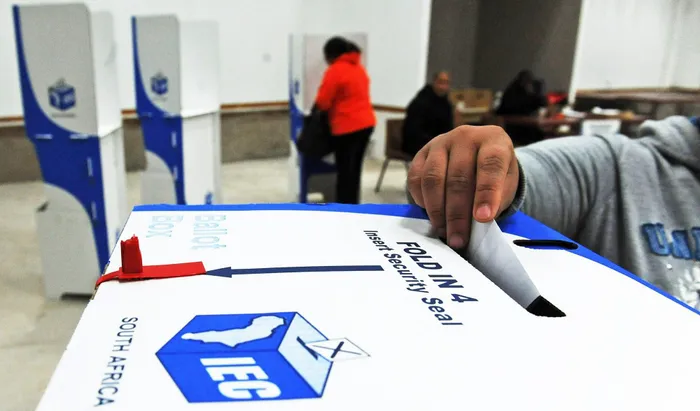
Poltical parties share their thoughts on the strategies that will be used ahead of the Local Government Elections.
Image: File
AS SOUTH Africa gears up for the 2026 local government elections (LGE) on November 4, the political landscape in KwaZulu-Natal is witnessing a surge in strategic maneuvering among various parties eager to capture the voter base.
With the electorate increasingly disillusioned by unfulfilled promises and deteriorating service delivery, parties face a daunting challenge: how to restore public trust and demonstrate genuine commitment to addressing the community's most pressing needs.
As political lines are drawn, the onus is on the parties to substantiate their claims with tangible plans and visible action.
The DA, Minority Front (MF), ActionSA, African Democratic Change (ADeC), and Ethekwini Ratepayers Protest Movement (ERPM) share their views on the report “Trends and thoughts on the forthcoming 2026 local government elections” by Eric Apelgren, and outline their LGE plans.
Francois Rodgers
Image: Supplied
* Francois Rodgers, leader of the DA in KZN, said the party’s strategy would centre on water, electricity, jobs and crime.
“Our focus will be on our successes, whether it is in the Government of National Unity, Government of Provincial Unity, and the municipalities where we govern outright. Our focus will be on our successes rather than the weaknesses of other political parties.”

Shameen Thakur-Rajbansi
Image: Supplied
* Shameen Thakur-Rajbansi, leader of the MF, said the party noted that while decampaigning was a predictable election tactic, it reflected a deeper failure of governance across major parties.
“Voters in 2026 are no longer swayed by political attacks alone, but by lived realities of collapsing service delivery, infrastructure decay, and rising costs of living. As outlined in our constitutional aims, the MF remains committed to dignity, equality, rule of law, and accountable governance for all citizens.”
Thakur-Rajbansi said coalition instability and infighting had directly harmed municipalities, reinforcing public frustration.
“The MF will not engage in destructive politics, but will campaign on solutions for clean governance, protection of minority and vulnerable communities, economic inclusion, and efficient service delivery.”
She added that voters would support parties demonstrating integrity, consistency, and a genuine commitment to improving their daily lives.

Thozama Qoqa.
Image: Supplied
* Thozama Qoqa, the provincial-secretary for ActionSA, said decampaigning was a pattern already visible in KZN, where political competition was “fragmented and highly-contested”.
“It is somewhat a rational strategy, with parties focusing on weakening rivals rather than only promoting their own strengths.
“The outlined dynamics are credible. The ANC remains vulnerable to attacks on corruption, stalled reform and poor service delivery, which are issues that resonate strongly with voters. The MK Party is likely to capitalise on this, while opponents such as the IFP and DA will question its stability and reliance on Jacob Zuma.
“Across the board, parties are expected to highlight internal divisions and frame coalitions as ineffective. In such conditions, reducing an opponent’s support can be as effective as building one’s own,” she said.
Qoqa said for voters, the LGE would likely centre on service delivery regarding water, electricity and infrastructure.
“Many may vote pragmatically or tactically, driven more by dissatisfaction than loyalty. The ANC is likely to retain a base, but lose ground where performance is weakest. The IFP may benefit from perceptions of stability, while the DA will emphasise governance.
“The MK Party remains a wildcard, with support linked to Jacob Zuma but constrained by questions around durability. Overall, outcomes will be shaped more by risk avoidance than optimism.
“We cannot ignore the existence of ActionSA which carries a strong position of anti-corruption and is governance focused. The party is showing surprising growth and is becoming the alternative that voters are looking for,” she said.

Niel Patchapen
Image: Supplied
* Niel Patchapen, an ADeC councillor in eThekwini, said the report reflected the current political reality.
“Parties are increasingly relying on decampaigning because voter trust is declining and elections are becoming more competitive, especially in KZN. Instead of winning support through delivery, parties are trying to weaken each other by highlighting failures, internal divisions and coalition instability.
“However, voters are shifting their focus. Communities are dealing with real issues such as poor service delivery, infrastructure failures, billing problems, exorbitant municipal bills and rising arrears. As a result, many voters are less concerned with political attacks and more focused on who can actually deliver results,” he said.

Rose Cortes
Image: Supplied
* Rose Cortes, deputy chairperson of the ERPM, said the report reflected what they were already seeing on the ground.
“Parties will focus heavily on one another’s weaknesses rather than presenting credible delivery plans. As a former head of international and governance relations at eThekwini, Mr Apelgren understands municipal governance well. That experience should inform why this 'decampaigning' approach is so damaging. It entrenches instability, and as he notes, coalition instability is already affecting service delivery.”
Cortes said ratepayers were not interested in “blame games”.
“They want potholes fixed, water flowing, electricity stable, and rates spent responsibly. When parties weaponise one another’s failures instead of fixing municipal systems, the voter loses.
“Furthermore, voters in eThekwini are exhausted. They are carrying a heavy rates burden while facing declining services, rising poverty and infrastructure decay. The integrated development plan diagnostic itself shows out-migration of skilled residents, unemployment and health reversals. In that context, voters will ask one question, ‘who can actually deliver value for what I pay?’.
“Trust is now earned through competence, not slogans. Parties that cannot demonstrate clean governance, fiscal discipline and a plan to stabilise core services, will struggle, regardless of how aggressively they decampaign opponents,” she said.
Cortes said the newly-formed political party’s position was simple.
“We support growth, but not at the expense of residents who are already overtaxed and underserviced. The municipality must fix the basics before overhauling or burdening services with additional large-scale demand. Ratepayers will be watching whether political leaders prioritise resident needs over vanity projects.”
** The MK Party, IFP and ANC did not comment at the time of publication.