

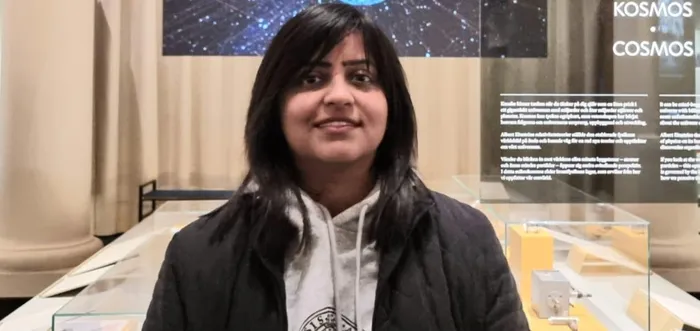
Dr Chevarra Hansraj.
Image: Supplied
Dr Chevarra Hansraj is among a group of six South African scientists preparing to step onto one of the most prestigious stages in global science: the 75th Lindau Nobel Laureate Meeting, set to take place in June in Lindau, Germany.
The other scientists are Dr Itumeleng Baloyi, Dr Jaymi January, Fannie Masina, Dr Xoliswa Lindokuhle Dyosiba and Dr Patrick Mwanza.
The Academy of Science of South Africa (ASSAf) confirmed that the candidates were selected through a highly competitive, multi-stage process and formally endorsed by the Council for the Lindau Nobel Laureate Meetings.
The annual gathering is regarded as a career-defining opportunity, bringing together early-career researchers and Nobel Prize winners for a week of high-level dialogue, mentorship, and collaboration.
This year’s meeting carries an interdisciplinary theme and will host approximately 636 young scientists from 88 countries, alongside 75 Nobel Laureates.
ASSAf, which serves as South Africa’s official partner to the Lindau Foundation, coordinates nominations with support from the Department of Science, Technology and Innovation.
Dr Hansraj, 30, is a lecturer and researcher in applied mathematics at Stellenbosch University. Her work explores some of the universe's most extreme phenomena.
“My field is applied mathematics, with a particular focus on mathematical physics, relativistic astrophysics and gravity.
“In simple terms, I use mathematics to study some of the most extreme objects in the universe, such as black holes, compact stars and the structure of spacetime.”
Her fascination with the cosmos began early, shaped by both her academic environment and a formative encounter with Stephen Hawking's 'A Brief History of Time'.
“Words like ‘neutron stars,’ ‘black holes,’ and ‘galaxies’ leapt off the page and have since become a daily part of my life.
“That curiosity deepened through my undergraduate studies, where I encountered one of the most profound ideas in modern science: that gravity is not a force in the conventional sense, but a consequence of the geometry of spacetime.”
Hansraj’s academic journey unfolded alongside groundbreaking discoveries in astrophysics. She noted the influence of Nobel Prize-winning work such as the detection of gravitational waves by LIGO and the first-ever imaging of a black hole.
“We went on to incorporate both of these aspects in my PhD topic. I studied how the spacetime geometry around a rotating black hole distorts as one approaches it and commented on the source of gravitational waves. It has truly been a journey from childhood fascination to making a meaningful contribution to science.”
However, her doctoral studies coincided with the Covid-19 pandemic, a global disruption that reshaped the academic experience.
“My PhD took place during the Covid period, so one of the greatest challenges was the isolation. I had expected to travel, attend conferences, meet researchers, and grow through the usual academic exchanges. Instead, much of that moved online or disappeared altogether.”
Despite these challenges, Hansraj credits discipline and support systems for helping her persevere.
“What helped me overcome it was structure, persistence and the support of my supervisors and parents. I tried to focus on what could still be done: reading deeply, writing, refining calculations. In a strange way, that period strengthened my independence as a researcher.”
Her resilience paid off.
She has since presented her work internationally, including at a major relativity conference in Scotland and as an invited speaker in China. She also previously attended the Heidelberg Laureate Forum, further strengthening her global academic profile.
Reflecting on her selection for Lindau, Hansraj described the moment as both surreal and deeply meaningful.
“I am deeply honoured to be one of the six South African young scientists selected. As a young scientist from South Africa, to be selected to engage directly with Nobel Laureates and outstanding young researchers from across the world feels almost surreal,” she said.
“Professionally, it is an extraordinary opportunity. It places me in a space where ideas, disciplines and generations of scientists meet. I see it as a chance to learn, to build collaborations, and to return with renewed energy.”
She is particularly eager to engage with leading figures in astrophysics and cosmology, including Nobel Laureates such as Reinhard Genzel, Saul Perlmutter, Adam Riess and Didier Queloz.
“Being exposed to Nobel Laureates and other young scientists working at the frontiers of different fields will likely sharpen my sense of which questions are most important, timely and impactful."
Beyond personal advancement, Hansraj sees her participation as part of a broader mission to elevate South African science on the global stage.
“South Africa has talented young scientists, but we often work far from the traditional centres of global scientific activity. Opportunities like this help build bridges.
“I want to bring back not only scientific ideas, but also stories and experiences that I can share with my students, mentees and younger researchers.”
She emphasised the importance of representation, particularly for women in science.
“Women remain under-represented in many areas of science, especially in fields such as mathematics and physics.
“Many young girls are interested in science, but they may not always see people who look like them occupying those spaces. Mentorship can change that.”
Hansraj is actively involved in initiatives such as STEM MentHER and Women in STEM panels, where she works to make science more accessible.
“Sometimes a young person simply needs to hear, ‘You belong here, and this path is possible for you,’” she said.
“But it is also about giving practical guidance, helping young women see the next step clearly. That has a real impact.”
She also highlighted the broader significance of mathematics as a tool for understanding the world.
“I want students to see that mathematics is not just a difficult school subject. It is a language for solving real problems. From understanding the universe to modelling diseases, designing technology, analysing data and improving everyday systems.”
Hansraj drew inspiration from overlooked pioneers such as Lise Meitner, whose contributions to nuclear physics were historically under-recognised.
“Her story is a reminder that women have always contributed profoundly to science, but their contributions have not always been recognised. We must ensure this kind of erasure does not happen again.”
As she prepares for Lindau, Hansraj carries both pride and responsibility.
“I feel a strong responsibility to represent South African science with excellence, humility and confidence. Being selected is not only a personal achievement; it is also an opportunity to show that high-quality research is being done here.”
Her message to aspiring young scientists, particularly women, is clear: “Science needs their curiosity, their imagination and their courage. It is for people who ask questions, keep learning and are willing to persevere.
“Find mentors, ask for help, keep applying for opportunities, and do not shrink yourself to fit other people’s expectations. Your ideas are valuable, your voice matters, and there is space for you in science.”