

Understanding the B-BBEE Legal Sector Code and its impact on transformation
Image: AI Generated
The introduction of the Legal Sector Code marks a significant shift in South Africa's legal profession, aiming to enhance black ownership and inclusion within law firms.
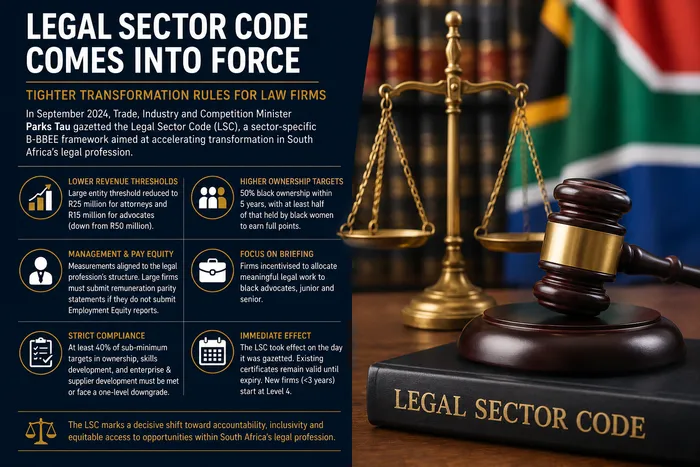
In September 2024, Trade, Industry and Competition Minister Parks Tau gazetted the Legal Sector Code (LSC), introducing a sector-specific B-BBEE framework aimed at accelerating transformation in South Africa’s legal profession.
The LSC replaces reliance on the Generic B-BBEE Codes, which had long been criticised for failing to reflect the unique structure of the legal industry—particularly the restriction that only admitted attorneys may own law firms.
The LSC is the subject of a matter being heard at the North Gauteng High Court where four of the country's top law firms are challenging it, effectively arguing against the minister's transformation strategy.
The new code is designed to drive more meaningful inclusion of black practitioners, with a strong focus on increasing the participation of black women in ownership and high-value legal work.
A key feature of the LSC is the overhaul of revenue thresholds used to classify legal entities. Under the new system, exempted entities are those earning up to R5 million annually for attorneys and R3 million for advocates.
Firms generating more than R25 million (attorneys) or R15 million (advocates) are now classified as large entities, a significant reduction from the R50 million threshold under the Generic Codes. The shift brings a greater number of mid-sized firms into a stricter compliance category.
The Code also raises the bar on ownership requirements. It sets a target of 50% black ownership within five years, doubling the previous benchmark of 25% plus one share. To achieve full points, firms must ensure that at least half of that ownership is held by black women. The LSC further removes certain “net value” calculations, placing emphasis on actual equity held rather than projected value.
Changes extend to management and remuneration practices. The LSC aligns management control measurements with the profession’s structure, including partners, associates and candidate legal practitioners. It also introduces stricter pay equity requirements, compelling large firms that do not submit Employment Equity reports to provide remuneration parity statements to demonstrate fair pay across racial lines.
One of the most notable reforms lies in procurement, particularly through the “briefing” requirement. Law firms are now incentivised to allocate substantial legal work to black advocates, both junior and senior. This measure aims to dismantle long-standing barriers that have limited black advocates’ access to high-value briefs essential for career advancement.
Compliance under the LSC is tightly enforced. Firms must meet at least 40% of sub-minimum targets in key areas such as ownership, skills development, and enterprise and supplier development, or face a one-level downgrade in their B-BBEE status.
The Code took effect immediately upon publication, with no transition period. However, existing B-BBEE certificates issued under the Generic Codes remain valid until expiry. New entrants to the profession—those practising for less than three years—automatically qualify as Level 4 contributors, with the opportunity to improve their rating based on ownership structures.
The introduction of the LSC marks a significant shift in the regulation of the legal sector. By tightening thresholds and strengthening compliance requirements, the Code is expected to reshape transformation efforts, placing greater pressure on firms to deliver measurable progress in ownership, equity and access to opportunities.