

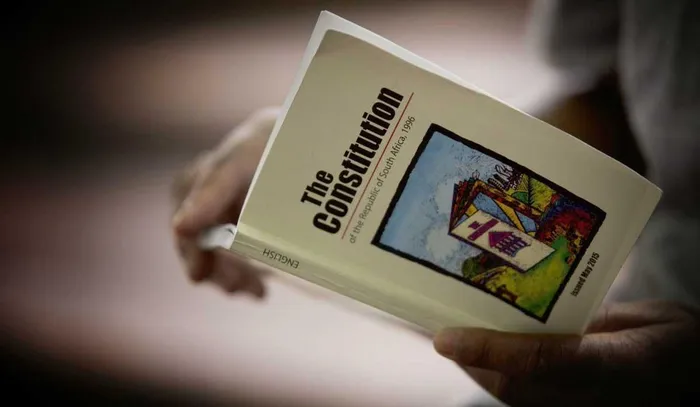
Reflecting on 30 years since its adoption, South Africa's Constitution serves as a critical framework for governance, cautioning against the abuse of power while highlighting the need for ethical leadership.
Image: FILE
Reflecting on 30 years since its adoption, South Africa's Constitution serves as a critical framework for governance, cautioning against the abuse of power while highlighting the need for ethical leadership.
South Africa’s Constitution, adopted 30 years ago, was never written to trust politicians. It was written to control them.
Celebrated as a symbol of freedom since May 8, 1996, its design is far more cautious, even suspicious of authority.
Dr Suhayfa Bhamjee, discipline head of public law and senior lecturer in criminal law at the University of KwaZulu-Natal, told IOL the Constitution is frequently misunderstood.
“An often overlooked truth is that South Africa’s Constitution is deeply sceptical of power. It does not assume future leaders will be wise, restrained, or benevolent. It assumes that power - even democratic power - will be abused unless it is tightly constrained.”
“This explains why all exercises of public power must be lawful, rational and procedurally fair; the state must give reasons for the decisions it takes; and ‘good intentions’ cannot justify rights infringements,” she said.
Under apartheid, Parliament held absolute authority. Laws could be passed that were legal, but deeply unjust.
The Constitution was designed to ensure that it could never happen again.
“Parliament itself is bound by the Constitution. Even laws passed by large majorities must comply with constitutional standards. This reflects a hard-earned lesson: majoritarianism is not the same as justice,” said Bhamjee.
Yet many South Africans still expect the Constitution to deliver change on its own.
“The Constitution was never meant to solve everything. It does not promise instant equality or substitute for ethical leadership.It is a framework for contestation, not a guarantee of outcomes.”
“When people express disappointment in the Constitution, that frustration more often reflects failures of political leadership and implementation, rather than flaws in the constitutional vision itself.
"The Constitution sets the standard. Living up to it is a political task,” she said.
Bhamjee explained further that understanding South Africa’s Constitution starts with something as simple as language.
Across the country’s 12 official languages, the word for Constitution consistently points to the idea of a foundation.
In Afrikaans, Grondwet translates directly as “ground law”, suggesting something solid on which everything else must rest. In isiZulu and isiXhosa, uMthethosisekelo carries the sense of something firmly set in place. Sesotho, Setswana, and Sepedi use Molaotheo, which also points to a guiding framework that structures all other law.
“The message across languages is the same. The Constitution is not just another law. It is the base upon which everything else stands. Think of it this way: if the foundation of the house you intend to build is crooked, it does not matter how advanced the materials are or how beautifully the structure is designed. No matter what you add on top, the house will always be unstable.”
“The Constitution was conceived with this understanding of the word itself - not merely as something that organises power, but as the foundation that must be sound, steady and trustworthy, because everything else in the legal and political system has to rest on it,” Bhamjee explained.
The Constitution was designed as the supreme legal foundation, not a flexible political document. That is also why the Bill of Rights is built into it, rather than sitting outside as a separate law.
“This placement was a response to history. Under apartheid, laws were used to deny rights. Embedding rights in the Constitution itself was a way to ensure that could not happen again.”
Looking back 30 years on, the Constitution’s biggest impact is often what people do not see, Bhamjee said.“It is not only about the laws that exist. It is also about the injustice that no longer easily becomes law,” she said.
POST