

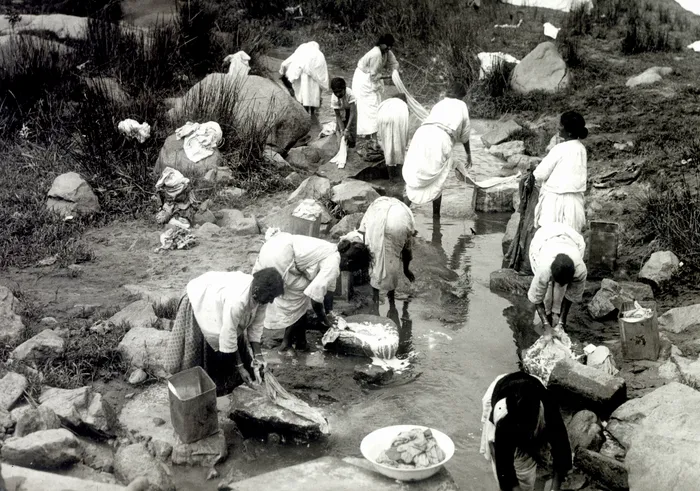
ndentured women washing clothes on the banks of the Umgeni River.
Image: 1860 Heritage Centre
This Mother's Day, Selvan Naidoo tells the untold stories of indentured Indian women in South Africa, their struggles against systemic violence, and the legacy that echoes through generations. He reflects on their resilience and the collective journey towards healing.
FOR the indentured Indian, the hope of a normal, structured family life as they had in their original homeland, was a mirage. This yearning may account for the abnormally high rate of suicides. The low numbers of women recruited into indenture made family living virtually impossible.
On the 384 ships that transported indentured workers, of the total of 152,184 souls who arrived on South African shores between 1860 and 1911, 62% were men, 25% were women, and 13% were children. From the outset, the female quota was seen as dead stock.
Jo Beall argued that “during the late 19th and early 20th centuries, Indian women were at the bottom of the class-race-gender hierarchy in colonial Natal. As workers, they were ultra-exploitable, being used for the most arduous and least skilled tasks in a forced labour system. As Indians, they were regarded as unwelcome additions to the already complex social make-up of the colony.”
Squatter market 1954.
Image: Mickey Padayachi
Many of the indentured workers described their lives with the term "narak" or hell on earth. The labelling of the indentured system as narakam and the lines (barracks) as vipaccara vituti or kasbighar (brothels), give a sense of how distasteful indentured workers viewed their conditions.
Women became vulnerable to sexual exploitation, abuse, and even murder. Hugh Tinker, in his seminal study titled A New System of Slavery: The Export of Indian Labour Overseas 1830-1920, argued that slavery left a legacy that the colonial and imperialist powers had no real interest in overcoming.
A convincing case could be made that indenture reproduced the actual conditions of slavery. Physical labour was favoured over mechanisation. Indenture was characterised by intense violence, including summary physical, psychological, and economic punishments. Women were especially vulnerable to sexual violence and exploitation. Freedom of movement was heavily constrained, even when passes could be obtained. The disproportionate number of women created unstable relationships, social ills, and immense difficulty in creating family life.
Women and children were not spared abuse. In one instance, a woman named Sornam was accused by her master of not working fast enough. In protest and desperation, she "flung down her hoe and also threw herself on the ground", whereupon she received a beating from the estate manager.
Women were subjected to abuse from as early as when they were on board the indenture ships. Neither the sugar barons nor their functionaries have been held to account for their direct involvement or complicity in the abuse of both African and Indian workers.
Happy Mother’s Day, remember, reflect, build.
This is the lyrics of a song, Uyirum Niye Udalum Niye, composed by AR Rahman and sung by Unnikrishnan:
uyirum neeye udalum neeye
uravum neeye thaaye
You are life, you are the body,
You are the connection, mother
than udalil sumandhu uyirai pagirndhu
uruvam tharuvaai neeye
You carried me in your womb, shared your life energy with me
You gave me life, mother
un kannil vazhiyum oru thuli podhum
kadalum urugum thaaye
Just one tear that flows from your eyes
Is enough to make the oceans drown
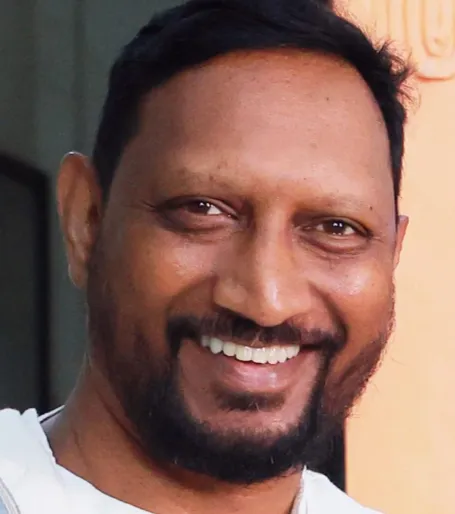
Selvan Naidoo
Image: File
Selvan Naidoos is the the maternal great-grandson of Camachee, indentured number 3297, and paternal great-grandson of Karpayamma, indentured number 96575, and director of the 1860 Heritage Centre.