

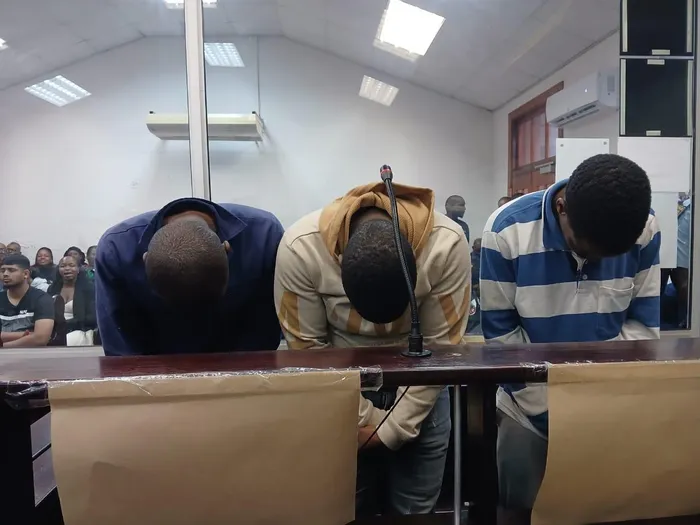
The three men charged with killing the Monswamy family of seven. If life imprisonment is the solution to deterring murder, how come the murder rate keeps increasing – now between 71 and 80 per day?
Image: DOCTOR NGCOBO Independent Newspapers
AS AN OUTPOURING of anguish and moral outrage at the brutal massacre of the entire Newark family, the POST’s May 6 – 10 edition provided a range of opinions on the causes of violent crime and the sociological solutions for it, but completely overlooked a very obvious reality.
While handwringing expressions of grief and anger may provide cathartic relief, the narrative that the death penalty does not provide a solution, begs a very basic question. If life imprisonment is the solution to deterring murder, how come the murder rate keeps increasing – now between 71 and 80 per day?
All social situations need boundaries to regulate behavior. Actions must have consequences. Terms and conditions must apply. Yet, as a boundary, the risk of life imprisonment clearly had no deterrent effect on the Newark murderers.
Despite the horror of what they perpetrated, convergent legal arguments hold that the death penalty violated the constitutional right to equality, dignity and life; and therefore was at odds with moral order. The glaring shortcoming of this liberal tolerance is that it fails to apply terms and conditions to the right to life.
In committing murder, the perpetrator shows absolute disregard for his victim’s right to life and dignity. Yet despite his heinous crime, constitutionally he does not forfeit his right to life. How does that accord with what is called moral order? Why should society owe a murderer the right to be treated with dignity and respect for his life? How then is the death penalty for murderers a “moral regression?”
Where is the morality in abortion? How is the denial of the right to a birthday to a developing human being who has a beating heart, not a moral regression? Where is section 11 of the Constitution on that score?
Constitutions are not cast in stone. They are subject to amendment at the behest of the people. Democracy, after all, is premised on the will of the people. The argument that capital punishment is vengeance and retribution was debunked by Professor Robert Blecker of the New York Law School in 2014. He pointed out that retribution governed by what was proportionate and appropriate, was not vengeful.
Dr David Malhausen, of the US Heritage Foundation, has countered the case made by those who cite wrongful executions as reason to oppose capital punishment. He notes that the majority of studies in the US recognise the deterrent effect of capital punishment.
The most pathetic argument against capital punishment is that it is cruel, and that violent crime is the result of poverty and inequality. What utter claptrap. Periods of economic depression and destitution have not recorded spikes in the murder rate. Deprivation and squalor may give rise to petty thievery, whereas the likes of the Newark butchers emanate from all classes of society.
Grandstanding expressions of “zero tolerance”, “unyielding justice”, and “standing together” are just vacuous bluster in the face of those with murderous intent. The key solution to reducing the murder rate is the political will to initiate amendments to sections 10 and 11 of the Constitution.
DUNCAN DU BOIS
Bluff