

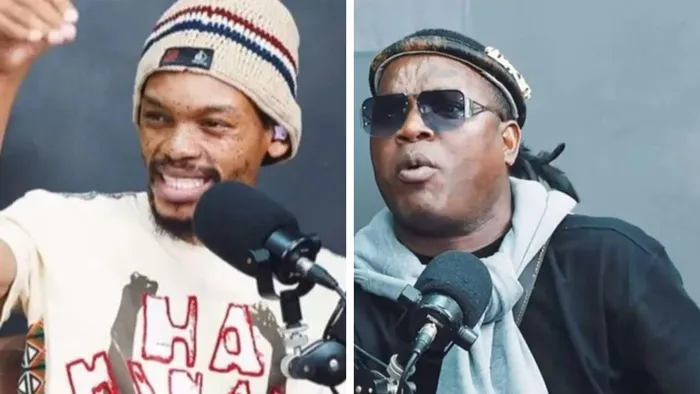
Nhlamulo ‘Nota’ Baloyi and Ngwize Mchunu.
Image: Video screenshot
SOUTH African music executive Nhlamulo ‘Nota’ Baloyi and radio personality Ngwize Mchunu are facing legal action for racist comments against Indians, made during a podcast, leading to widespread outrage.
Baloyi and Mchunu were reported to the Equality Court on Tuesday by Mervin Govender, general secretary of the Phoenix Tenants and Residents Association.
In the podcast, Mchunu said: “You see, Chinese have the same mentality as a****la (c***ies). Indians have been there for more than 150 years in this country. But they are abusing our people in different factories and different companies.”
In response, Baloyi said: “Too much. And Indians had a chance to go back to India. They had a chance to go back to India. They were rallied up. This is from 1924 all the way up to 1931.
“There are some that went back to India. Those that stayed here, stayed because in India they knew that they would be treated like slaves. So, you have been treated like kings in this country from the beginning. Do you understand what I am saying?
“Your duty is to show that you are kings. You are leaders. You understand?”
Mchunu then said: “I do not know who told a****la after a white person it is them. How did they get that position? Like it is a white person first, then number two is a a****la.”
Govender said Baloyi and Mchunu would be charged for contravening the Promotion of Equality and Prevention of Unfair Discrimination Act (Pepuda Act), which was meant to prevent and prohibit hate speech.
He said their comments were “reckless, inflammatory and racially divisive".
“We strongly condemn the statements made by the two podcasters during a recent podcast circulated widely on TikTok and other social media platforms, where derogatory remarks were directed at the Indian community, including the use of the offensive term ‘a****la’ (c***ie).
“Such statements are deeply hurtful, irresponsible and dangerous in a democratic South Africa that continues to strive for social cohesion, nation-building and racial harmony. Public figures and content creators carry a responsibility not to incite hatred, racial hostility or discrimination for attention, clicks or controversy,” he added.
Govender said their utterances had caused outrage in the Indian community and broader South African society who rejected racism in all forms.
“The careless normalisation of racial slurs and hateful rhetoric threatens peaceful relations between communities, and undermines the constitutional values of dignity, equality and non-racialism.
“We confirm that steps are being taken to institute proceedings against both individuals at the Equality Court for hate speech and racial discrimination arising from their conduct and public statements,” he confirmed.
He said they had requested that the video be immediately removed by TikTok South Africa and other digital platforms where it had been published.
“We requested the removal of the video based on the offending video content, which violates community standards, and relates to hate speech, racism and incitement.
“South Africa has suffered enough from racial division and social instability. We call on all leaders, activists, media personalities and citizens to reject racism consistently, whether directed at Africans, Indians, coloureds, whites or any other community.
“Freedom of expression cannot be abused as a shield for racial insults and inflammatory conduct,” Govender said.
The Film and Publication Board said they were concerned about the circulation of the video.
In a statement, the board said: “The video contains statements accusing Indian people of abuse, calling them "c***ies” and telling them to go back to India which may be regarded as discriminatory and potentially harmful in nature.
“Freedom of expression should be balanced against the rights to dignity and safety of others, especially where the exercise of such right may cause harm or discriminate against others. The content of the video clip and the sharing thereof by any member of the public, is in contravention with Section 18H of the Films and Publications Act, 1996, which prohibits the distribution of content (video or photo) which amount to advocacy of hatred that is based on identifiable group characteristics, and that constitutes incitement to cause harm.
“The act states that everyone who is found guilty of distributing such content shall be liable for a fine of up to R150,000, or up to two years imprisonment, or to both a fine and such imprisonment.”
The board had also engaged TikTok to remove the video from its platform.
“Internally, the board will monitor the take-down by digital platforms to ensure that no further dissemination or distribution by the public occurs. Members of the public are advised not to share, re-post, or distribute the said video in any form because they will equally be guilty for the dissemination or distribution of prohibited content, thus being held liable for penalties prescribed by the act,” the statement read.
Members of the public are encouraged to report complaints relating to harmful and prohibited online content to the Film and Publications Board via their toll-free number: 0800 148 148 or WhatsApp 083 428 4767.