

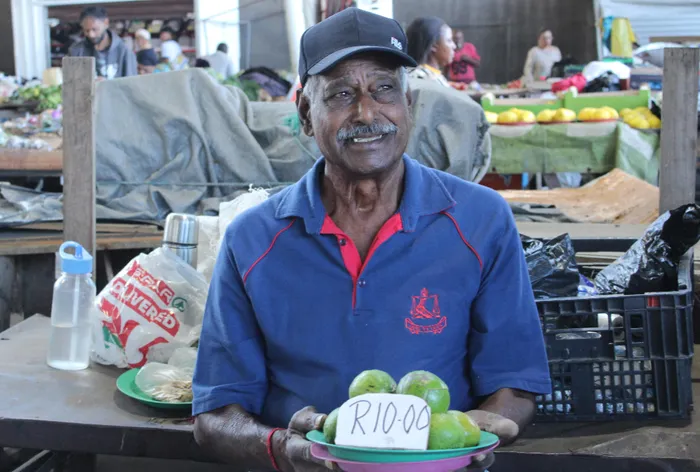
Allan Govender, 83, a vegetable trader.
Image: Yoshini Perumal
Traders at the Bangladesh Market are grappling with rising costs and stagnant refurbishment plans, leading to significant financial losses.
They said they hoped the refurbishments, which had been in the pipeline since 2020, would happen soon so they could attract more customers and boost their sales.
Last week, the eThekwini Municipality announced that R2 million would be made available in the 2027/2028 financial year for improvements to the market.
However, Tony Govender, councillor for ward 70, said the city had still not utilised the R2 million budget that was allocated to the market in the 2026/2027 financial year.
“The current allocation is R2 million which must be used before the end of June this year. We then have another R2 million allocated for the next financial year, but I am concerned that no progress has been made so far, and we may then lose our funding which would go back to the Treasury.
“There have been no upgrades since the building of the market in February 2007. In 2020, I requested an upgrade to the market. The contract was awarded and the builders were ready to start the project, but for reasons unbeknown to me, the project remained stagnant.
“Our concern is that many of our indigent traders are suffering a loss. Some are unable to trade due to not having a controlled fenced area to gain access to the trading stalls,” said Govender.
“The market needs a shelter in some areas, and existing shelters need repairs or replacing. The rain affects traders. While some lose their stock due to rain damage, others become ill after they get wet. I am currently waiting for feedback from the relevant departments regarding the project’s expected start date,” Govender said.
Don Dhurgapersad, 45, a fruit trader, said his stall had been in his family for over 40 years, and this was one of the hardest times to trade due to the high cost of living.
He said supermarkets in the vicinity had also contributed to their losses each week.
“I worked with my dad in the market from the time I was little. We sold mielies, jackfruit, coconut, and seasonal fruit. My dad became ill at the market in September and he died. It is sad that he never got to see the promised refurbishment of the market.
“The fuel price increases and the chain stores offering cheaper deals have led to us being crippled financially. We only trade on two days of the week, and we are being killed by the supermarkets,” he added.
Dhurgapersad said business had decreased by 70% in the last three months.
“The cost of living is too high. People cannot afford the basics. I used to sell 250 dozen mielies in two days. Now, I only sell about 20 dozen in the two days.
“I am unable to find work at my age, and we are struggling to make ends meet. I hope that once the market is refurbished, people will come to us once again,” he added.
Nelly and Mahen Govender, who have a fruit, vegetable and spice stall at the market, said he hoped that the budget included repairs for the roof, as they lost stock when it rained.
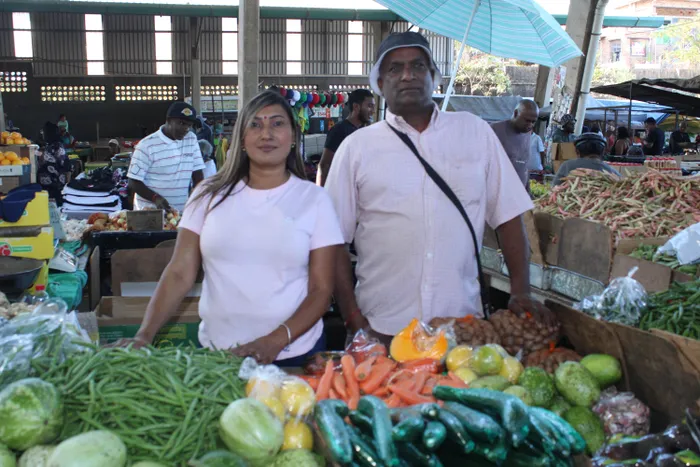
Nelly and Mahen Govender.
Image: Yoshini Perumal
“We were promised a shelter since 2007, but to date, we trade in the rain. We get wet and our goods are damaged, but we have no choice but to come here and try to sell our stock.
“We also need the toilets to be refurbished and maintained. If the area is well maintained and clean, then people will come,” they said.
Mahen said the fuel price increase had added to their woes and they struggled to provide fruit and vegetables at affordable prices to residents due to the food price increase.
“The cost of most vegetables had increased. Carrots are now R210 for 10kgs. Cucumbers are now R20 each. The price has doubled.
“The currents prices are unheard of, especially during this time of year. We have to invest R15 to make R3 profit. People, especially the elderly, cannot afford to pay full prices. We give them smaller portions at lower prices just so that they have something to eat,” he said.
Sashika Ramlutch, a spokesperson for the food stall owners, said they had ongoing issues, which were not adequately addressed.
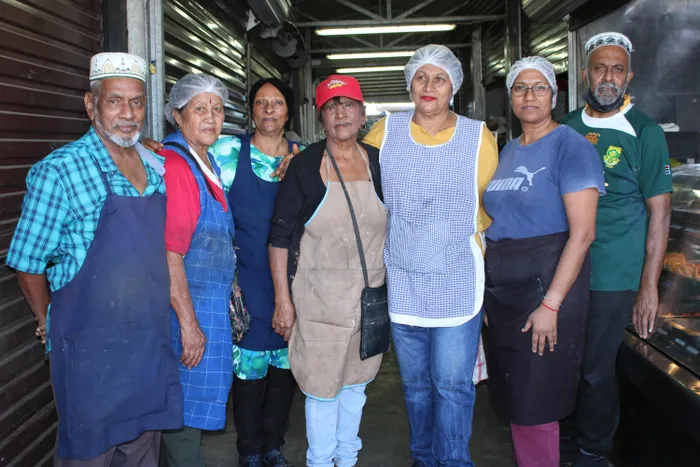
Food stall owners: Razack Shaik, Sunitha Maharaj, Fathima Shaik, Rani Dhurgaparsad, Margaret Naidoo, Sashica Ramlutch, and Rashid Shaik.
Image: Yoshini Perumal
She said despite a budget of R2 million being allocated, they were constantly turned away and given a “story about no money or budget for pesticides”.
She said they were promised extractor fans and a proper drainage system, but to date, nothing had been done.
“We needed an expansion of the food area, and the food stall owners were given the go-ahead to put money together to pay for the expansion.
“It was a verbal agreement with the then market association chairperson Vic Pillay, who is now late. We each contributed R5,000, but once the trench was dug, the project was stopped.
“At our own cost, we pay to clear the blockage of the drain, as the smell becomes unbearable, and drives customers away. If we do not pay for this, then the health inspectors visit and fine us.
“We hope that the budget is used to address these issues, as it contributes to us not having customers and running a loss each week,” she said.
Allan Govender, 83, a trader selling pepper, avocados, pumpkin, flowers and green beans, said the market was once vibrant, and due to its current state, people did not shop there.
“We are not making enough money to sustain ourselves. We make marginal profits and struggle to sell. It is a sad reality. I once sold out every week. Nowadays, I am heartbroken when I take my stock back home,” Govender said.
Gordon Govender, 89, a hat trader at the market for 30 years, said he was unable to sustain himself due to the high cost of living, as he uses his profits to take care of himself and his 85-year-old wife.
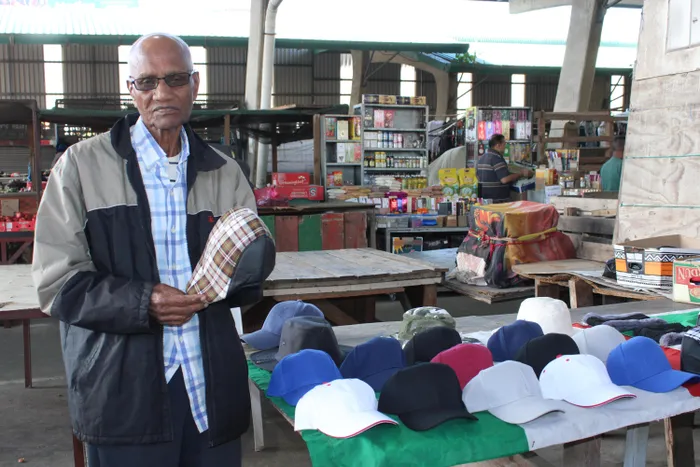
Gordon Govender, 89, a hat trader.
Image: Yoshini Perumal
“I hope that they revamp the market so that we can see it vibrant like the old days while I am still alive. The market needs to be clean for people to shop here. The cost of living affected my business. I sell caps for R50, but caps are now novelty items which people think twice about buying.
“People still bargain with me and they cry to pay the price, even though my profit is very small. The money I make at my stall pays the R1 200 rent for the stall for the year, and it pays for my funeral policy, which is R360 for the year.
“If I make extra money, I buy a few groceries and vegetables. I am also supporting my two unemployed sons. My wife is sick and I also have to buy her medication with the money I make. It costs me R52 to go to town and back to purchase stock,” Govender said.
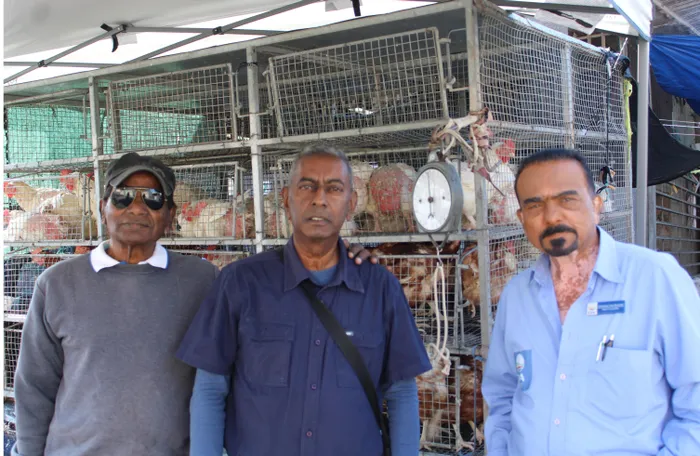
Desmond Pillay, Seelan Pillay, and councillor Tony Govender.
Image: Yoshini Perumal
Seelan Pillay, a poultry trader, said they were promised a shelter since 2007.
“We cannot cope with the conditions in the market, which adds to us losing business. The cost of chickens has increased from R120 to between R150 and R170.
“Last month I paid R460 for a 19kg gas bottle. This month I paid R640. How do we survive? The government is not making it conducive for small traders to survive,” he said.