

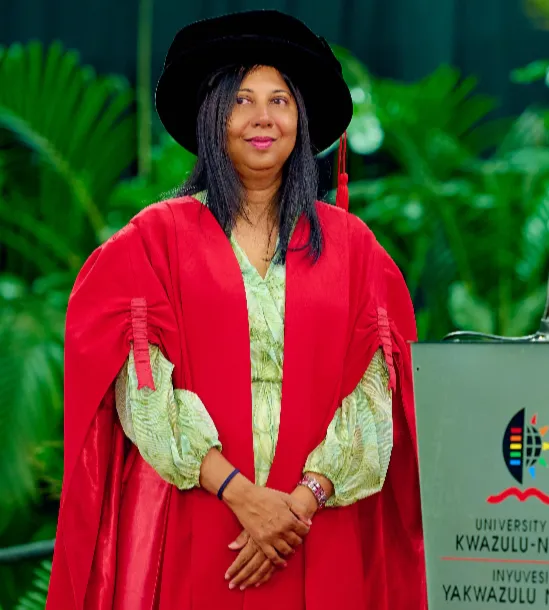
Dr Nadine Rapiti, right, recipient of the Distinguished Teachers’ Award.
Image: Sethu Dlamini
Dr Nadine Rapiti, the head of UKZN's Haematology Discipline at Inkosi Albert Luthuli Central Hospital and Victoria Mxenge Hospital within the KwaZulu-Natal Academic Complex, has been honoured with a Distinguished Teachers’ Award at this year’s Autumn graduation.
Describing receiving the award, she said, “It’s an absolute honour to be following in the footsteps of brilliant teachers at UKZN, who also taught me as both an undergraduate and postgraduate student at the University’s Medical School.”
Rapiti said her journey into academia was inspired by her father.
“He taught me that knowledge is power, but humanity starts with sharing knowledge. My dad used to sell fruit and vegetables in the Glenwood area, while teaching his four kids and countless others poetry, politics, and mathematics. He showed us that learning happens anywhere when the mind is open to learning, and his greatest pride was not that he put my siblings and me through medical school, but that his children are educators at UKZN, who know how to share knowledge."
At the heart of her work lies a teaching philosophy grounded in “social constructivism and humanism”, with mentorship playing a central role.
Rapiti said this approach had evolved over time to reflect the changing needs of students and the broader health landscape.
“By teaching in a manner the student relates to, education jumps out from a textbook, journal, or lecture notes and becomes an experience to remember.”
Her approach to teaching is rooted in “understanding that students’ experiences shape their learning journey”, with a strong emphasis on “making learning relatable”.
She said: “I am committed to creating an environment that nurtures the student, where the student is safe to question and answer without judgment - my ultimate teaching philosophy.”
Reflecting on what made an exceptional educator, Rapiti emphasised: “Listening to students and adapting my teaching style to suit individual students is critical."
She noted that effective teaching extended beyond subject expertise to include empathy, adaptability, and a deep commitment to student success.
Her research interests in haematology continue to address critical issues such as HIV haematology with research translating to practice, reinforcing the link between teaching, research, and societal impact.
Despite the demands of academia, Rapiti, remains motivated by seeing her students’ progress, become teachers themselves, advocate for patients, and feel inspired to question and find their own voices.
“Walking that journey with students is an incredibly rewarding passion. I hope that students leave UKZN not only with a qualification, but with voices that question and hearts that care.”
For Rapiti, recognition as a distinguished teacher represented appreciation for doing a job she loved, one often accompanied by challenges and many late nights.
“It is a recognition for all those who teach, and I appreciate UKZN for the acknowledgement.”
Rapiti said her academic journey began with both her parents, who reinforced the value of education by attending night school after having kids.
“My mum then juggled teaching cultural studies at a local school with being a ‘super-mom’. So, although we had little money growing up, we had a rich upbringing because of these family values.
"After studying medicine at UKZN, then postgraduate training in haematology, I worked as a haematology consultant in the United Kingdom for a few years, but returned to UKZN in 2005, at the request of the head of department at the time, eventually leading to a distinguished career dedicated to teaching and mentorship.”
Addressing the broader role of educators highlighted the importance of not only having expertise but also being able to share it. She noted that while expertise was an acquired skill, teaching was a combination of learned behaviour and instinct, encouraging fellow academics to continuously refine their teaching craft alongside their disciplinary knowledge.
Looking ahead, Rapiti envisions advances in precision medicine and molecular science while continuing to inspire students through a deep passion for bridging the gap between laboratory diagnostics and patient care.
Rapiti underscores the importance of strong foundations in mathematics and science at school level, encouraging students and educators alike to support other students in their subject choices, and help expose students to shadowing or mentoring opportunities in the real world.
She also reflects on the evolving landscape of the health sciences, noting advancements such as artificial intelligence, precision medicine, and molecular science that continue to shape teaching, research, and practice.
Importantly, Rapiti challenges common misconceptions about academia, noting that “academics are not mono-skilled, but actually wear the hats of administrators, researchers, mentors and very often "parents", emphasising that impactful teaching is both an art and a discipline.
Beyond her professional achievements, Rapiti also reflected on her personal journey, recalling that she had always wanted to be a writer and chuckling that she had never imagined this would take the form of writing research papers.
In a country navigating complex socio-economic challenges, Rapiti shares a powerful message for young people: “We live in a country filled with promise. The students of today are this promise. So, engage each other fully in this moment, with no preconceptions, and merge your different strengths to live up to your promise.”