

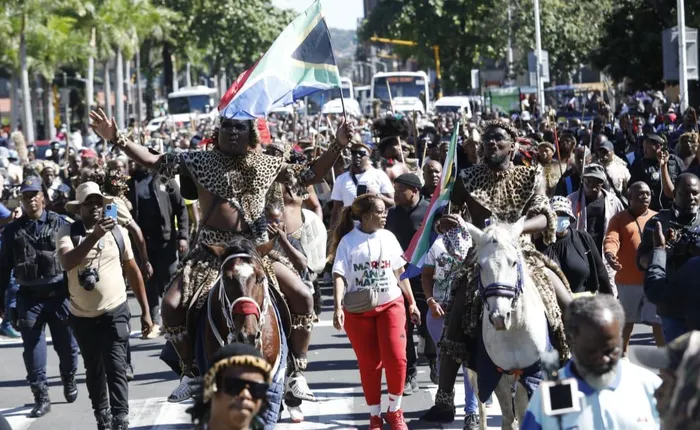
Hundreds of men adorned in traditional Zulu attire, affiliated to the March and March movement, marched through the streets of Durban, calling for the removal of foreign nationals illegally in the country.
Image: Doctor Ngcobo/Independent Newspapers
LEADERS from the Indian and Pakistan South Africa Associations express concerns over the treatment of foreign nationals, advocating for dialogue and fair immigration policies to foster social cohesion and economic stability.
They said calls for the removal of foreign nationals from South Africa, have ignited fear and concern, leading to community protests and discussions on immigration enforcement, and its implications for local safety and economic opportunities.
In recent months, March and March, a citizen-led movement, has been advocating for stronger immigration enforcement and protecting opportunities for South African citizens.
They have also taken a stance against foreign nationals using facilities such as public schools, clinics and hospitals.
They have marched through the Durban CBD in recent weeks, resulting in clashes between the marchers and foreign nationals.
Last week, members of March and March, accompanied by hundreds of men adorned in traditional Zulu attire, took to the streets in the Durban CBD to express discontent over what they perceived as a threat posed by foreign nationals to local safety and economic opportunities.
Following this, Thamsanqa Ntuli, the Premier of KwaZulu-Natal, and Lieutenant-General Nhlanhla Mkhwanazi, the provincial commissioner of police in KZN, held a multi-stakeholder engagement last week, to address illegal activities affecting communities across the province.
The engagement brought together stakeholders including March and March, the Nsizwa Nobunsizwa Development Foundation, the eThekwini Municipality, the Department of Home Affairs, the Department of Economic Development, Tourism and Environmental Affairs, the Department of Public Works, and the Department of Cooperative Governance and Traditional Affairs, to strengthen co-ordinated efforts in combating crime, and restoring law and order.
Ntuli emphasised the importance of collaborative partnerships in dealing decisively with illegal activities that undermined community safety, economic development, and social stability.
He further called on all stakeholders to work together in ensuring safer communities throughout KZN.
Ntuli added that a technical task team would be established to comprehensively address all aspects of the matter.
Mkhwanazi reaffirmed the commitment of the SAPS to intensify operations against criminal activities and strengthen visible policing, intelligence-driven operations, and community co-operation.
Amit Shivaji More, president of the Indian Association of South Africa, said they acknowledged that communities across South Africa faced challenges related to unemployment, service delivery, and economic pressures.
“These concerns require urgent and practical solutions. However, actions that target individuals based on nationality, risk deepening divisions and may not address the underlying causes of these challenges.”
More said the current environment was creating uncertainty among foreign nationals, many of whom lived in South Africa for extended periods, and were integrated into local communities and industries.
“There is a general sense of concern and uncertainty across communities. While some individuals feel vulnerable due to recent events, others are concerned about the broader economic and social implications. In addition, this situation may affect social cohesion, business stability, and investor confidence if not managed constructively.”
More added, however, that the association did not support illegal immigration.
“This applies not only to South Africa, but globally. Unregulated or illegal migration creates challenges related to safety, security, and governance, and can place additional strain on public services and local economies. It may also contribute to perceptions of unfair competition in employment and business.
“We therefore support a lawful, transparent, and well-managed immigration system that balances economic needs with social stability, while ensuring fairness for both citizens and legal residents,” he said.
More, who is also an executive committee member of the India South Africa Chamber of Commerce, added that foreign nationals and expatriates contributed across various sectors of the economy.
He said this included small businesses, technical industries, health care, and services.
“Many enterprises run by foreign nationals employ South Africans and support local supply chains.”
More said the association believed that the focus should be on strengthening the rule of law and ensuring consistent enforcement.
“There should also be focus on addressing root causes of unemployment, inequality, and service delivery; improving immigration management systems to ensure clarity, fairness, and control, and encouraging dialogue to promote understanding and reduce tensions.”
Hayat Ullah Khan, president of the Pakistan South Africa Association’s KwaZulu-Natal branch, said they were deeply concerned by the growing rhetoric and actions aimed at excluding foreign nationals from essential services and economic participation in South Africa.
“We believe that denying individuals access to health care, education, and lawful business activity undermines the constitutional values upon which South Africa was built. Access to hospitals and schools are basic human rights, and no community should be subjected to fear or intimidation.”
Khan said many foreign nationals in South Africa had been part of local communities for decades.
“They have invested in the economy, created employment opportunities, paid taxes, and contributed positively to the social fabric of the country. The overwhelming majority are law-abiding residents who seek only to live peacefully and support their families.”
Khan said the recent marches, including those held in the Durban CBD, had created anxiety and uncertainty within many communities.
He said while every person had the democratic right to protest peacefully, such actions must not promote hatred, division, or xenophobia.
“At the same time, we believe there is room for constructive engagement and dialogue. The association is prepared to sit together with community members, the March and March Movement, and other groups raising concerns, so that meaningful discussions can take place.
“We believe solutions can be found through co-operation and mutual understanding. Communities can also advise us on what more foreign nationals can do to contribute positively towards local communities, social development, and the South African economy.
“The association calls on the government, law enforcement agencies, civil society, and community leaders to work together to address social and economic challenges responsibly and lawfully, without scapegoating foreign nationals,” he said.
Khan added that South Africa had long stood as a symbol of human rights, dignity, and unity in diversity.
“We remain hopeful that dialogue, constitutional values, and peaceful coexistence will prevail.”
Pavershree Padayachee, provincial manager of the South African Human Rights Commission in KZN, said: “The actions taken by the March and March Movement aiming to prevent foreign nationals, both documented or undocumented, from accessing hospitals, clinics, and education, or operating businesses, are unlawful, and constitute severe violations of human rights.”
She said Section 27 of the Constitution stated that everyone had the right to access health care services, including reproductive health care and emergency care.
“The Constitutional Court in the Khosa judgment interpreted the word ‘everyone’ in Section 27 as being broad and inclusive of permanent residents of South Africa, not just citizens. Accordingly, the right to education extends to every child within the borders of South Africa, who is of a school-going age.”
Padayachee said Section 9 guaranteed equality, and protecting against discrimination based on social origin or nationality.
“Denying individuals access to services based on their nationality violates their fundamental human rights, and flies in the face of our democratic state founded on the values of human dignity, achievement of equality, and the advancement of human rights, supremacy of the Constitution and the rule of law.”
Padayachee said the commission was returning to the Durban High Court to argue the merits of its case against March and March, and Operation Dudula.
“The initial application, which sought to interdict these groups from illegally blocking foreign nationals from accessing public health care, was struck off the urgent roll in October 2025 due to a lack of deemed urgency, rather than a dismissal of the substantive issues.
“This legal action follows the landmark Kopanang Africa Against Xenophobia and Others v Operation Dudula and Others judgment in the Gauteng Local Division of the High Court, where the court among others affirmed that under Section 41 of the Immigration Act, only official immigration officers and the police were legally empowered to demand identification documents or check the status of individuals. The commission seeks an order to prevent private individuals from harassing or intimidating vulnerable persons at healthcare facilities,” she said.
Shenilla Mohamed, the executive director of Amnesty International South Africa, said the actions of March and March were concerning as they promoted xenophobia and risked inciting or justifying human rights violations against refugees, migrants, asylum seekers, and other foreign nationals.
“While we understand the frustrations of many South Africans facing challenges with service delivery, unemployment and crime, violating the rights of others is never a solution.
“It is unlawful and must be met with accountability for perpetrators. Such campaigns scapegoat foreign nationals for systemic issues in South Africa. This mirrors patterns seen in past xenophobic violence and intimidation, where vigilante groups have harassed migrants, blocked access to health services and education, and fuelled discrimination.
“Furthermore, Amnesty International has consistently stated that the persistence of such violence stems from government inaction, policy failures, a lack of effective criminal justice responses, and political rhetoric that legitimises xenophobic sentiment,” she said.
Mohamed said to address ongoing calls and prevent escalation into violence, the government must demonstrate stronger political leadership and take concrete steps.
She said this included ensuring prompt and effective investigations and prosecutions of those involved in xenophobic attacks, intimidation, or harassment to break the cycle of impunity.
“Xenophobia must be rejected. South Africa has a proud history of fighting for human rights and dignity for all. This must extend to everyone within its borders.”
Ela Gandhi, a peace activist, said: “I can understand when people feel frustrated because they are not able to access services because of the many foreign nationals who are taking up these services such as space in schools, in hospitals and on the streets vending goods.
“The poor are affected by this and feel the pinch. That is why the organisers of these demonstrations are able to mobilise mass support. Sadly, however, the campaign is resulting in dehumanising people.
“They do not see a human face that is being pushed out of hospitals, schools and streets. They too are trying to survive. Attacking them is the easy way out and perhaps a way to get votes, but losing one's humanity is brutalising human beings.”
Gandhi said the correct thing to do was to seek and apply a well-constructed immigration policy.
“If the energy used in pushing people out can be diverted to ensuring that an efficient system of border control is exercised, then perhaps a better more humane result can be achieved. While I sympathise with the frustration of the people, I condemn the methods they are using.”
March and March did not comment at the time of going to print.