

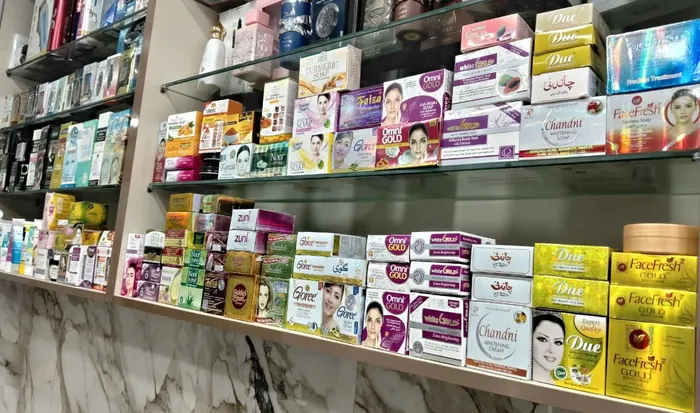
Some of the products which are said to be for skin-lightening are sold at local barber shops and beauty salons.
Image: Nadia Khan
Despite ongoing warnings from health experts about the associated risks of skin-lightening products, their use remains prevalent in South Africa.
Dr Meagan Jacobs-Alfred, a recent UCT PhD graduate in public health, scrutinised this trend in a recent doctoral study.
Her thesis, titled "Perceptions and experiences of skin lighteners in Cape Town", delved into the motivations, health risks, and societal pressures that drove individuals to alter their complexions.
Jacobs-Alfred's interest in the subject was sparked during an internship at UCT funded by the National Research Foundation.
“I encountered issues related to colourism and skin tone, which sparked curiosity about why skin tone was socially valued, and why some people used skin-lightening products. As a person of colour, I was also interested in understanding the social meanings attached to skin tone and the motivations behind these practices.”
She said the research highlighted how colourism – the preference for lighter skin within communities of colour – continued to influence perceptions of beauty and success in South Africa.
“Colourism in South Africa is closely linked to colonialism and apartheid, where lighter skin was historically associated with privilege, status and access to opportunities. As a result, lighter skin continues to be viewed as more attractive and socially desirable, while darker skin may be stigmatised.”

Meagan Jacobs-Alfred
Image: Supplied
Jacobs-Alfred said participants in the study also described social and economic pressures linked to lighter skin.
“Lighter skin is often associated with higher social status, success and attractiveness, which can create pressure for individuals to conform to these beauty standards. In some cases, lighter skin is believed to increase opportunities for employment, relationships and social acceptance.”
She said skin-lightening was widely regarded as a public health issue because the products were associated with serious physical and psychological health risks. This included permanent skin damage, low self-esteem and even skin cancer.
“Many products contain harmful ingredients such as mercury and hydroquinone, which can cause severe medical complications. Users in the study reported several health risks, including skin irritation and burning, discolouration, thinning of the skin and increased sensitivity to sunlight, and possible long-term conditions such as exogenous ochronosis and skin cancer.”
Jacobs-Alfred said South Africa had strict regulations governing skin-lightening products, including bans on mercury and hydroquinone, and restrictions on advertising.
However, she said, covert marketing and illegal markets continued to exist by using indirect language to avoid explicit claims.
“I was consistently struck by the secrecy and concealment surrounding these products and information about them. The illegal nature of the overall skin-lightening trade means that service providers are fearful of being exposed to authorities. Instead of explicitly advertising skin-lightening products, companies use euphemistic terms such as ‘skin brightening’, ‘skin toning’ and ‘dark-spot removal'.”
She added that public health campaigns were needed not only to address health risks but also to tackle the underpinnings of colourism.
“These campaigns should promote positive depictions of darker skin, educate on the dangers of skin-lightening products, and foster body positivity. Additionally, the media and advertising sectors must contribute by embracing diverse beauty representations, and refraining from associating lighter skin with success.”
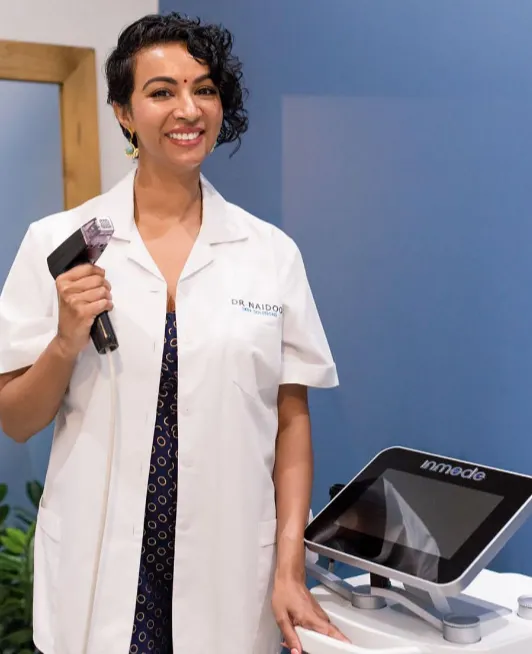
Dr Parushinee Naidoo
Image: Supplied
Dr Parushinee Naidoo, an aesthetic medical doctor at Skin Solutions, said they received regular enquiries regarding skin-lightening treatments.
“The demand for these treatments are still high, especially considering the potential detrimental effects, and the fact that it is illegal in South Africa to sell skin-lightening and skin-bleaching products.”
Naidoo said managing hyperpigmentation and using skin-lightening treatments were different.
“Hyperpigmentation is a medical skin condition that can be treated safely and effectively. Skin-lightening products, however, change patients' natural complexion, and can cause severe and irreversible damage to the skin.
“It can cause rebound hyperpigmentation, severe acne, increased sun sensitivity and dermatitis. Some skin-lightening products even contain mercury which the body can absorb systematically, causing neurological problems and kidney damage."
She believed that skin lightening should not be considered.
“I recommend seeing a skincare medical professional to manage pigmentation, and address concerns in a healthy, holistic manner.”

Dr Sheena Geness
Image: Supplied
Dr Sheena Geness, an aesthetic medical doctor, said requests for skin-lightening had declined in recent months at her practice due to a shift to embracing natural beauty trends.
"As a member of the American Academy of Aesthetic Medicine South Africa, we are moving away from the notion of skin-lightening and towards skin restoration, aiming to correct uneven skin tone and pigmentation problems, and improve skin health and clarity. In my practice, we don’t chase unrealistic skin tones or alter an individual’s natural identity.”
Her advice was for people to seek medical advice before using products on their skin.
“Topical agents work by mainly inhibiting an enzyme called tyrosinase that is involved in melanin production. There are also certain ingredients like hydroquinone, which is banned in some parts of the world, due to the risk of ochronosis (a rare disorder that causes blue-black pigmentation of the skin).
“It is not advisable for patients to self-medicate due to the increased risk of rebound pigmentation, inflammatory conditions or dermatitis. Patients should start using mineralised tinted sunscreen with an SPF of 30 to 50 daily, and wear sun-protective clothing. If a person has pigmentation, they must see a qualified dermatologist or aesthetician. Self-medicating is risky, and can cause serious damage,” she said.
Beauty shop owners, however, report a different perspective.
A hair and beauty salon owner, who declined to be named, said customers who used skin-lightening products, often returned for further purchases.
She said they stocked a range of skincare products including those advertised for skin lightening.
“We have customers who prefer these products over the 'name branded' ones. They say they achieve the desired results for an even complexion. Customers say the well-known brands don’t give them the results. It is also more cost effective as the products start from as little as R20 for a soap. None of my customers say their skin was damaged.”
A barber shop owner, who also declined to be named, said skin-lightening products were popular among women and men.
“More men come in for facials and purchase a range of products, from skin-lightening soaps to masks and creams. It gives them confidence. Teenage girls and boys also use the products if they have dark marks due to pimple breakouts.”