

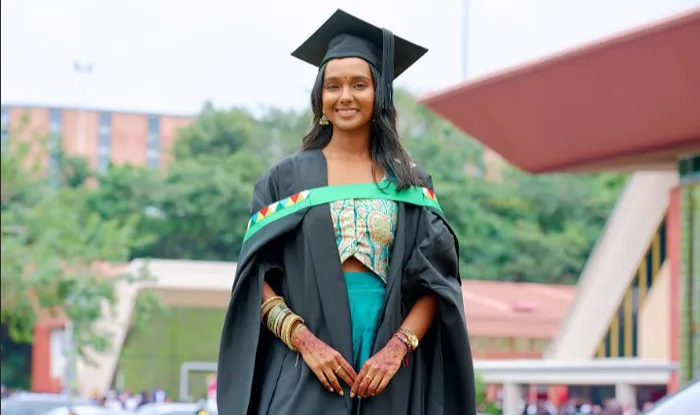
Mayuri Chinniah
Image: Sethu Dlamini
Mayuri Chinniah has graduated cum laude with a Master of Science in Microbiology from UKN.
Her research explored how natural compounds found in South African seaweeds could help fight two major health challenges: diabetes and cancer.
Her thesis, titled: “Antioxidant, Antidiabetic and Anticancer Potential of Extracts from Two Indigenous Seaweeds (Ecklonia maxima and Gracilaria gracillis)”, was supervised by Professor Ademola Olaniran and Dr Nontokozo Msomi.
“Beyond the academics, I was motivated by the university’s commitment to addressing real-world challenges in South Africa and beyond,” said Chinniah.
She said the current treatments for diabetes and cancer could be expensive and often came with side effects, creating a need for safer, more sustainable alternatives.
“By studying extracts from two types of seaweed, one brown and one red, I found that they can improve how the body uses sugar, reduce harmful stress caused by unstable molecules (oxidative stress), and even slow down the growth of certain cancer cells,” she said.
“These seaweeds showed potential to help the body manage blood sugar more effectively and to protect cells from damage, while also displaying selective activity against cancer cells.”
She emphasised that the relevance of her work lay in its potential to contribute to developing affordable, natural therapies that could support healthier communities, particularly in regions where access to conventional medicine was limited.
Her research also highlighted how local marine resources could play a role in tackling global health problems.
“From young age, I was fascinated by how scientific discovery could explain the world around us and, more importantly, improve lives,” she reflected.
This curiosity evolved into a commitment to research that had the potential to make a tangible difference.
Her particular interest in cancer research stemmed from both its scientific complexity and its profound human impact. At the same time, she recognised the importance of addressing broader health challenges such as diabetes, combining these interests to explore natural, accessible solutions.
“The significance of my research lies in its potential to offer safer, more affordable and sustainable alternatives for managing chronic diseases such as diabetes and cancer,” she said.
She also noted that her work demonstrated the value of exploring indigenous marine biodiversity as a source of innovation and expressed hope that such discoveries could bridge the gap between cutting-edge science and real-world impact.
Chinniah plans to build on the foundation of her MSc through further research and academic opportunities.
“My hope is to contribute to clinical studies that can translate laboratory findings into real-world applications,” she said.
She also aspires to grow as a scientist and mentor, particularly encouraging young women to pursue careers in science.
Chinniah thanked her family for their support, recalling encouragement that began in her childhood. She also acknowledged her supervisors, mentors, friends and peers for their guidance and motivation throughout her studies.
“As I reflect on this journey, I am very grateful for the opportunities, challenges and growth that have shaped me along the way,” she said.
“Most importantly, I want to emphasise that science is not just about discovery but about service.”