

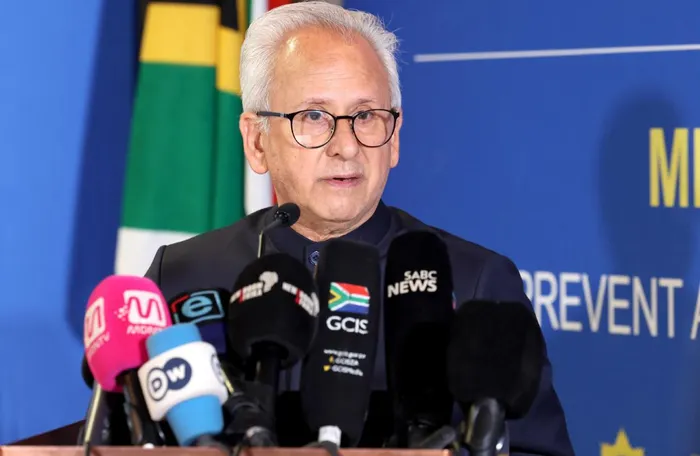
Firoz Cachalia.
Image: File
Acting Police Minister Firoz Cachalia’s objectivity was questioned after he pleaded with the ANC and the parties in the Government of National Unity (GNU) to protect President Cyril Ramaphosa against his possible removal from office.
Cachalia, who made these remarks during an interview with eNCA, stated that impeaching Ramaphosa would destabilise the country, adding that the ANC and its partners in the GNU must protect him.
While the ANC announced its support for Ramaphosa, the DA stated its commitment to the GNU saying it will not trade accountability for political power.
Ramaphosa faces a newly-established parliamentary impeachment committee investigating his conduct in the Phala Phala farm scandal.
This major development follows the Constitutional Court (ConCourt) ruling, which declared Parliament’s previous 2022 block of the inquiry unlawful.
The court ruled that Parliament acted unconstitutionally by dismissing a Section 89 Independent Panel report, which found "prima facie" evidence of serious misconduct regarding $580,000 in cash hidden in a sofa on Ramaphosa's farm.
Governance expert and political analyst Sandile Swana said there was political bias coming from Cachalia’s remarks, as he had been close to Ramaphosa during their anti-apartheid activism within the United Democratic Front (UDF) in the 1980s.
Swana added that Cachalia’s statement could also imply that Ramaphosa should never be investigated and punished, regardless of what he had done.
Swana added that although there was chaos when former President Jacob Zuma was arrested in 2021, this could not be used as an excuse for not punishing Ramaphosa.
He called on Cachalia to identify the instigators of any possible form of instability and report this to the intelligence services and arrest them.
“It is Cachalia’s job to make sure that there is no chaos if Ramaphosa is removed. He should protect the internal stability of the country,” Swana said.
Cachalia's spokesperson, Kamo Mogotsi, said the minister could not respond to queries on his remarks as he was preparing to table his 2026/27 Budget on Tuesday (tomorrow).
Mogotsi added that the Minister was willing to discuss the rationale behind his comments.
National Assembly Speaker Thoko Didiza last week established a 31-member Section 89 Impeachment Committee to investigate and determine whether there was sufficient evidence to impeach Ramaphosa.
Political parties have until May 22 to submit their finalised member nominations.
The 31 seats are allocated among 16 political parties as follows: ANC (9 seats), DA (5), MK Party (3), EFF (2), and one seat each for the IFP, PA, FF Plus, ActionSA, ACDP, UDM, RISE Mzansi, BOSA, ATM, Al Jama-ah, NCC, and UAT.
Political analyst Kim Heller said constitutional accountability cannot ever be "destabilising", adding that political accountability must always trump the shielding of political elites.
Heller added that Cachalia’s utterances add to the perception that state institutions are protecting Ramaphosa, instead of defending the Constitution.
“These remarks disrespect the democratic processes and add to political disillusionment among South Africans,” she said.
Professor Sipho Seepe said that this set a dangerous precedent that Ramaphosa was above the law, adding that the country had seen law enforcement failing to do their job to hold him accountable.
“The NPA has been unwilling to charge in the face of prima facie evidence pointing to the fact that he has a case to answer,” he said.
Meanwhile, the Organisation Undoing Tax Abuse (OUTA) said, regardless of lingering societal concerns, constitutional and parliamentary processes must be allowed to run their course.
The organisation said the public must respect these constitutional frameworks and manage the subsequent outcomes as they unfold.
“We imagine it is this economic instability of political changes that the Acting Minister Cachalia is referring to, but we can’t be certain. What we are certain of is that no matter what the fears or concerns in this regard, the legal and parliamentary processes must proceed, and we - as a nation - cannot usurp those processes, and thus must deal with the outcomes as they happen,” said OUTA CEO Wayne Duvenhage.