

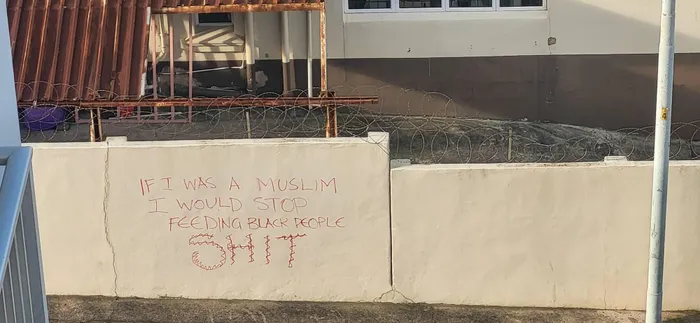
One graffiti message painted on a wall on Gordon Road in Morningside.
Image: Supplied
Communities in Morningside and North Beach are reeling after a series of hateful graffiti messages on public walls targeting the Muslim community were discovered, prompting widespread condemnation from religious leaders and civil society.
The vandalism was reported along Sol Harris Road, Gordon Road, Carpendale Park, and near the Masjid mosque on John McIntyre Road.
The messages carried inflammatory and divisive rhetoric directed at Muslims living in South Africa.
One graffiti message painted on a wall on Gordon Road in Morningside read: “If I was Muslim, I would stop feeding South Africans S**.”
Another slogan at Carpendale Park in North Beach stated: “What do Muslims want from South Africans?”
A third message near the Masjid mosque on John McIntyre Road read: “If Muslims can’t employ South African’s, they must go.”
Another slogan in North Beach read: “Muslims are messing SA.”
The incidents have sparked outrage among religious leaders and community organisations, who have condemned the messages as acts of hate speech designed to sow division in Durban’s multicultural society.
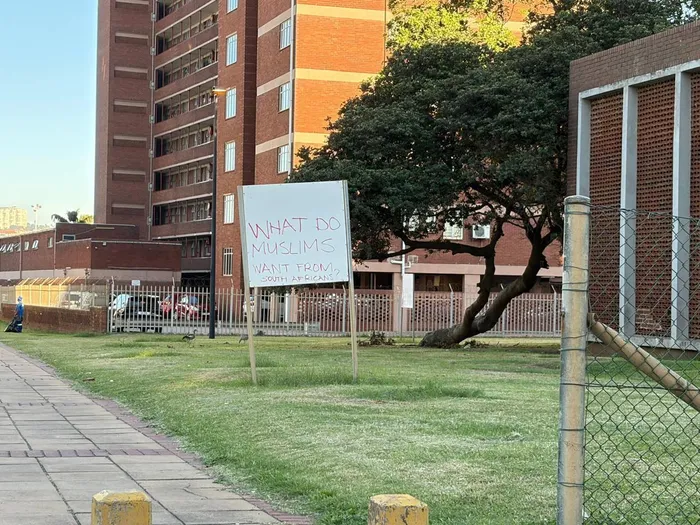
Another slogan at Carpendale Park in North Beach.
Image: Supplied
Professor Brij Maharaj, Deputy President of the South African Hindu Maha Sabha, strongly condemned the graffiti and warned against attempts to fracture social cohesion.
“The South African Hindu Maha Sabha notes with deep concern the recent incidents of graffiti in parts of Durban that target and demean the Muslim community.
“Such acts are not only disrespectful but run counter to the values of dignity, mutual respect, and unity entrenched in the South African Constitution, and which underpin our diverse society. We unequivocally condemn any form of expression that seeks to divide communities, spread intolerance, hate speech or undermine religious harmony.”
He emphasised Durban’s long-standing multicultural identity, saying the city has historically been a place where people of different faiths and cultures live, work, and celebrate together.
“It is this shared heritage that must be protected and strengthened. Acts of vandalism that single out any religious group are an affront to all of us. They erode social cohesion and create unnecessary tension where there should instead be understanding, solidarity and nation-building,” he said.
Maharaj called on religious leaders, civil society organisations and community members to work together to strengthen interfaith dialogue and tolerance.
“We therefore call on all religious, community and civil society leaders to promote a renewed commitment to interfaith dialogue, cooperation, and mutual respect.
“The authorities should act swiftly to address these incidents and ensure that those responsible are held accountable.”
He added that the incidents highlighted the ongoing need to build an inclusive society where diversity is respected and protected.
“These incidents serve as a reminder of the work that remains to build a truly inclusive society where every individual is valued, and every faith is respected. The Maha Sabha reaffirms its dedication to promoting peace, unity, tolerance and shared humanity across all communities,” said Maharaj.
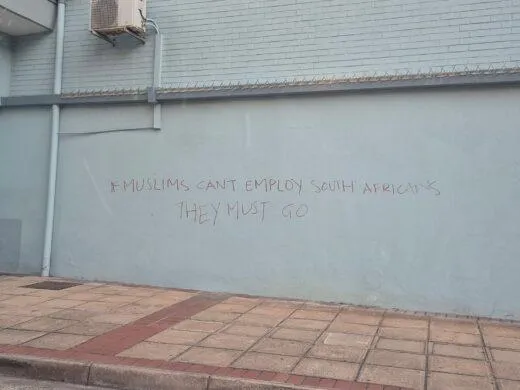
A third message near the Masjid mosque on John McIntyre Road.
Image: Supplied
Dr Yusuf Patel, secretary general of the United Ulama Council of South Africa, described the incidents as the work of individuals seeking to create mistrust and division.
“These acts appear to be the work of Islamophobes intent on sowing division and mistrust within society,” Patel said.
He rejected the anti-Muslim narratives reflected in the graffiti and highlighted the contributions Muslim communities continue to make across South Africa.
“Yet the facts speak for themselves. The Muslim community in Durban and across South Africa has consistently contributed towards the upliftment of the poor, support for vulnerable communities, disaster relief, education, healthcare, and social development, serving people irrespective of race or religion.”
Patel said the graffiti ignored the reality of Muslim involvement in humanitarian and nation-building initiatives.
“These hateful and hollow attempts to demonise Muslims stand in stark contrast to the reality on the ground, where Muslim organisations and ordinary Muslims continue to play a constructive role in nation-building and community welfare.”
He stressed that the Muslim community would not allow itself to be manipulated into conflict or division.
“We will certainly not be drawn into the agenda of division, by giving credence to agent provocateurs,” said Patel.
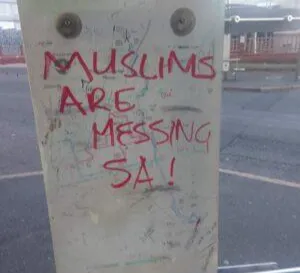
Another slogan in North Beach.
Image: Supplied
Pastor Vanessa Samuel-Chetty also condemned the incidents, describing the graffiti as dangerous and socially destructive.
“I categorically object and oppose any sort of racial slur, any sort of hate speech against any religion in any shape or form, whether it is written, whether it is spoken, whether it is put on any social platform,” Chetty said.
Drawing from her decades of grassroots community work, Chetty said communities in South Africa had fought hard to build unity despite many ongoing social challenges.
“As a community worker, I have worked in the community now for 38 years, and I know what a struggle it is for communities to just come together on social ills, on the matters of social injustices. To now stir racial war, religious war against religions, it's just a wasted effort. We have other social ills that we need to focus on.”
Chetty pointed to issues such as teenage suicide, gender-based violence and child abuse as the real crises facing communities.
“We have other social ills that actually create challenges in the community. The social fabric of our community is woven by the community members and we need to understand that until we accept that we can be religiously tolerant, then we have a recipe for peace in our community.”
Chetty also referenced constitutional protections surrounding freedom of speech and hate speech.
“We have the freedom of speech and it is embedded in our constitution. The pillars in the constitution protect us for freedom of expression, freedom of speech, but it also protects us against hate speech, which puts the guardrails in place.”
She warned that hate-filled rhetoric could incite violence and deepen divisions.
“So I strongly oppose this kind of display. It invokes violence. It incites religious factions. And I will categorically oppose it,” she said.
At the same time, Chetty argued that frustrations within communities should be addressed constructively through dialogue rather than public intimidation and hate speech.
“If people are angry, we should be given platforms to speak on, actually vent these kinds of angles because people who are angry often lead to violence, it leads to other social ills.
“So if somebody has a problem with any, whether it be a racial issue, whether it be a religious issue, we should address these issues and not incite fear, not incite violence in this way, because it just doesn't do any good to the community,” she said.