

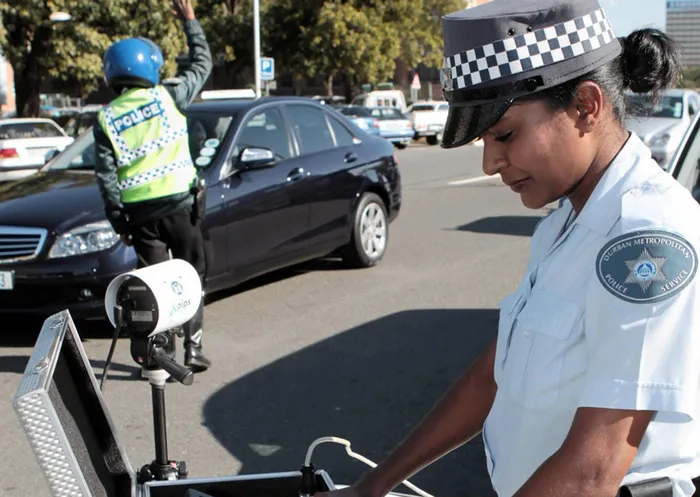
A seven-year court battle between the eThekwini Municipality and a service provider resulted in the absence of functional back-office services, compromising the municipality's ability to process traffic infringements and recover fines.
Image: Terry Haywood
A seven-year court battle between the eThekwini Municipality and a service provider resulted in the absence of functional back-office services, compromising the municipality's ability to process traffic infringements and recover fines.
The municipality’s Security and Emergency Services Committee outlined the challenges the Durban Metro Police Directorate faced with a service provider since a contract was awarded in June 2016. This contract covered supplying, installing, maintaining, and supporting electronic enforcement technology, as well as providing operational and back-office support for processing and finalising violations.
The committee chairperson, Councillor Zandile Myeni, reported to the eThekwini Executive Committee (Exco) on Tuesday that discussions are underway to propose an amendment to the contract to incorporate the required back-office functionality and related support services.
The committee reported that after the tender was awarded, the municipality and the contractors were embroiled in a legal dispute regarding the fee structure of the service level agreement. The protracted litigation was resolved through a court order, which instructed that the contract be reinstated.
Accordingly, the contract was reinstated on July 8, 2025, with the end date of October 30, 2025.
The committee stated that during the litigation process, the municipality's back-office system, Oracle had declined to a state of being non-operational due to failure to cope with expected volumes as well as the fact that there was no support for the current system.
“This has resulted in the municipality failing to fulfil its roles and responsibilities of the contract to comply with the court order. Two audit findings against Metro Police Directorate may only be resolved by the replacement of the obsolete Oracle fines system,” Myeni said.
The roles and responsibilities of the initial contract at the start of the litigation were as follows:
Service provider:
Durban Metro Police Services:
The committee stated that the contractor is positioned to provide a turnkey solution through its Helios system, which is Administrative Adjudication of Road Traffic Offences (AARTO) compliant, scalable, and capable of being operational within five days of approval.
Based on previous collection data, the municipality collected approximately R11.1 million per month whereas the cost to Municipality is R4.1 million per month. The net income will be approximately R7 million per month.
This figure is based on 20% collection per month.
Myeni estimated the timeline for the system to become fully operational is approximately six months following budget approval.
"The proposed amendment will enable the municipality to achieve legal compliance, restore operational capability, and improve revenue recovery processes," she said in her report.
She said the municipality will avoid capital expenditure and ongoing maintenance costs. The service provider will provide the required infrastructure and assume responsibility for system functionality.
"The implementation of an integrated solution will enable the municipality to fully utilise modern enforcement technologies, which have statistically outperformed traditional enforcement methodologies," she said.