


South African author and journalist, Redi Tlhabi.
Image: File
Pharmacy giant Dis-Chem is facing increasing public backlash and calls for a consumer boycott following a heated social media exchange involving a major shareholder and prominent author and journalist Redi Tlhabi.
The controversy erupted on X during a heated dispute over the conflict in Gaza and related philanthropy, which quickly degenerated into personal attacks.
Mark Saltzman, a major Dis-Chem shareholder and the son of the company’s founders, Ivan and Lynette Saltzman, publicly targeted Tlhabi during the exchange, invoking financial support linked to his family and the Dis-Chem Foundation to discredit her.
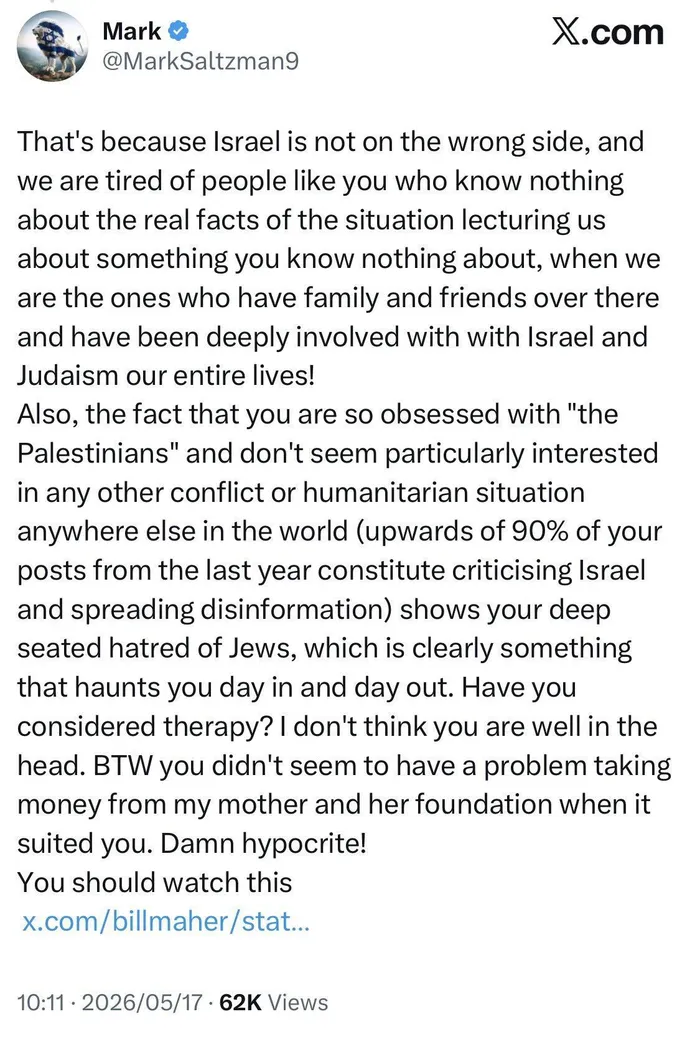
A screenshot of the tweet from the now-deleted X account.
Image: X
The incident sparked immediate outrage from the South African public and political activist groups, including the SA BDS Coalition.
Critics condemned what they termed a "transactional instinct", arguing that corporate and philanthropic wealth was being weaponised to silence public figures and discipline political speech regarding Gaza, a deeply sensitive moral and historical issue in the country.
As the online backlash intensified, Dis-Chem scrambled to contain the reputational damage by issuing an initial statement distancing its corporate operations from Saltzman.
The company emphasised that he was strictly a shareholder, held no board seat, was not an employee and had no authority to speak for the brand.
"These views are not endorsed by Dis-Chem and do not reflect the position of the board or management. We are a proudly South African, apolitical and non-partisan company with the primary focus of improving access to affordable healthcare and delivering better health outcomes for all South Africans," shared Dis-Chem.
They added: "We are, and will remain committed to respectful engagement, sound governance and constructive relationships with all our stakeholders, especially our customers and partners."
However, the response failed to quiet the burgeoning boycott. Critics and consumers slammed the pharmacy group's handling of the event, labeling the initial reaction as a defence mechanism that lacked strong corporate moral conviction against Saltzman's aggressive social media behaviour.
In response to the growing crisis, Dis-Chem issued a second, more explicit statement addressing the derogatory language and the financial claims made against Tlhabi.
"We do not condone misogynistic or derogatory language directed at any person. The language used in the exchange by Mark Saltzman does not reflect the values of Dis-Chem, our board or management team.
"While Mark Saltzman is a Dis-Chem shareholder, it is important to note that he is not a board member nor an employee of Dis-Chem and has no authority to represent us in any way. We reiterate that we unequivocally reject and distance ourselves from the comments and sentiments.
"It’s also important to state that the Dis-Chem Foundation has always conducted its work with the utmost integrity and with strong financial and operational guardrails in place. We have no record of any payment being made to Ms Tlhabi in her personal capacity by either the company or the Dis-Chem Foundation. Any inference otherwise is false.
"While individual shareholders may express personal views independently of the company, Dis-Chem remains committed to respectful engagement, accountability and constructive public discourse. Our focus continues to be on improving access to affordable healthcare and serving all South Africans with integrity and care," the second statement read.
Despite the tougher stance, Tlhabi rejected the company’s framing of the situation, criticising Dis-Chem for failing to name Saltzman directly in its condemnation and for treating the two parties as equals in the dispute.
Responding directly to the corporate management, Tlhabi said: "Firstly, thank you for leaning forward and acknowledging the moment. I appreciate that you support non-aligned community initiatives.
"That's what I always thought until a significant shareholder and son of the founder implied otherwise. However, you are not condemning Mark's attacks on me, including using a misogynistic term (b****h), repeatedly, prior to this moment.
"Dischem cannot place the two of us on the same footing or treat our statements as equivalents. He initiated the attack with his misogyny and a blatant lie that maligned me personally and professionally. I also note your safe avoidance of mentioning him by name and referencing the significant words that were an activator of my response: I.e that I received money from his mommy and you as an institution.
"Until you make it clear that this is false, and that a significant shareholder calling me a b****h is unacceptable, then your words below are.....okay, I guess, but lacks moral conviction and steadfastness."
Social media users had their say, too.
@yusk71 commented: "This is a typical response to protect their business. Mark, as a shareholder, continues to benefit from the profits; that is why Dischem needs to be boycotted."
@tshepom619 wrote, "I wish @Dischem had approached this with the same energy they showed when a certain group threatened to boycott the brand over its revised hiring policies. Get Mark to issue a public apology."