

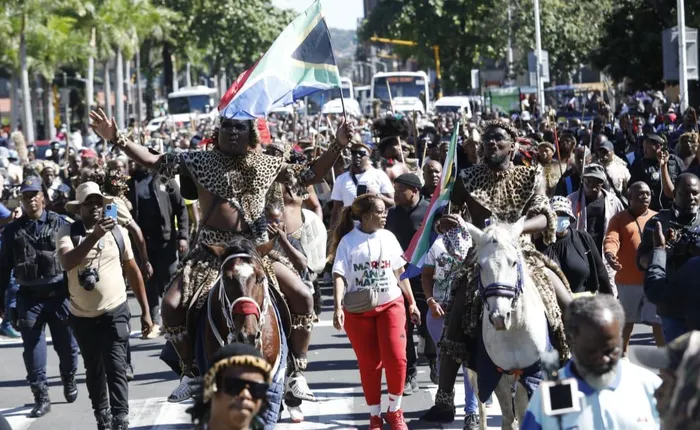
Hundreds of men adorned in traditional Zulu attire, affiliated to the March and March movement, recently marched through the streets of Durban, calling for the removal of illegal foreign nationals in the country.
Image: Doctor Ngcobo / Independent Newspapers
Anti-illegal immigration group March and March announces a national shutdown on June 30, urging illegal foreigners to leave South Africa, amid rising protests and government calls for calm.
This follows an urgent meeting at the Union Buildings in Pretoria on Monday, between ministers in the Justice, Crime Prevention and Security Cluster to address rising protests over illegal immigration.
The meeting focused on growing demonstrations against immigration and undocumented foreign nationals across the country.
Security cluster ministers and senior officials responsible for national security attended the discussions in Tshwane.
Ministers also met political parties, groups and associations involved in mass protests and community marches against undocumented foreign nationals.
Speaking on the sidelines of the meeting, March and March member Sanele Dube said the group was concerned by remarks made by Defence Minister Angie Motshekga about the planned shutdown.
“We are concerned by the Minister of Defence’s remarks that the 30 June date we have given for illegal foreign nationals to vacate the country is being treated as just another shutdown,” Dube said.
“For us, it seems the government does not take South Africans seriously.”
“South Africans are saying they have had enough of illegal foreign nationals and want them removed from the country.”
Dube said the movement rejected claims that its campaign was xenophobic or ethnically driven.
“We want to make it very clear that our call is not xenophobic. It is a call centred on the national security of the country, and we want to protect South Africa and South Africans,” he said.
He added that support for the movement extended beyond KwaZulu-Natal.
“Jacinta (Ngobese-Zuma - the leader of the movement) was in Cape Town recently, where residents are also raising concerns about illegal foreign nationals. In Rustenburg, there will be a March and March gathering, and plans are underway in Limpopo. This is not a Zulu issue. It is a South African issue.”
Speaking at a media briefing on the same matter, Motshekga said citizens had a constitutional right to protest.
“The 30th of June is within their rights. There is nothing to panic about,” she said.
She said the right to protest also came with responsibilities and warned against unlawful conduct during demonstrations.
“We have seen incidents during some marches that cannot be overlooked,” Motshekga said.
“While South Africans have the right to protest and their anger and frustration are understood, the government is also hard at work.”
She said the Department of Home Affairs continued to conduct inspections and operations aimed at addressing undocumented migration.
“It is not as though there is already a crisis because of the threat of 30 June,” she said.
“On 1 July, the sun will still rise in the east and set in the west.”
Motshekga said South Africans had a shared responsibility to build the country and urged protesters to respect the dignity of others.
“I was terrified when I saw a South African pepper-spraying a foreign immigrant,” she said.
“At the end of the day, they are human beings. We have a duty to protect everybody’s dignity.”
She added that migration was an international phenomenon that South Africa had to manage responsibly.
“It has created serious challenges for us as a country and for the state, but it is also a global trend that we must manage both as a continent and as a country,” she said.
Minister of Justice and Constitutional Development Mmamoloko Kubayi rejected claims that the government had been passive on immigration.
“We have not been lukewarm,” Kubayi said.
“Joint operations have been taking place week in and week out, and we have statistics to show for it.”
Kubayi reiterated that groups had the right to protest but urged organisers to ensure demonstrations remained peaceful and properly coordinated with authorities.
“We have appealed to them to notify us about marches - how many people they expect and where they are going - so law enforcement can prepare adequately,” she said.
“When they do not notify us, it becomes difficult to plan.”
Anti-migrant sentiment has gained political traction in recent years, with some groups claiming foreign nationals are taking jobs and placing pressure on public services.
Previous protests linked to immigration have at times turned violent.
Groups including March and March, Operation Dudula, ActionSA, the Inkatha Freedom Party and the MK Party support calls for tougher immigration controls.
These groups accuse the government of failing to act decisively against undocumented migration and have called for stricter visa regulations, a review of asylum policies, action against businesses employing undocumented migrants, accountability for corrupt police officers and restrictions on public services for undocumented migrants.