


Are canned pilchards still a budget lifesaver, or have they become expensive for many South Africans?
Image: File
Canned pilchards have long been a staple item on grocery lists across South Africa, lauded not only for their affordability but also for their versatility.
A typical 400g can is reputed to serve a family of four - an accessible option for families looking to stretch their rands, especially amidst the increasingly high cost of living.
During a recent grocery trip, I couldn't miss a fellow shopper's shock at the R30 price tag of a can of Lucky Star tin pilchards; really, how did we get here?
In January, Lucky Star shared a post of a low-cost meal using their can of pilchards and priced it at R25.99; four months down the line, the same can is found at a higher price. But one can be lucky to find it on special for R25.99.
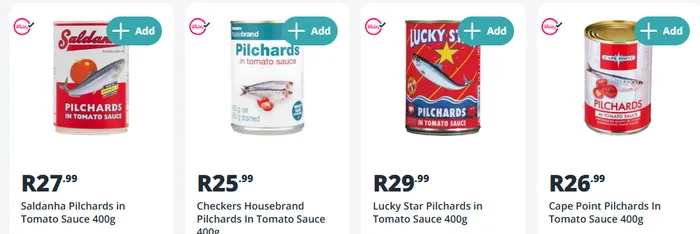
Pilchard prices at Checkers.
Image: Screenshot
Many households turn to canned items to stretch out their groceries, but if one can is R3 and possibly R180 for 6, it brings the affordability into question for a house that is struggling to buy basic food items, especially with the cost of living being high.
Pilchards can go with pap, pasta, and rice, making it a versatile option for many households. However, if a household is struggling to buy such fresh meat, and the alternative good source of protein is becoming expensive, this leaves them in a pickle.

A can of Lucky Star Pilchards on special at Walmart stores.
Image: Oluthando Keteyi
A standard 100g serving of canned pilchards provides about 24g to 26g of high-quality, complete protein
In South Africa, the average monthly cost of a household food basket (comprising 44 essential grocery items for a typical family) is roughly R5,452.
In January 2026, "Tinned fish" was identified as an individual food item within the NAMC food basket, experiencing an inflation rate between 1% and 2.99% when compared to January 2025.
More specifically, "Fish (excl. tuna) 400g" showed a year-on-year price increase of 2.52% and a month-on-month increase of 0.04% in January 2026. However, the report does not provide specific details regarding "tin pilchards" as a distinct item.