

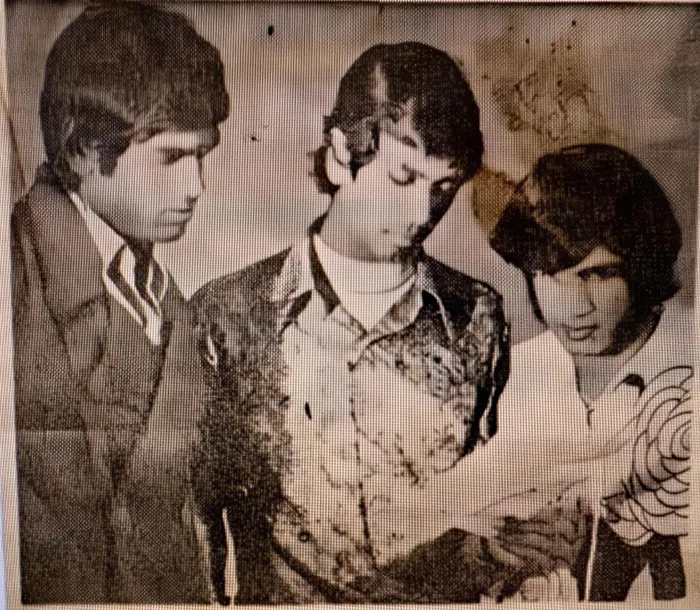
Three of the students expelled from the Springfield College of Education. They were Morgan Reddy, left, Anand Jugath, and Roy Sukuram.
Image: Supplied
THE Phoenix Working Committee (PWC) played a pivotal role in the history of Phoenix. Its origins lay in the support extended to residents of Tin Town, many of whom were forcibly relocated to the apartheid township. Overnight, these residents found themselves in a barren, underdeveloped environment, far from their workplaces, and separated from the neighbours and community networks they had built over decades.
As one activist recalled that the committee was formed to help Tin Town residents “negotiate a better deal and a good transition from the old to the new”.
Conditions were challenging for the first residents of Phoenix.
Dhaya Rambaran, former chairperson of the PWC, recounted in a 2003 brochure commemorating the 25th anniversary of the founding of the organisation: "When my family and I arrived in the Westham area of Phoenix, there were very few families in the area, gravel roads, and no street lighting. In short, the entire place we were to call our home was underdeveloped. At night, we often had to grope our way home. Going to work in the morning, especially if it rained, meant that we went to work with double soles. Transport was worse: buses had to drop passengers off in Redfern, and residents from Westham had to make the long trek every morning and evening to and from Redfern. Life was difficult."
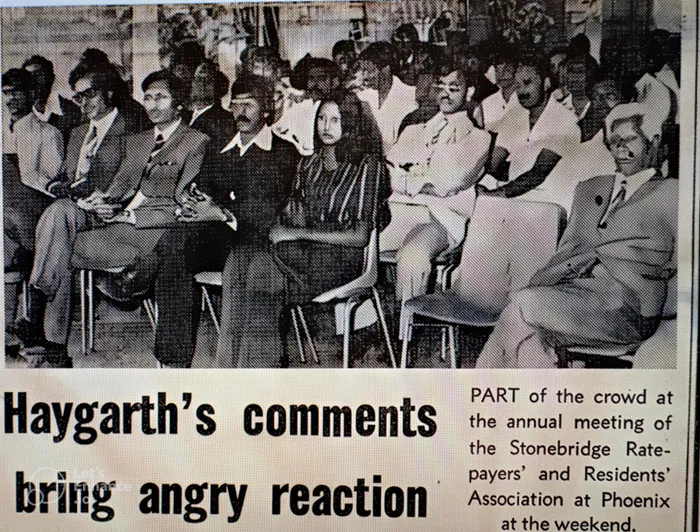
Protest meeting in Stonebridge against high rentals.
Image: Supplied
A 1982 survey found that about half of the township's residents were living below the poverty line. One newspaper reported in the early 1980s that “at least 10 people from each area are put on the eviction list every week. If there is a slight increase in wages (by 5%), the rent goes up by 20%.”
Residents were also subjected to water and electricity disconnections because of their inability to pay.
Most of the units into which Phoenix was divided, formed residents’ associations.
In January 1978, association representatives formed the PWC with Roy Sukuram as chairperson.
PWC official Sharm Maharaj recounted the role of NIC members from around 1978: “I heard the first time about some people who were having meetings about facilities in Phoenix. I said I rather go and see what is it they were offering, and when we went there, I was just so interested about the kind of language that was spoken, the kind of demands which were being made. I saw a thousand people saying, ‘yes, I also want that’. It was George Sewpersadh, it was Pravin Gordhan, it was Yousuf Vawda, those sorts of people. They were on the stage and said a whole lot of slogans, but the kind of things they told us were not meant to incite us, they were connecting with us.”
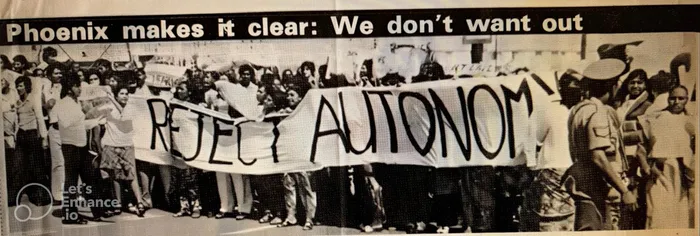
The community of Phoenix mobilised against Autonomy.
Image: Supplied
Others involved in the PWC, however, argued that the role of Phoenix residents in the formation of the committee had often been understated. One such figure was Sukuram, who was born in Cato Manor. His father worked at the Indian Market on Warwick Avenue, where Sukuram assisted on weekends. He attended Sastri College, and later the Springfield College of Education.
During his student years, he became active in the student representative council (SRC) and was drawn to Steve Biko’s Black Consciousness Movement. Sukuram was expelled in June 1972 because of his political activism. Despite appeals from the community, the Department of Indian Education refused to reinstate him. Adding to the family’s hardship, the bursary he had received had to be repaid by his struggling family. As one of the earliest residents of Phoenix, Sukuram described the PWC as an organic movement that emerged from within the Phoenix community itself.
While opinions differ on the relative influence of organic township leadership versus external members of the NIC, it is undeniable that the PWC played a central role in mobilising Phoenix residents around issues that directly affected their everyday lives.
Aside from day-to-day struggles over rent and service delivery, the key issue facing the township was the Durban City Council’s plan to grant Phoenix autonomy in 1977/78. Chatsworth was offered autonomy in 1976, but it was rejected.
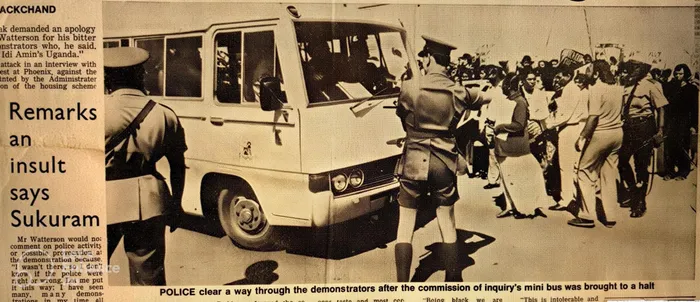
Protest against a Commission of Enquiry into Autonomy.
Image: Supplied
As Sukuram recounted, legislation had been “promulgated for the excision of Phoenix from the City of Durban. They wanted Phoenix to become a town in its own right. We played a major role in galvanising the community against that. The NIC, NGOs, church groups, and other communities really bloomed into an incredible mass movement. The City Council was trying to shirk its responsibilities. Financially, autonomy was not viable because of the low-earning capacity of the people. Phoenix also lacked industries to generate revenue for a local authority. Furthermore, we did not have the requisite experience of running a town. Autonomy was just an extension of the apartheid policy where the various race groups were forcibly separated to ‘develop’ on their own. That was a major, major, major victory.”
Ela Gandhi asserted that the quick involvement of activists was crucial, as autonomy would have had negative consequences for the residents of Phoenix: “The activists quickly prepared a newsletter telling people the drawbacks of accepting autonomy. The people then mounted a campaign against autonomy. This protest happened because the community was educated about what would happen if they accepted autonomy. If you have autonomy in Phoenix, you have to buy bulk electricity from Durban. When you do this, the price of electricity is going to be higher than in Durban. In addition, this was another racially-based government body, and it would alienate the various race groups if such options were accepted.”
At the height of apartheid’s injustices, when families across Durban were forcibly removed from their homes and relocated to Phoenix, it was individuals working through the PWC, such as Maharaj, Sukuram, and unsung women like Mrs Maharaj with a placard in hand, who helped transform the township into a community that people could call home.
* Adapted from Ashwin Desai and Goolam Vahed’s book Colour, Class and Community-Natal Indian Congress, 1971-1994 (Wits University Press, 2021).