

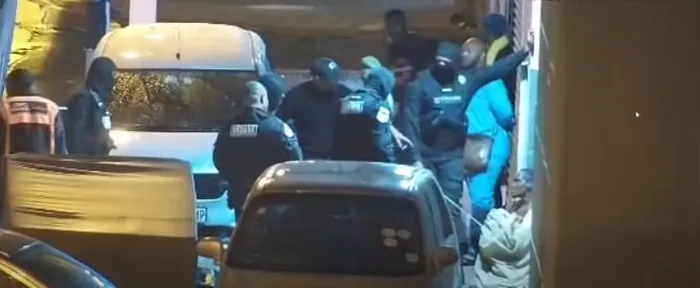
CCTV footage showing Ensure Security personnel brutally assaulting a homeless man outside the Embassy Building in the Durban CBD on December 18.
Image: Screenshot
AN INVESTIGATION by Carte Blanche has uncovered disturbing allegations of violence against homeless individuals in Durban, prompting advocacy groups to call for immediate action and accountability from authorities.
They said the exposé, which aired on May 24, had drawn long-overdue attention to what they described as ‘systemic abuse’ and official inaction.
Speaking on behalf of the homeless community in the city, Dr Raymond Perrier, director of the Denis Hurley Centre (DHC), said they were “grateful to the team at Carte Blanche for drawing attention to this issue in a thorough and sensitive way.”
The investigation was prompted after a four-minute video allegedly showing security personnel from Ensure Security assaulting a homeless man in Durban.
According to Perrier, the footage first came to the DHC’s attention in January 2026 and left staff deeply disturbed.
“When we got the video in January, I was shocked but not surprised. It is a four-minute video of Ensure Security personnel relentlessly hitting this innocent man. There were so many personnel watching this violence play out yet nobody stepped in to help.”
Perrier alleged that at least six security personnel were involved in the incident, either directly or indirectly.
“There were more than two people involved, actually six people because the others were just watching,” he said.
He described one particularly disturbing moment in the footage.
“At one point you could see a security personnel with a bottle of water. You think he is giving it to the homeless man but instead he throws it on the pavement. I presume to wash the blood off.”
Perrier claimed that the DHC’s attempts to report the incident to authorities were initially met with resistance.
“We had received no responses from the SAPS and the municipality when we originally filed the complaint. We actually only opened a case in March, six weeks after the video was made public by us.”
Perrier alleged that police initially refused to open a case, insisting that only the victim himself could do so.
“The police gave us a hard time. They said we cannot open a case, only the victim can, which is untrue. I feel they were just avoiding dealing with this issue.”
Perrier said the matter only progressed after he wrote directly to the SAPS Commissioner.
“Eventually I wrote to the District Commissioner of SAPS which then allowed us to open the case.”
Even after the case was opened, he claimed progress remained slow.
“They only started working with the case in April. The person in charge of the case said he was on leave for two months.”
Police spokesperson, Colonel Robert Netshiunda said: "The matter is under investigation and no arrest have been made. It should be noted that the case was opened by a third party on behalf of the alleged victim, whom police have been looking to get a statement, from to no avail."
Perrier said one of the most troubling aspects of the case is that the homeless man seen in the video has still not been located.
“We cannot find the homeless man from the video and we still continue searching for him.”
Perrier said the DHC was informed that the man was allegedly taken by the security personnel to a police station following the assault.
He said however, that there appeared to be no official record confirming this.
“We were last told that Ensure put him in their vehicle and took him to the police station but there is no record of any homeless man being brought in.”
Perrier said the man may have gone into hiding out of fear, but warned that more serious possibilities cannot be ruled out.
“He could be hiding because of fear, which is justifiable, or he could be dead. We do not know.”
He said the assault captured on video was not an isolated incident but part of a wider pattern of ‘systematic abuse’ directed at homeless people in Durban.
“Before this incident, we were getting reports from November 2025 of violence against the homeless.
Perrier said the organisation conducted surveys among homeless residents and the findings revealed widespread distrust of law enforcement and private security companies.
“The homeless do not trust law enforcement to protect them or have their best interests in mind. We did a survey with the homeless, which revealed that they experience more violence from SAPS and security companies than they do from fellow homeless people. Up until now, we still receive reports of violence against the homeless.”
He alleged that some security companies used pepper spray against sleeping homeless people.
“We are told that security companies pepper spray them to wake them up. We can only assume because they do not want to be seen physically harming them and have proof of bruises. Yet pepper spray should only be used in self-defence.”
Perrier said the DHC also criticised the eThekwini Municipality for its “failure to adequately address homelessness in the city”.
“The municipality subcontracts the security companies to certain areas, so they should be held liable for this situation.
“The programme results in part from our frustration at the lack of action by any of these parties against the perpetrators, whom Ensure Security have confirmed they can identify, and also the continued reports of violence that we have received from homeless people,” he said.
Perrier said the DHC also questioned the municipality’s broader strategy on homelessness, including plans for a multi-million rand facility in Lower Illovo.
“We remain sceptical of the planned multi-million rand project in Lower Illovo which seems designed to hide the problem, not address it in a constructive way.”
He added that the DHC has repeatedly voiced frustration that eThekwini “has done less to help homeless people than almost any other metro in South Africa.”
While acknowledging that some homeless individuals commit crimes, Perrier stressed that homelessness should not be conflated with criminality.
“We condemn criminal acts by all members of society - homeless people, private security personnel and politicians. It is true that some homeless people commit real crimes, but from our experience the majority of homeless people are not criminals and do not wish to be.”
He argued that many homeless people are effectively criminalised by municipal policies and inadequate public infrastructure.
“There are many homeless people who are placed on the wrong side of the law by legislation and policies which effectively criminalise poverty,” Perrier said, citing the lack of 24-hour public toilets and difficulties in obtaining street trading licences.
Perrier warned against any return to forms of extra-judicial punishment associated with South Africa’s apartheid past.
“Even if someone commits a crime, there is a process of law which should hold them accountable. Extra-judicial violence was a feature of Apartheid-era policing and there is no place for it in a democratic, free South Africa.”
Perrier said meaningful solutions to homelessness require cooperation between government, civil society and communities.
“Homelessness is a complex problem that does not have easy solutions. The DHC is committed to working with all people of goodwill to explore genuine solutions that are based on working with homeless people and not against them.
“But the starting point must always be to treat homeless people as people, with the same rights and responsibilities as all other people who live in South Africa,” he said.
Ensure Security told POST today (May 26) that they had no comment.
The eThekwini Municipality’s Marketing and Communications Director, Mandla Nsele, said the municipality was intensifying its multi-sectoral approach to addressing homelessness in a humane, supportive, and sustainable manner.
“Working closely with NGOs, social workers, health professionals, and community stakeholders, the city continues to engage directly with affected individuals to understand their needs and provide tailored interventions. These include access to temporary shelters, counselling, skills development, and reintegration programmes.
"A cornerstone of this initiative is the Sakhithemba Homeless Shelter in Illovo, which has been expanded to accommodate up to 1 200 individuals. The facility will offer a comprehensive range of support services, including psycho-social care, life skills training, and job readiness programmes. Admission will follow a structured screening process to ensure appropriate placement and support.
“During a recent oversight visit, Deputy Mayor and Chairperson of the Public Safety Committee, Councillor Zandile Myeni, reaffirmed the City’s commitment to expanding safe accommodation for vulnerable residents. She expressed satisfaction with the quality and progress of refurbishment work, noting that the upgraded facility will significantly enhance the Municipality’s capacity to support individuals experiencing homelessness.
“Originally approved in August 2024 as a 400-bed facility scheduled for completion in the 2026/27 financial year, the project scope has since been broadened in response to growing need and the Municipality’s expanded focus on social safety and inclusion. Phase two of the refurbishment programme is currently underway, with ongoing engagement between the project management team, community leaders, and stakeholders.
"Homelessness remains a complex challenge requiring strong partnerships across all spheres of government and civil society. To this end, the Municipality is intensifying coordination through dedicated outreach teams, improved data management, and expanded support services. The Municipality further emphasises that any allegations of assault must be reported to the South African Police Service (SAPS), the appropriate authority to investigate and take necessary action,” said Nsele.