

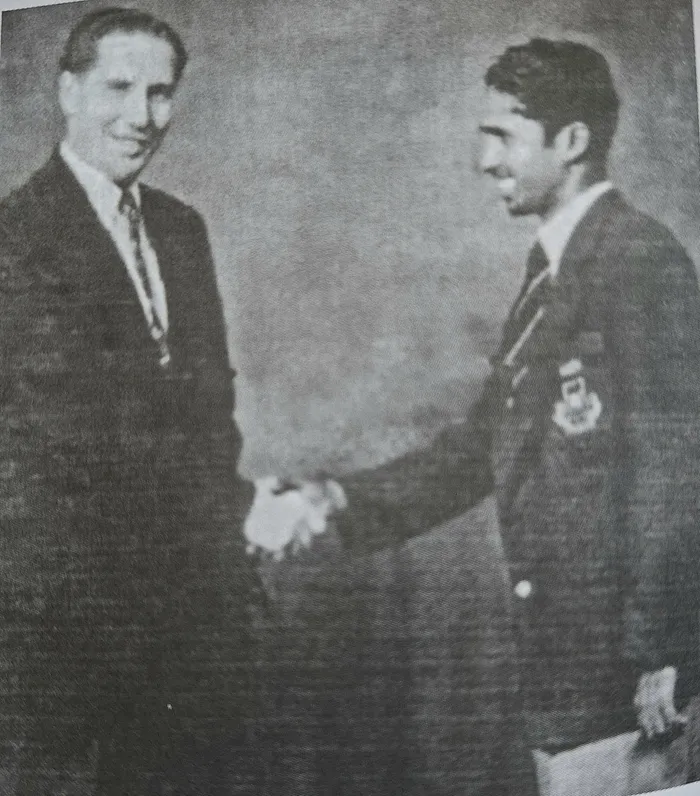
Toplan Parsuramen with Roy McLean.
Image: Supplied
"Cricket is as much part of the history as books written are part of the history.” CLR James
IN MARCH 2003, Shane Warne arrived in Phoenix, Durban. A local entrepreneur had arranged for him to visit a few schools.
Warne was at his diuretic best as he generously mixed with the locals. And then something magnificent happened. One of the province’s greatest spin bowlers, now residing in Phoenix, arrived. His name, Toplan Parsuramen.
Parsu, as he was popularly known, was, tragically, a stranger to the people gathered. Warne, though, had been briefed, and for once stayed on script, giving Parsu a warm hug.
A mat was laid out and the two great spinsters bent their arms. Despite his humiliating World Cup expulsion, Warne was in his prime. Parsu, 69 years old, was frail and slightly stooped. But one could sense his joy at meeting Warne, and the gasps as Parsu turned the ball both ways.
In the late 1960s and early 1970s, I watched Parsu bowl at Asherville Grounds, playing for his beloved Clares. He had a longer-than-usual run-up for a spinner. The matting wicket forced bowlers to rely more on guile than spin. And Parsu, for all his shy smile and humility, was a trickster. Many pedigreed batters saw the looping ball, and their eyes would light up as if the lunchtime breyani had arrived early.
But so much was in the flight, the ability to get the ball to dip and skid, the batsman vainly trying to step back as his torso fell forwards, and he would be done.
Parsu grew up in the immediate shadow of Kingsmead. His father, Topsy, was a groundsman, one of 10 families employed by the city to look after the sports fields. Cramped for space, Parsu hung about on the boundaries of Kingsmead. He was not allowed to play at Kingsmead, let alone throw a few balls on the grass wicket.
But from an early age, he watched and made his mental notes. He grabbed an opportunity to work the scoreboard. He also got to bowl to Dennis V Dyer, the Springbok opening batsman, in the Kingsmead nets. After a few hours, Dyer would throw him a coin or two.
It was here that Parsu developed the “wrong un”. Dyer did not have a long career in the Test team. He was deemed too cautious and hesitant. If you had Parsu as your net bowler, it might introduce some trepidation. Both of Dyer's sons would go on to play provincial cricket on fields denied to the invisible Indian maestro.
Despite the exclusion, Kingsmead held a special place in Parsu’s heart. When I spoke to him in the early 2000s, he told me that it was the 1948 Test match between the Springboks and England that he most remembers – arguably the greatest Test played at Kingsmead in the era of racial segregation.
Knowing the cracks in Kingsmead’s racial wicket, he sneaked in and found a spot near the sight screen on the last day. The English were set to make 128 to win. It came down to the last ball.
In the age of apart-hate, there were camaraderies nurtured even if they could not be shared on the cricket ground itself. One thinks of a lovely 1956 photograph of Springbok Roy McLean and Parsu now playing his cricket in Mayville, dressed in blazers, shaking hands.
But non-racial cricket was unorthodox, and threatening. Starved of resources, it went into severe decline. Parsu would keep playing for Clares, but it was for love rather than competition. And, under international isolation, many a would-be Roy McLean and Dudley Nourse would have their talents confined to the bastions of white exclusivity in a South Africa built for them.
Parsu’s innings came to an end the year that Kingsmead celebrated its centenary of Test cricket. Kingsmead, the venue of the Timeless Test and the Friendship Test against India, as apartheid fell.
As much as this bastion of cricket hurtfully excluded the Parsus and D’Oliveiras, Kingsmead came to play a role in a much bigger game – the struggle for democracy. It became a target that anti-apartheid forces could aim at.
While many white cricket lovers looked for the shadiest places to sit or found a spot around their favourite fielder, many black cricket lovers, with heavy hearts, shunned the venue, the diehards following the game through the voice of Charles Fortune.
Attitudes hardened as the South African Council on Sport headlined the slogan, “no normal sport in an abnormal society”, threatening excommunication to those who sat in Kingsmead’s “non-white” strip.
When I began to talk to ex-cricketers about recognising Kingsmead’s 100 years of Test cricket, I sensed what philosopher Wendy Brown called “wounded attachments”.
There are those who asked: how can we recognise a stadium that for much of the 20th century did not recognise us? For them, the present is always trumped by occupying the high ground of the past. Others want us to play abnormal cricket for the rest of our lives, with Kafkaesque racial bean counting. This is fuelled, of course, by white apartheid cricketers still fixated exclusively on their own wounds as if the Parsus of the world did not exist
The tragedy in all this is, as Jean Améry puts it, “resentment blocks the exit to the genuine human dimension, the future”.
Is Kingsmead not as much Parsu’s as it is McLean’s? In 2014, Parsu was awarded a Heritage blazer by Cricket South Africa. The circle between McLean and Parsu about 58 years later was made complete.
Watching Parsu bowl at a shopping mall in Phoenix brought a tear to my eye. This slightly hunched man had moved through so many areas, Mayville, Springtown, playing for his beloved Clares, and then to the outer limits of the city, Phoenix. Cut off from the people he played with, unable to watch the game he loved. He was a master of spin. That day, next to Shane Warne, it cast my mind all the way back to watching Parsu bowl at Currie's Fountain.
February 1967. Sitting next to my father. I was 8 years old. The great Basil D’Oliveira was in town. Parsu bowled D’Oliveira for one. The ball turned, also sideways. For months afterwards I tried on the pavement of Prince Edward Street to do a Parsu. But my limp wrist and having the concentration span of a fly seeing a jalebi in Patel’s front counter, it was to no avail.
Next time you go to Kingsmead, look out for Toplan Parsuramen. It is through people like him, who kept the game alive, that we can celebrate the Keshavs and Senurans of the world.