

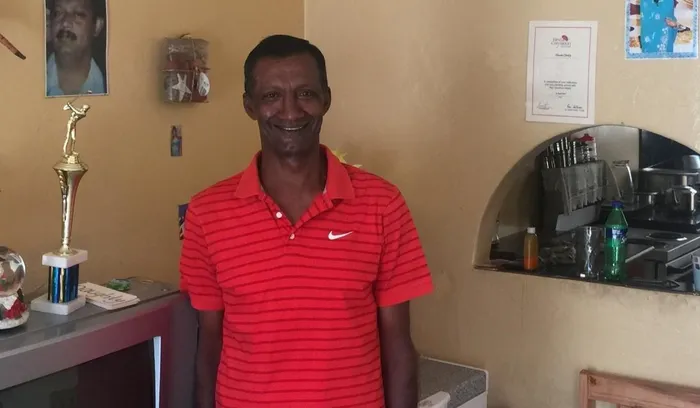
Poongavanam “Vassie” Chetty with his golf trophy.
Image: Supplied
…he returns, trying to imitate in his gait the inflexible rigour of an automaton, all the while carrying his tray with the temerity of a tightrope walker, maintaining it in a perpetually unstable equilibrium, perpetually destabilised, and perpetually re-established with only the slightest movement of the arm and hand. His entire conduct seems to us like a game. (Jean Paul Sartre)
Those who made their way to Phoenix travelled many roads. In our research on waiters, we found out about so many who had made their lives in Phoenix. Waiters have fascinating stories because they live in two worlds at once. They walked a tightrope as outsiders to white society, but with everyday access to the inside, adopting a demeanour of servility: bowing but not scraping; attentive but never intrusive; personable but not familiar; discreet about a customer’s broader tastes, but never appearing secretive to his boss. The Indian waiter’s name tag would be suitably adjusted so that it could be pronounced by the white clientele.
Poongavanam “Vassie” Chetty was born on September 1, 1959, in Verulam on Natal’s North Coast. Although his father’s surname was Pillay, his grandmother registered him under her own surname, Chetty, and named him "Poongavanam" after her husband. Because the name was considered too long by family and friends, he became widely known by the shortened “calling name" of Vassie.
Vassie’s father, Dennis Pillay, worked in the Durban Corporation’s refuse department. Around the time of Vassie’s birth, municipal employees were being relocated from the Magazine Barracks, and Dennis was allocated a house as part of this process. Vassie’s mother, Latchmi, worked at a clothing factory, and continued there until her death in 1979.
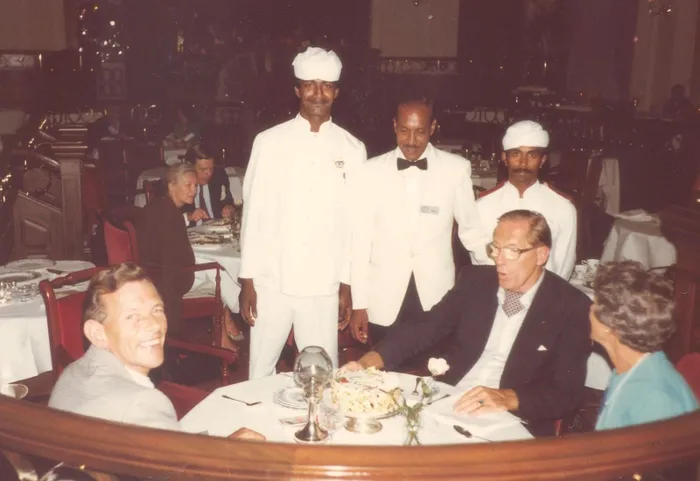
Poongavanam “Vassie” Chetty, left, at the Royal Hotel.
Image: Supplied
Their family home on Malacca Road, Redhill, was made of wood and iron, and was built, in his words, “on a hillside where there was a very big tin-shed house where about three or four families were staying. Toilets were outside. All the families shared the toilet”.
Vassie, his parents and six siblings lived in a two-bedroomed house. His father left when they were young, and he and his sisters were placed in hostels and orphanages by social workers.
Without a stable home environment, Vassie paid little attention to schooling, focusing instead on caddying at the Beechwood golf course, (‘where my granny used to work. She used to rake the bunkers’) to supplement the family income. He started caddying at the age of 10, working on Wednesday and Friday afternoons, and on Saturday and Sunday mornings. Though young, he had to pull the cart and carry golf bags for white golfers.
After completing Standard 7, Vassie started work in 1978 at a retail store called "Lakhani’s Stall" to support the family. He was living in Greenwood Park at the time, close to his mother, while his granny had moved to Phoenix. His elder brother, Krish, organised a job at the Athlone Hotel in Riverside in 1979. He started as a trainee waiter: “the Indian waiters taught me a lot – all the old people, like Mr George, Siva Pillay, and so forth. They were very good to me.”
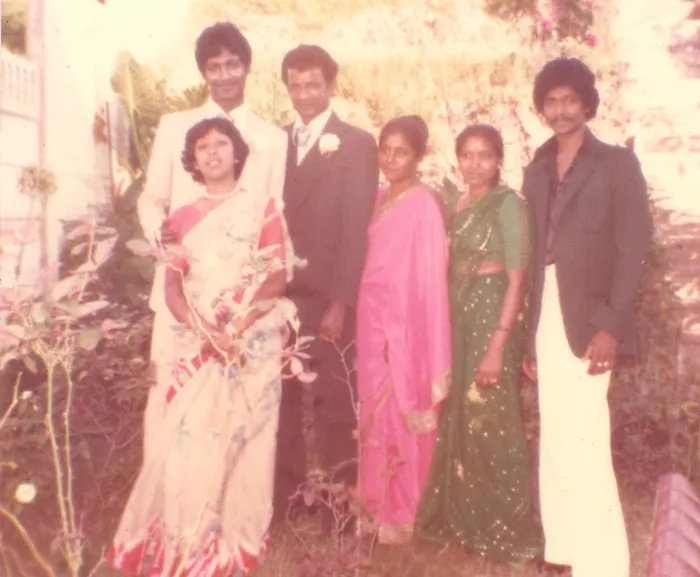
Poongavanam “Vassie” Chetty and Manorajini, known to the family as "Dolly", with extended family members.
Image: Supplied
At the end of that year, he joined the newly-built Maharani Hotel on North Beach. This was a different proposition: “very posh, five-star, and we worked in a restaurant called the ‘Papadum’.”
He returned to the Athlone after a year because the management offered him higher wages. Vassie moved to the Blue Waters Hotel in 1982. By now, he was a fully-fledged à la carte waiter, providing what was called silver service. A year later, Vassie was on the move again. A manager from the Royal Hotel was impressed with him and recruited him for the hotel.
Vassie started work at the Royal on September 15, 1980, beginning his journey in the grill room as a commis waiter, which is an entry-level position in the industry, and he performed basic tasks while learning the ropes of the trade: “I would carry the stuff from the kitchen and give it to the senior waiters who would serve it to the guests. And it was all silver service.”
He worked at the Royal for 18 years until his retrenchment in 1999.
Vassie was an enthusiastic sportsman with a particular passion for soccer. He played as a right winger for the Royal Hotel football team and developed his love for the game from a young age while representing the Fannin school team. He vividly recalled playing barefoot against opponents who wore proper football boots because his family could not afford football gear. Despite these hardships, he excelled on the field and remained deeply committed to the sport.
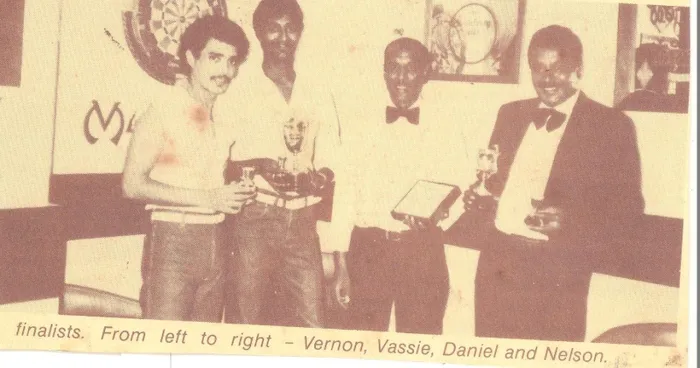
Poongavanam “Vassie” Chetty, second from left, with finalists at a darts championship in the 1970s.
Image: Supplied
Beyond soccer, Vassie distinguished himself in several other sporting activities, including golf and snooker. He was introduced to golf while working as a caddy and later began taking the sport more seriously during his employment at the Royal Hotel. According to Vassie, “we opened up a Royal Hotel golf club. We used to play on all-white courses on the South Coast”.
Access to these facilities was arranged by white managers at the Royal Hotel, who negotiated permission for their Indian waiters to use the courses once a week during apartheid, when such spaces remained racially exclusive.
Vassie also became an accomplished darts player. He learnt the game at the Mount Edgecombe Hotel and the Green Cat Bar in Verulam, where darts formed an important part of Indian working-class social and drinking culture. Competitive tournaments were regularly hosted at the Moon Hotel. He represented the Natal Hotel Industry darts team for 12 years, competing against teams from other provinces, and earned a reputation as one of the strongest players in the league.
In 1982, Vassie married Manorajini, known to the family as "Dolly". He met her through her brother, Steven Munsamy, with whom he worked at the Royal. Vassie moved to Phoenix in 1984. Social workers helped him secure a house in the township so that he could take care of his siblings. The waiting list for houses numbered in the thousands, but his application was expedited due to the social workers' intervention.
“Without seeing the house, I paid a deposit and took the keys straight away.”
Vassie was thrilled: “finally, you’ve got something to pay for your own. In Greenwood Park, you were paying somebody else's rent. We now had an inside toilet and bathroom. It was very much better here, everything inside here. I was very happy to move because you are moving to something more classic.”
Those who were given council homes paid a monthly rent/levy for around 20 years before finally securing ownership. Though the houses were rudimentary, the owners were thrilled to finally have something in their name.
Vassie explained that one of the occupational hazards of working as a waiter was exposure to alcohol abuse. By the late 1990s, he had developed a serious drinking problem. However, he proudly recounts that, with the support of the church, he gave up alcohol completely in 2004. Central to this personal transformation was the Faith Revival Church, located near his home in Phoenix. Pastor Edwin Govender played a significant role in helping Vassie overcome his addiction. Vassie began attending the church after his marriage, and during the period when his drinking had become increasingly problematic.
He currently worships at Resurrection Life Church under the leadership of Pastor Joey Govender. With a huge congregation, the church reflects the rapid growth and influence of Pentecostal Christianity within the township.
Vassie still resides in his home in Croftbury, a place that represents the fulfilment of a lifelong dream of having a secure roof over his head. Beyond providing shelter, his house in Phoenix gave him a profound sense of belonging and community, for which he remains deeply grateful.
Adapted from Professor Ashwin Desai and Professor Goolam Vahed's, A History of the Present: A Biography of Indian South Africans, 1990-2019. Oxford University Press.