

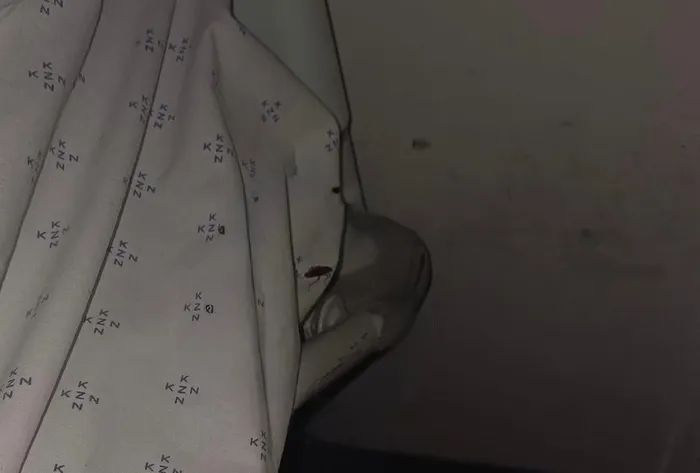
Cockroaches crawling on the hospital beds.
Image: Supplied
FIONA Abuu recounted her distressing experience at King Dinuzulu Hospital hospital, where a cockroach infestation allegedly overshadowed the care she received after her Caesarean section.
She is a second patient to express concern over hygiene conditions at King Dinuzulu Hospital, formerly known as King George V Hospital.
Abuu, 34, of Newlands East, said she was admitted to the hospital six months ago when she gave birth to her daughter via Caesarean section.
While she praised the medical staff and the care she received, she said the condition of the ward left her distressed and eager to return home.
"It was my second experience at King George hospital. I had my son there six years ago and I had no issues. Everything was fine. I never had any issues with THE healthcare,” she said.
However, Abbu claimed her most recent stay was marred by an infestation of cockroaches in E-Ward, where she was transferred with her newborn shortly after she gave birth.
"I went back to the ward with the baby around 3am and laid her down. The first night, I noticed I could not sit on the chair," she recalled.
"I wanted to sit and feed her and I could not, so I had to lie down and feed her because the chair was covered in cockroaches."
According to Abuu, the insects became more active at night.
"The moment you sit down, they cover your legs. They start crawling up from your feet. I just dusted them off and did not think much of it because I thought it only happened at that time of night."
She said conditions worsened the following evening when a power outage plunged the ward into darkness.
"When there was a power failure, I went to the nursing station with my baby to find out what was going on. You could just see the cockroaches crawling out from every corner. It was baby roaches, so there is definitely an infestation," she said.
Abuu described how some patients attempted to shield themselves and their newborns from the cockroaches.
"The other patients had covered themselves and their babies with blankets. I carried my baby the entire time," she said.
Hospital staff reportedly informed patients that the outage was due to load shedding and that the ward did not have access to a generator.
"They said there was only a generator for theatre. We were without electricity for around 45 minutes to an hour. I was actually thinking about taking a forced discharge and going home with my baby. That was how bad it was."
Despite the ordeal, Abuu said she remained appreciative of the healthcare workers who cared for her during her stay.
"Understandably, the nurses and nursing staff could not do much about it. We were forced to just dust them off ourselves," she said.
She added that the infestation appeared to extend beyond the ward itself.
"I came home with roaches in my bag, that was the extent of the infestation. If I had opened the food, there was no way I could eat it. Even if it was sealed, the cockroaches would crawl all over the packets and burrow into the folds."
Abuu said she completed a patient survey upon discharge and commended hospital staff for their professionalism.
"I had nothing but praises for the staff and the care that I received. I am still very thankful for both my experiences and never had any issues with the treatment I got. However, the state of the facility itself is declining from what I see."
She said she was prompted to speak publicly after recently seeing social media posts from other patients alleging similar experiences.
"I had forgotten about it until I came across a post on Facebook the other day about the infestation. I basically could not wait to get home because of the cockroaches,” said Abbu.
Last week, another patient, Imraan Bennette, 52, of Morningside, described his experience at the hospital as “traumatizing.
He alleged the cockroach infestation forced him to stay awake at night as they crawled on him.
“On May 24, I was moved to Medical One ward and that is when I saw the cockroach infestation. The wash basins had cockroaches running across them, they were all over the soap dispensers, mattresses, cabinets and floors,” Bennette alleged.
“I reported it to the nurses and they told me management was fully aware of the infestation and there was nothing they could do about it.”
According to Bennette, the infestation was so severe that he could not sleep.
“I spent the whole night killing cockroaches. They were crawling on me while I was trying to sleep. At one stage, I must have killed between 15 and 20 cockroaches during the night,” he said.
“I was traumatized. You expect a hospital to be hygienic, especially when you are there because of a medical emergency. Instead, I was dealing with cockroaches crawling over me.”
Bennette said he does not blame the hospital’s cleaning staff, whom he described as hardworking under difficult conditions, but believes management has failed to address the issue adequately.
“The cleaning staff are doing their best, but the cleaning supplies and pest control methods are clearly not effective,” he said.
“To me, the pest controller being used is making a big buck out of using the weakest and most ineffective cockroach treatment. That contract should be revoked with immediate effect.”
Bennette, who works as the fleet maintenance manager for Olympic Bus Lines, said he understands the importance of maintaining clean and hygienic environments.
“There are chemicals available that can keep pests away for long periods, but whatever is being used here is clearly not working,” he added.
The KwaZulu-Natal Department of Health did not respond at the time of publication.