

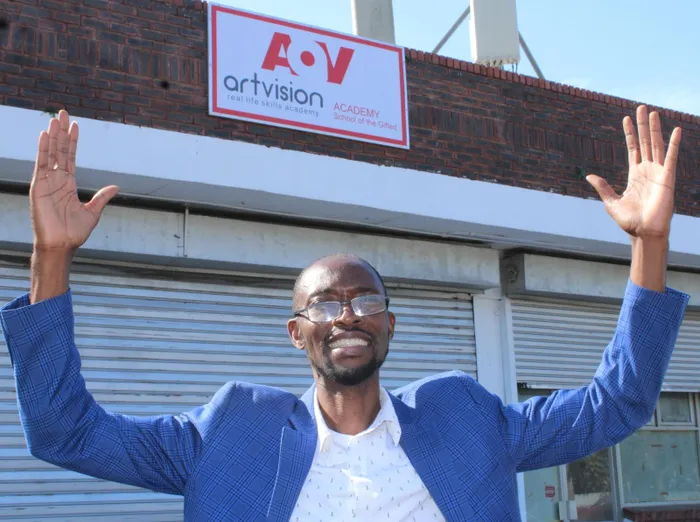
Mack Kapya Dollvins Art Vision Academy for the homeless was opened on Friday.
Image: Yoshini Perumal
Despite living a life filled with trauma and hardships, Mack Kapya Dollvins, 50, a Congolese refugee, transformed his traumatic past into a beacon of hope by establishing the Art Vision Academy, aimed at rehabilitating and empowering homeless individuals in Shallcross.
The Art Vision Academy was a dream of Dollvins after he spent eight years trying to escape from fighting in the war in the Democratic Republic of Congo (DRC), and 10 years living on the streets of Durban as a refugee.
The centre was sponsored by Sibaya Community Trust and was opened on Friday.
The furniture and air conditioning were donated by the DSK Group NPO.
The centre will cater to homeless people fighting addiction and provide rehabilitation and skills development programmes to work hand-in-hand to keep them off the streets.
Dollvins was kidnapped from his home in the DRC when he was 12 years old.
He was taken straight into training, where he was beaten and told to fight in the war.
“I was 12 and at the frontline of war. I did not know what I was fighting for. I was given a gun. I was shot multiple times. I went through things no child should ever go through. But I knew I had to escape.
“I failed at escaping more than 10 times. Each time I was caught, I was beaten and starved. I spent eight years trying to escape. When I was 17, I finally escaped with help and lived on the run until I registered as a refugee in South Africa.
I was 23 at the time,” Dollvins said.
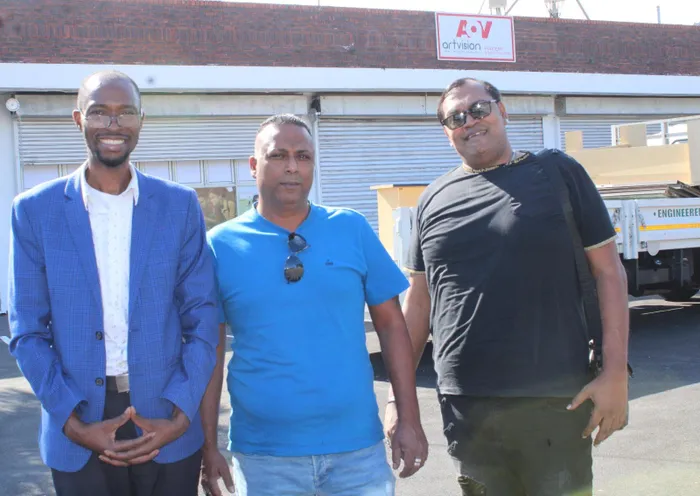
Mack Kapya Dollvins with DSK Group trustee Nischal Bridglall and DSK Group founder Dr Daniel Chettiar.
Image: Yoshini Perumal
When he got to South Africa with his pregnant wife and twin sons, who were under a year old, Dollvins and other young refugees were taken to a homeless shelter which only catered for women and children.
His wife and twin sons remained at the shelter while he slept near the Addington Children’s Hospital in Durban central, which was closed at the time.
“I only knew French and Swahili, so I did not know how to communicate with anyone. I learned how to speak English on the street.
“I lived on the street for 10 years. At night, the streets are every child’s nightmare. There would be fights among homeless people, and we would get assaulted. Random men would come at night and rape us.
“That pain led me to start taking drugs. I was eating from the bins because I had no income or means to earn money. I became addicted to mandrax and other drugs to take the pain and frustration away. To avoid the assaults and rapes, we would sneak into the children’s hospital to sleep at night,” Dollvins recalled.
He said to motivate the young street children and keep them away from resorting to stealing and crime, he would use the fading paintings of cartoons and animals on the walls of the children’s hospital to tell them stories.
"I made up the stories from my time at the war and about my life, turning them into moral tales. The children were dying from sickness and starvation because we were all eating rotten food from the bin. I was sick from this and was admitted to Addington Hospital when people came to pray over the patients.
“They told me I was special and that they were seeing great things for me, but I did not understand what it meant because my life was never easy and I was homeless. When I was discharged, I saved a few rands and bought washing liquid to wash cars along the beachfront to earn money. I bought food with the money for myself and the others. My dream was to become a pilot, so I also saved money to educate myself. I slowly came off the drugs.”
One night when Dollvins and other street children went to sleep at the hospital, they found that the hospital had been refurbished.
“Vivian Reddy had refurbished the hospital. He arrived at the launch in a Rolls-Royce. I remember him talking to us street children and he motivated us. He said if you can dream it, you can achieve it… ‘If you believe in yourself, you will make it possible’ and he gave me a business card saying if you come off the streets, come and see me. I was 28 years old.
“It is hard to come out of homelessness. We live like dogs. Eating from bins. Sleeping in inclement weather. People do not even give us leftover food. They would rather throw it in the bin. At the robots, when we ask for food, people roll up their windows. This leads the homeless child to face abuse and the rejection leads them to crime.
“I knew I needed to improve my English and upskill myself. I would go to City Hall and other libraries to use the internet to learn English and aviation. I eventually saved enough money to enrol at UKZN in 2008, but I was told I couldn't because I needed formal education to enrol.
“I met Professor Vivian Ojong, who saw my eagerness to enrol and she let me participate in the classes for the day. I then sat in her anthropology classes and I would learn and participate.
“She had a good heart, and she gave me a place to stay. She taught me English after hours. She taught me marketing and I would sell perfumes for her to make extra money. I bought a laptop with my earnings, and I bought a flight simulator so I could reach my dream of being a pilot.”
In 2013, he went to Reddy’s office with the business card he had given him when they met at the children’s hospital.
“There were no jobs there but the staff helped me with a job to do the website maintenance at another company in the building. I worked for free. I would bump into Vivian every day, and would be polite and open his door for him. He was humble, and always made conversation with me. I remember thinking, he is such an established man, yet humble enough to carry a lunch tin in his hand to work every day.
“After two months, I was permanently employed by the company, and I was told I would get paid. Each month, I would give a portion of my salary to the homeless people for food and shelter.
“When Professor Ojong sold her house in Hillary, I was homeless again. I would stay with friends or at the shelter. I saved my money to study aviation and in 2014 I enrolled at the Durban Aviation Center to register to become a pilot in 2013.”
Dollvins flew about 15 hours until two of his friends and students from the aviation academy crashed in a small aircraft he was supposed to fly in 2014. They both died in the crash in Amanzimtoti.
“That was my wake-up call. That could have been me in that plane. I kept thinking that people were dying all around me, from the streets to the aviation school, and I needed to do something.
“After the accident, I was traumatised and stopped flying for about two months. I was doing a flying test when the radio stopped working and I had to do an emergency landing. As I was landing, a voice in my head said ‘what you are doing is good for you, but it is not your purpose’.
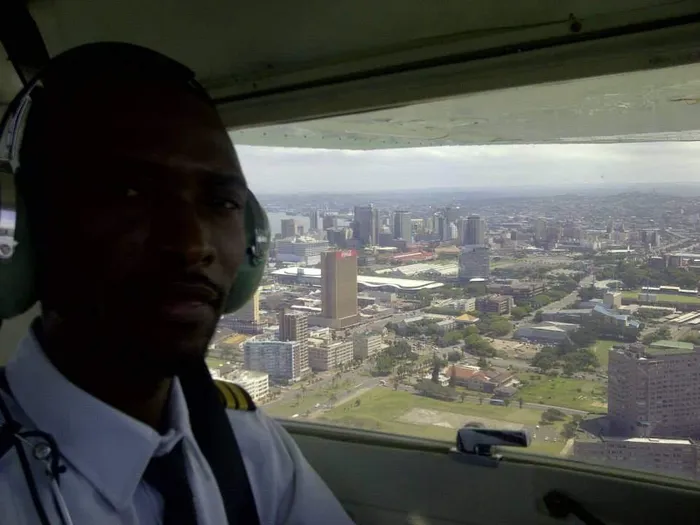
Mack during his flight training.
Image: Supplied
“I could not concentrate. I saw the faces of all those friends on the street, the war, and the students who died in the crash. I landed the aircraft and told my instructor that I quit. My instructors arranged counseling for me, as I was about to write the exams to complete the first year when I wanted to quit. I then said I wanted to quit and open a centre for the homeless, drug addicts, and the abused.”
His instructor told him that although he was not going to be a captain of aircraft, he would be a captain of humanity.
Dollvins used his savings to open a two room school in South Beach for drug addicts and alcoholics.
“It was called Empire Dynasty Recording Studio. We did personal growth, music, and arts. Street children would flock to the studio. We would raise funds and create events so that bands could get paid. We used that money to build the Art Vision Academy and registered as a non profit company in 2018.
“We then moved to Morningside and operated from there until we were evicted in 2025. About 25 students and I slept outside the academy for three days until the eThekwini Municipality assisted us with storage for our equipment. The females were taken to my house, and I joined the men to sleep at a shelter.
“In 2025, for the first time, I had the courage to go to Vivian and tell him that I was that boy from the street that he spoke to when he refurbished the children’s hospital.
“It touched him because I would open the door and make conversation with him, and never asked for help until then. I told him that I was an instrument to his words, that if you could dream it you could achieve it.
“Our students became lawyers, authors, music instructors at UKZN, and are working in corporate companies like King Price Insurance. I then asked him for help and the Sibaya Community Trust had donated a refurbished centre to us in Shallcross,” Dollvins said.
The academy has the capacity to house 15 females and 15 males, and the capacity to accommodate 100 students each month. Programmes will include rehabilitation, personal growth, support groups, and counseling with Lifeline.
Skills development programmes will include welding, sewing, information technology, artificial intelligence, music, film and radio production.
For more information or to get involved, contact Dollvins on 074 775 7031.