

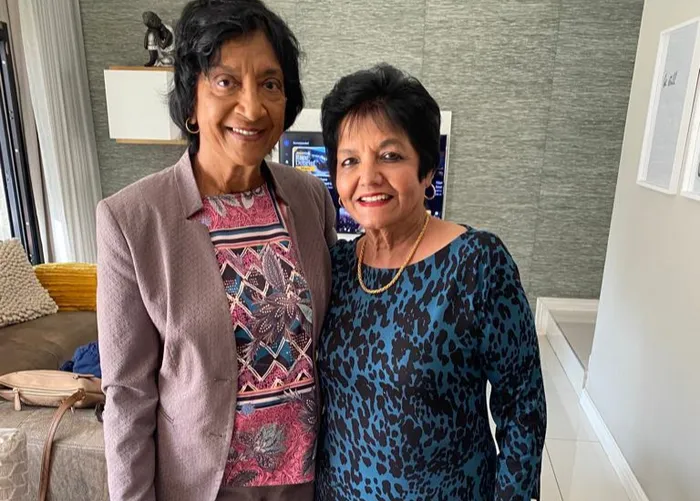
The organisation's founders, from left, Judge Navi Pillay and the late Professor Anshu Padayachee.
Image: Supplied
FOR the past 40 years, the Advice Desk for the Abused has stood with survivors, empowered voices, and worked towards breaking the cycle of gender-based violence (GBV) and abuse in communities.
As the non-profit and public-benefit organisation marked this milestone, chairperson Dr Lubna Nadvi shared its journey which began in 1986.
She said the organisation, originally named the “Advice Desk for Abused Women”, was co-founded by Judge Navi Pillay, a world-renowned legal professional and former United Nations High Commissioner for Human Rights; and the late Professor Anshu Padayachee, an academic and gender-rights activist.
“In the early 1980s, there was a need for a legal intervention for women who were experiencing domestic violence. A lot of women used to approach, in particular, Professor Padayachee.
“Judge Pillay and Professor Padayachee, who were known to each other, approached a magistrate to request that a legal intervention be introduced to ensure that women who were going through domestic violence, would be protected through some kind of peace order or protection. However, the magistrate was not really co-operative, and they decided to start the organisation to offer support to women who were victims of domestic violence,” she said.
Nadvi said the organisation started as a phone service.
“They started from their homes. Women could phone for assistance. In the early 1990s, the organisation was granted space to operate from the then University of Durban-Westville campus. Eventually, through the generosity of Telkom, a toll-free line was set up.”
Nadvi said at this time, Padayachee and others were involved in the drafting of the Domestic Violence Act – which would also include being able to obtain a protection order.
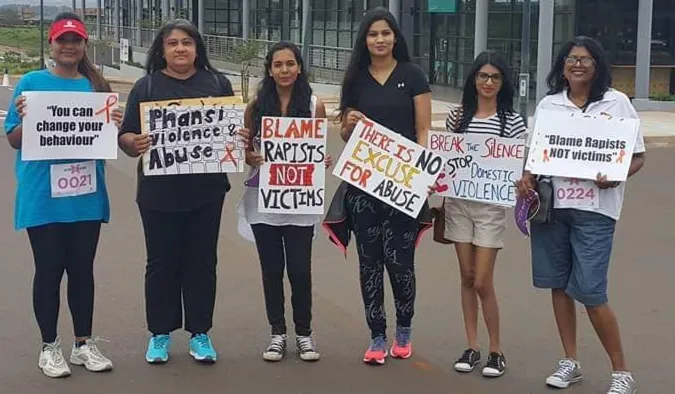
Dr Lubna Nadvi, chairperson of the Advice Desk for the Abused, second from left, with members at a gender-based violence awareness walk.
Image: Supplied
She said the organisation later changed its name to the Advice Desk for the Abused due to an increase in the abuse of men, the elderly, and the physically-challenged.
“We were receiving calls from different members of society. While violence against women was still a great problem, there were reports of perpetrators also being women.”
Nadvi said they trained crisis interventionists (CIs) to offer counselling and support to abuse victims.
“They offer counselling and guidance such as advising the person of their options, including obtaining a protection order. The organisation later reached an agreement with the Department of Justice to have our CIs present at the courts to offer physical advice and assistance for people applying for protection orders. We had CIs based at the magistrate courts in Durban, Verulam, Chatsworth and Pinetown, and then later at the Point Family Court.”
Nadvi said the organisation also offered training for people who wanted to become CIs.
“We offered two-to-three-day training workshops to anyone, even those who wanted to acquire the skill. However, if they wanted to be part of the organisation, they had to serve 40-hours of service under the guidance of an experienced CI.”
Nadvi said over the years, they had partnered with various organisations, such as the South African Depression and Anxiety Group, Lifeline and Bobbi Bear, among others, in initiatives relating to the fight against GBV and child abuse.
“We have also been invited by corporates and other stakeholders such as the eThekwini Municipality, to speak on GBV, and on available support mechanisms and interventions.
“We also joined marches, pickets or such actions, for example, outside courts on related cases of GBV and femicide. We have also been contacted by religious leaders and schools to give talks,” she said.
Nadvi said among the highlights was the organisation’s members' role in the drafting of legislation to protect people against domestic violence.
“Professor Padaychee and past board members were instrumental in the drafting of the Domestic Violence Act. That was a major success as there were no laws at the time to protect women.
“The organisation has also assisted in developing case laws. In the past 40 years, we have assisted with about 500,000 cases of GBV and abuse.”
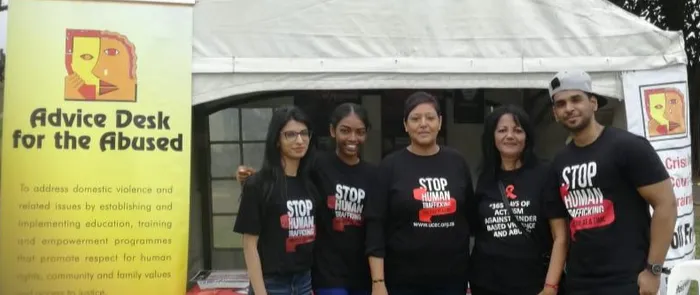
Members at an anti-human trafficking event.
Image: Supplied
Nadvi said despite concerted efforts in the fight against GBV, it remained a growing concern.
“It is unfortunate that statistics show that GBV and violations especially involving women and children are highly-prevalent in our communities.
“Professor Padayachee had once said it was expected that there would not have been a need for the organisation’s service, post-apartheid. Domestic violence would have been eradicated as human rights would prevail. But it worsened.
“While we have some of the best legislation in the world to protect people, it is still not enough. More seemingly needs to be done, and that means more government interventions and education in communities,” she said.
Nadvi said communities needed to take a stand.
“Our motto is that there should be activism against GBV, 365 days. Society needs to be more mindful and conscious that this is a real issue. They can no longer remain silent, and turn a blind eye.
“Victims need to break the cycle. Do not stay silent. There is support out there. Don’t be afraid, it can save your life,” she said.
Nadvi said funding was one of the organisation’s greatest challenges.
“Our service is completely free. However, we provide our CIs with a stipend. We also have travel costs, for example, when a CI needs to go to court or we need to go into a community. We also have an office, and need the basic necessities such as stationery. We would also like to provide education in townships and far-lying areas, but don’t have the resources.
“Furthermore, we need more volunteers, whom we can train and send into areas to provide information on GBV. We are now appealing to businesses and the public to assist us, so we can continue providing the help and hope to people in need,” she said.
Nadvi said the organisation's goal was to reduce the incidents of GBV and abuse.
“We can only do this if we are able to consistently go out and speak to people of their rights and the resources available. Our ultimate goal is to reach a point where GBV is reduced so significantly that the organisation is no longer needed. However, we will remain available to people if needed.”