

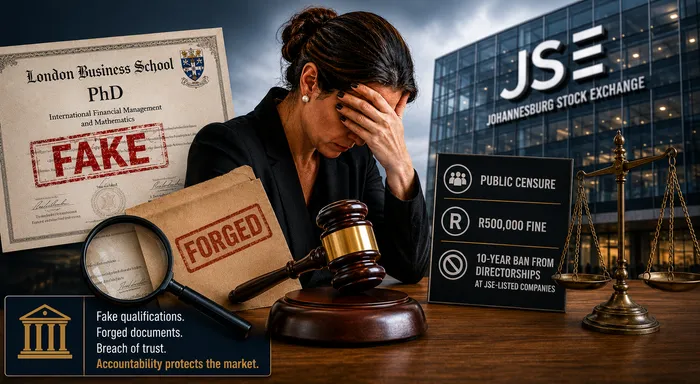
Former EOH director faces sanctions for fraudulent PhD qualifications.
Image: AI-Generated
THE Financial Services Tribunal has dismissed Anushka Bogdanov's appeal against sanctions imposed by the JSE for misrepresenting her qualifications, concluding that she submitted forged documents to secure her position at EOH Holdings.
In a strongly worded judgment handed down on Tuesday, the Tribunal upheld the JSE's decision to publicly censure Anushka Bogdanov impose a R500,000 fine, and bar her from serving as a director or officer of any JSE-listed company for ten years.
The case stemmed from Bogdanov's long-standing claim that she held a PhD in International Financial Management and Mathematics from London Business School (LBS), a qualification central to her appointment and subsequent rise within EOH Holdings.
Bogdanov joined the EOH board in June 2019 as chair of several key committees, including the social and ethics, risk and governance, and remuneration committees. In February 2020, she was elevated to the roles of lead independent director and deputy chairperson.
Questions surrounding her qualifications emerged in 2020 when she was considered for a board position at African Bank. During a vetting process conducted by the Prudential Authority, copies of her qualifications were requested. A PhD certificate purportedly issued by London Business School was submitted as part of the documentation.
Subsequent investigations revealed significant anomalies in the certificate. EOH's internal risk unit determined that the document contained spelling errors, an incorrect institutional logo, references to a vice chancellor position that did not exist at LBS, and a doctoral programme the institution did not offer. Investigators further confirmed with London Business School that the certificate was fraudulent.
The tribunal noted that despite multiple opportunities over several years, Bogdanov failed to provide any credible evidence that she had ever been enrolled in, completed, or been awarded a PhD by London Business School. The judgment pointed out that she produced no application records, student registration details, supervisor information, thesis documentation, examination records, or proof of degree conferral.
Instead, Bogdanov maintained that records relating to her studies had allegedly been deleted by London Business School. She further claimed that a traumatic personal incident involving her then-husband and two members of the institution's faculty had led her to abruptly leave the United Kingdom following a viva voce examination in 2008.
The tribunal rejected these explanations as implausible and unsupported by evidence.
"She never produced any evidence that would have shown that she had applied for and was registered for the PhD at LBS," the tribunal stated, adding that her assertion that all records had been deleted was not reasonably believable without corroborating documentation.
The judgment found that Bogdanov had continued to represent herself publicly as "Doctor" for many years despite allegedly knowing that no PhD had been conferred upon her. The tribunal further held that when she submitted her curriculum vitae to EOH in 2019, listing the doctorate among her qualifications, the conduct was "intentional and fraudulent."
The tribunal went even further, observing that the facts appeared to disclose elements of criminal conduct.
According to the ruling, the matter might never have come to light had it not been for a whistleblower within EOH. Internal investigations subsequently revealed that Bogdanov's qualifications had been widely published in company disclosures, Stock Exchange News Service (SENS) announcements, media statements, and EOH's integrated annual reports.
After being alerted to the issue, the JSE undertook a lengthy investigation spanning approximately three years. During that period, the exchange repeatedly requested evidence supporting Bogdanov's academic claims. The Tribunal found that she consistently failed to provide satisfactory answers and only conceded in October 2024 that the PhD had never been awarded to her.
Even then, she sought to distance herself from responsibility by alleging that an unnamed individual had forged the certificate without her knowledge or consent. The Tribunal dismissed that explanation, finding it incompatible with the evidence.
"It is clear to the tribunal that these forgeries were either committed by the applicant herself or with her knowledge and consent," the panel concluded.
Bogdanov challenged the JSE's sanctions on both procedural and substantive grounds. She argued that she genuinely believed she had earned the PhD following her viva examination, that she received no unlawful benefit from the qualification, that her health issues were insufficiently considered, and that the penalties imposed were disproportionate when compared with sanctions imposed in other cases.
She also contended that the incorrect qualification had been inserted into documentation by a secretary without her knowledge and maintained that the listing requirements had not been applied consistently.
The tribunal rejected all of those arguments.
The panel held that directors of listed companies have a duty to verify the accuracy of information they submit to regulators and investors. It found that Bogdanov had signed declarations confirming the truthfulness of her qualifications and had undertaken to exercise reasonable care in ensuring their accuracy.
The judgment emphasised that the case involved not a single mistake but a prolonged pattern of misrepresentation, false declarations, forged documents, and repeated failures to cooperate with regulatory inquiries.
While acknowledging that the JSE had considered her health circumstances as a mitigating factor, the tribunal ruled that those considerations were outweighed by the seriousness of the misconduct.
The panel also dismissed comparisons with other disciplinary matters, including another high-profile case involving a disputed PhD qualification, stating that each case must be assessed on its own facts.
Ultimately, the tribunal found no procedural unfairness, factual error, legal misdirection, or bias in the JSE's decision-making process. It concluded that the sanctions imposed by the exchange were justified and proportionate to the misconduct.
"The application for reconsideration is dismissed," the tribunal ordered.
The ruling represents a significant victory for the JSE in its efforts to enforce standards of corporate governance and market integrity, while sending a clear message about the consequences of misrepresenting qualifications in South Africa's listed-company sector.
The decision leaves intact the public censure, R500,000 administrative fine, and ten-year ban that effectively excludes Bogdanov from serving in leadership positions at JSE-listed companies until 2035.