

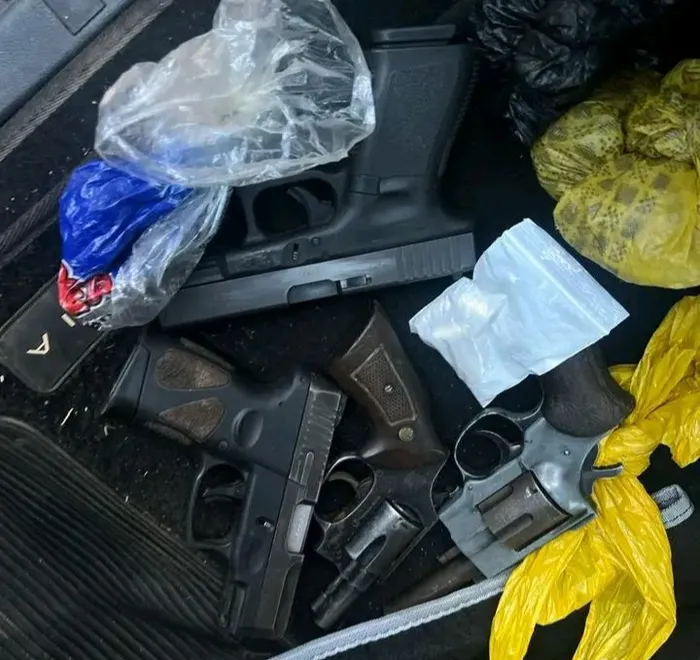
A photograph of guns as a threat was sent to a client of Brad Nathanson Investigations. Photo: Facebook
Image: Photo: Facebook
EIGHT men, including a Ballito businessman and a married sales consultant from South Durban, have allegedly been extorted of thousands of rand after falling victim to a “nude scam” on Facebook.
Experts warned of the increasing prevalence of such scams and provide advice on how to avoid becoming a victim.
The scam allegedly involves individuals posing as single women on Facebook obtaining personal details and nude photos of the men before extorting money from them while threatening to expose their photographs.
Prem Balram, head of Reaction Unit South Africa, said medical and legal professionals, teachers, and a salesperson were scammed of about R5,000 each this week.
“The men all had the same story. They had befriended the women on Facebook after initiating contact through friend requests and brief conversations before requesting WhatsApp numbers.
“They then obtained personal and work details, sent explicit images, and requested explicit images in return. This was followed by blackmail demands for substantial sums of money.
“Several of the victims paid large sums of money before they sought assistance,” Balram added.
He said the majority of the cases were from Durban, Ballito, Stanger, and Isipingo, and he was dealing with two cases in Johannesburg.
“There is an increase in these types of cases and we are warning men to be aware. An insurance company salesperson told us that he was chatting to people online as his sales pitch to sell insurance.
“He said the person extorted him for R5,000 after he sent a naked photo of himself. After the R5,000 was paid, the person then wanted R1,500. He then refused and received threats that the person had seen his profile on Facebook, and saw that he had a wife and would expose him if he did not pay.
“The man then felt compelled to tell his wife about the extortion, but he said although he confessed about chatting, he had left out the information about him sending naked photos of himself. He contacted us when he did not know how to stop the threats,” he added.
Balram said a Ballito businessman in his 40s was also scammed for R5,000, and when further demands were made for another R1,500. The person then threatened him. When he called the number from a private number, there was a man on the other end of the line. He then contacted Rusa.
“Two years ago, I was called out to a suicide where a young man, in his late 20s, who was married and had children had been found hanged.
“When I checked the suicide note, the man wrote that he was being extorted by a man for money after he sent naked photographs of himself to him, thinking he was a woman.
“The man felt that he could not live with being extorted. Greed for money is driving these types of scams. Men and women are being conned and extorted every day,” Balram added.
Brad Nathanson, a private investigator, issued a warning on his social media platforms onn Monday also warning men of nude scams which he said had nothing to do with romance, sex or escorts, but were actually extortion.
“Every week I hear from another man who believed he was chatting to a woman online. Sometimes she is an escort. Sometimes she is a lonely divorcee. Sometimes she is simply interested in him.
“The conversation turns sexual. Photos may be exchanged. Promises are made. A meeting is discussed. Then the trap closes.
“Suddenly, a WhatsApp message arrives. The message is aggressive. Threats are made. The victim is told he has caused trouble, wasted someone's time, or interfered with a dangerous criminal's business.
“The threats become more graphic. Photographs of mutilated bodies, weapons, assaults or executions are sent as proof of what supposedly happened to the last person who crossed them. The victim is terrified. He knows his wife, employer, and family does not know.
“And that is exactly what the criminals are counting on. The criminals are often hundreds or thousands of kilometers away. The woman may never have existed. The photographs are usually stolen from somewhere on the internet,” Nathanson said.
He said the threats are designed to create panic and force immediate payment.
Many victims pay.
“Then they discover the worst possible truth. Paying does not solve the problem. It proves that the victim is frightened and willing to hand over money.
“Once you pay, the demands usually continue. The amount increases. New threats appear. New stories are invented. The criminals have found a customer.”
As a private investigator with decades of experience, Nathanson said the culprits of these types of scams are extremely difficult to identify and locate.
He said they hide behind false identities, fraudulent SIM cards, fake documents, money mules and stolen accounts.
“Modern regulations largely affect law-abiding citizens, while professional scammers simply sidestep them. The easiest way to avoid becoming a victim is not to enter the game in the first place. You have no idea who is on the other side of that screen. That attractive woman may be a criminal syndicate.
“That flirtatious message may be the opening line of an extortion operation. That moment of excitement can become months of fear,” Nathanson warned.