

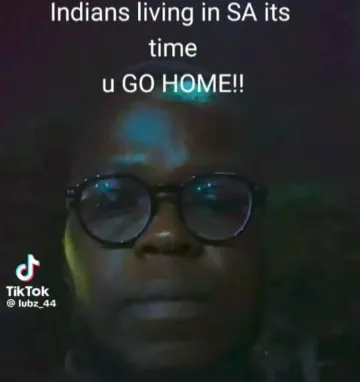
Lubabalo Sanqela released the video during the G20 Summit
Image: A screenshot of the video
COMMUNITY leaders have condemned Lubabalo Sanqela for a TikTok video questioning the loyalty of Indian South Africans.
Representatives from various organisations have called his comments "dangerous and divisive," emphasising that South Africans of Indian origin are not foreigners but citizens with roots dating back 165 years who have contributed significantly to the nation's development and struggle for freedom.
Sanqela, who describes himself as a mining entrepreneur on social media, said in the video, which was released last week: “I think we need to have an open discussion about the Indian people living in South Africa, particularly the Indians living in KZN. Their leader is here. The prime minister of India, Modi, is here in South Africa to attend the G20 meeting. Indian people were naturalised and that is how they got South African citizenship and that is how they got to carry South African IDs.
“They have their own country. Should shit hit the fan, they got India to run to, not South Africa. That's why, at most, when we call them for marches to say let's go and defend South Africa, they will never show up. They never come. They don't also respect our people, our people in the call centres, in their shops, working at garages, they don't respect us. I think it's time we have a discussion about Indian people living in South Africa.”
Sanqela did not respond to calls.
Dr Raj Govender, commissioner for the Cultural, Religious and Linguistic Rights (CRL) Commission, said Sanqela’s video undermined social cohesion and called upon South Africans to reject “divisive rhetoric”.
“This kind of video is irresponsible and should never be circulated. It undermines social cohesion and distracts from the real work of building an inclusive, innovative, and harmonious South African society. We must reject divisive rhetoric in all its forms and reaffirm the constitutional principle that South Africa belongs to all who live in it, united in our diversity.
“The video is currently making its rounds on social media. The derogatory statements are made about South Africans of Indian origin. It is deeply concerning and fundamentally misplaced. As a nation, we must guard against messages that inflame racial tensions or create the false impression that certain communities are ‘less South African’ than others,” he added.
Govender said South Africans of Indian origin were not foreigners in this country.
“They did not ‘receive citizenship’ through special favours or naturalisation. The overwhelming majority were born here over multiple generations, with their roots going back 164 years. They contributed to the liberation struggle, to our economy, to education, to the cultural richness of our society, and to the democratic nation we enjoy today.
“They are South Africans in every sense of the word - by birth, by history, and by constitutional belonging. To claim that one community ‘has another country to go to’ is dangerous rhetoric that undermines our shared citizenship. No South African - whether African, Indian, coloured or white - should be told they do not belong in the land of their birth.
“Furthermore, it is factually incorrect and unfair to suggest that South Africans of Indian origin do not stand up for the country or participate in national causes. Our communities work together daily, in schools, neighbourhoods, faith organisations, non-government organisations, business networks and civic movements. The narrative presented in the video is a sweeping generalisation that feeds division instead of unity.
“Yes, South Africa needs dialogue. But it needs to be constructive, respectful dialogue that builds understanding, not sensational videos that provoke anger and mistrust. Genuine nation-building comes from honest engagement, addressing misconceptions, and reinforcing that our diversity is a strength, not a threat,” Govender said.
Professor Brij Maharaj, deputy president of the South African Hindu Maha Sabha, said Sanqela’s video was offensive and contrary to the values upon which our democracy was built.
“It undermines the very essence of our constitutional order and must be unambiguously condemned by all committed to our non-racial democracy. Our Constitution is unequivocal: ‘South Africa belongs to all who live in it, united in our diversity.’
“Section 9 of the Bill of Rights guarantees equality and prohibits discrimination based on race, ethnicity, or culture. Section 3 affirms the common citizenship of all South Africans, while Section 21 protects the freedom of movement and residence within the Republic. These provisions make it clear that every citizen, regardless of ancestry, has the right to live and thrive in this country.
“South Africans of Indian origin are not outsiders. They are fourth and fifth generation citizens. Over generations, they have made immense contributions to the country’s economy, culture, and liberation struggle. To suggest that they ‘return to India’ ignores this history, undermines the democratic values of human dignity, equality, and freedom, and is morally indefensible,” added Maharaj.
He said the country’s future depended on rejecting such divisive narratives and reaffirming our commitment to the constitutional promise, that this country belongs to all who lived in it.
Pradeep Ramlall, secretary of the Global Girmitya Center South Africa, said Sanqela’s statements were dangerous and divisive.
“Indian South Africans are not foreigners, they are South Africans by birth for over 165 years. Most Indian origin families in KwaZulu-Natal trace their roots in South Africa back to 1860, when indentured labourers were brought to Natal.
“Their children, grandchildren, and great-grandchildren were all born here, lived here, and contributed to this country’s growth. To deny their citizenship or loyalty based on ethnicity contradicts the facts and undermines the constitutional principle that all who live in South Africa, and who are citizens, are equally South African without exception.
“India is not their ‘back-up home’ as India does not offer citizenship to Indian South Africans simply because they arrived in the country as slaves under the indenture programme. Indian South Africans overwhelmingly hold only South African citizenship, vote in South African elections, and are bound by South African laws. To claim they can ‘run back to India’ misleads the public and fuels suspicion where none is warranted,” added Ramlall.
He said generalising an entire community was irresponsible, and if there were issues relating to unfair treatment and lack of political participation, then it should be addressed as behavioural or economic issues, not racial issues.
“Blaming every Indian person for the actions of a few is unjust and inflames tensions at a time when KZN needs stability and unity, not racial divisions. South Africa’s struggle was multiracial, and many Indian South Africans stood side-by-side with African and coloured compatriots during the liberation struggle, facing banning orders, torture, and imprisonment.
“To erase that history is an insult to people like Dr Yusuf Dadoo, Ahmed Kathrada, Mac Maharaj, George Sewpersad, Fatima Meer, Strini Moodley and many other stalwarts who gave their lives in the fight against apartheid. South Africa needs solution-driven conversations, not racial scapegoating. If the intention is to address real problems such as unemployment, poverty, exploitation of workers, or social tensions, then those conversations must be grounded in fact, fairness, and accountability, not inflammatory rhetoric aimed at entire communities. We do not strengthen South Africa by dividing South Africans,” Ramlall added.
Yogin Devan, a media consultant and social commentator, said the video was “nothing short of disgraceful and downright ignorance”.
“It is 165 years after the arrival of Indians to South Africa and generations of sacrifice, resilience, and undeniable contribution by this group to the nation’s fabric, there remain individuals poisoned by prejudice who cannot stomach the presence, progress, and success of Indians. Such narrow-mindedness insults not only the Indian community but the very ideals of equality and justice that South Africa claims to uphold.
“Such bigoted individuals are not merely misguided but are a blight on society, a stain on humanity, and an unforgivable embarrassment to all people who cherish freedom, dignity, and equality. Their prejudice exposes the hollowness of their character and stands in direct opposition to the values that define a just and liberated world.
“And let it be clear that the Prime Minister of India Narendra Modi was not on a shopping trip or some casual visitor at the G20 Summit. He stood there as a statesman of global stature. He is the elected leader of the world’s largest democracy, and the head of a rising superpower whose voice carries weight on every continent. To remark on his presence as if he is unwanted on South African soil is to deny reality itself.
“India’s initiation of sanctions at the United Nations in 1946 was not a symbolic gesture but was a decisive act of moral leadership by Prime Minister Jawaharlal Nehru. By taking a firm stand against apartheid, India helped galvanize international pressure that contributed in no small measure to the eventual dismantling of that brutal system. This principled action played a vital role in opening the path to democracy in South Africa, proving that solidarity across nations can bend the arc of history toward justice.
“Purveyors of hate speech must understand that South Africa has legal recourse. The Equality Court exists precisely to confront and dismantle the poison of unfair discrimination, hate speech, and harassment. It stands as a guardian of constitutional values, ensuring that no individual is targeted or demeaned on the basis of race, gender, sexual orientation, or any other protected ground. Those who peddle prejudice should know that their actions are not only morally bankrupt, but legally accountable,” Devan said.