


Residents and community leaders joined to march against the ongoing gang violence
Image: Doctor Ngcobo
FOLLOWING the launch of the Wentworth Rise Against Violence campaign, community leaders are demanding immediate intervention to end the deadly gang violence plaguing their streets.
With shootings becoming 'an everyday occurrence' and another life lost just days after the campaign launch, residents are calling for specialised anti-gang units and SANDF deployment while addressing the root causes of violence.
Days after the campaign was launched at the Women of Worth (WOW) Centre in Austerville last week, another man was shot and killed.
Community leader, Neil Axford, said the area was riddled with gang-related violence, sparked by drug trade.
He said the campaign was born out of “deep pain, hurt, frustration and grief”.
“Shootings are an everyday occurrence in this community. The violence is not sufficiently addressed, and people are living in constant fear.
“The campaign was specifically designed to draw attention to the lives which have been lost in our community and to shine the spotlight on the ongoing violence. We have had enough of the violence as a community.
“After the campaign, we launched an online survey as a platform for our community to voice their opinions and concerns. Within 48 hours 1 111 participants completed the survey.
“The survey exposed the five critical challenges we face. We had a mom who told us that when one reported crime to the police, the drug dealers knew who it was almost immediately.
“A father said he wanted to speak out about the drug dealing, but was afraid his family would become a target. This indicates a breakdown in trust between the community and the police,” he said.

Youth and children joined the recent march
Image: Doctor Ngcobo
Slow response times and a lack of visible police presence was also highlighted in the survey.
“A grandmother said her nephew was shot and bled out while waiting for emergency services who arrived two hours later. A shopkeeper said whenever they heard gunshots, they called the police but nobody arrived and the shooters were ‘long gone’.
“A teacher said he felt powerless when he watched pupils being recruited to sell drugs outside the school. A young man said a 16-year-old was shot outside his gate. He said that he believed the young boys in Wentworth did not see a future for themselves beyond gang life,” Axford said.
He added another man who participated in the survey said his nephew was killed three years ago and to date no arrests had been made.
A widow who lost her husband to gang violence said police had arrested a suspect who was released on the same day.
She said she was not given an explanation as to why he was released, and was forced to see him walk freely in the community every day.
Axford said the community needed more strengthened collaborations with police, and a more “fierce” approach to end the violence.
“We want the KZN police commissioner to meet with us to address our concerns and to find a way to end the killings. We need the full support of the Wentworth SAPS and the security companies in the area.
“We are calling for more police operations, the re-establishment of the Metro police unit, and the deployment of specialised anti-gang and drug enforcements. We also need the simultaneous deployment of SANDF so that the area can be stabilised while the new structures are put into place.
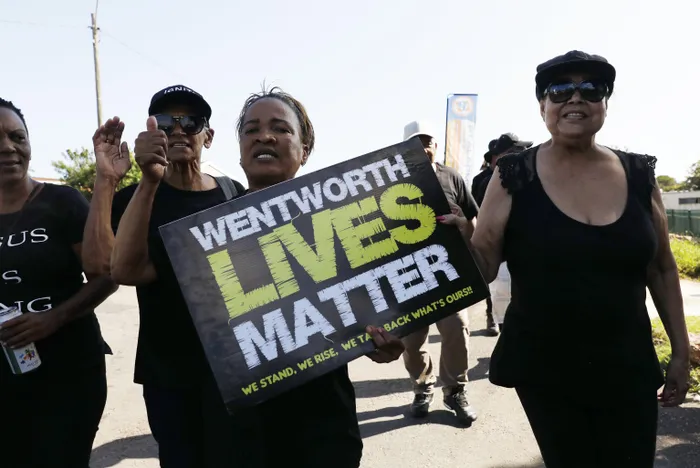
Residents are standing together to end the violence
Image: Doctor Ngcobo
“We also need answers on the murder cases. We need to know why cases are not reaching court, and where the challenge are. We also want to know who is failing. Is it the detectives or the prosecutors?” he asked.
Wentworth resident Darian Smith, the founder of the Community Fathers initiative, a growing movement of men choosing to take responsibility for rebuilding trust and strengthening family structures within the neighbourhood, said guns were easier to find than mentors in Wentworth.
“What we are seeing in Wentworth is not random violence, but the result of years of neglect, broken systems, and broken homes colliding. Young men are growing up in an environment where guns are easier to find than mentors, drugs are more present than opportunities, and many boys are raised without active, present fathers to guide them through anger, loss, and identity.
“Law enforcement interventions may bring short-term relief but the reality is that soldiers cannot raise sons, and police cannot heal trauma.
“The long-term solution must be rooted in active citizenry, where fathers step up and men are accountable. Communities must mentor boys before gangs do. If we do not invest in families, fatherhood, and safe spaces for young men to belong, the bloodshed will not end.
“Ending this violence requires both force and care, urgency and patience. We cannot arrest our way out of a problem we failed to prevent,” Smith said.
Olivia Stuart-Jones, a community leader and senior cultural chieftess at the Abbaquar-San Dream Centre in Austerville, said living in the heart of Wentworth has led her to witness first-hand how men and young boys were being sucked into the path of gangs and violence.
“I see every day how the young men are caught in a storm of challenges. The main spark behind the shootings is a mix of poverty and massive youth unemployment. Many men and young boys feel as if there is no way out.
“When jobs disappear, gangs step in and offer a sense of belonging and quick cash, which fuels the cycle of retaliation and gun violence.
“A lack of trust in the local police makes it harder for the community to break the pattern of violence.
“Despite the stance we took at the Wentworth Rise Against Violence campaign, another life was lost in the same week. This shows how fragile the peace is when the underlying factors contributing to the violence are not addressed,” she added.
Stuart-Jones said families of victims were severely impacted by the violence, and the residents were living in fear.
“Mothers and grandmothers are battling with the loss of their loved ones while trying to keep the household together. Children grow up witnessing trauma, which can scar them for life and perpetuate the cycle. The constant fear makes everyday tasks, like sending kids to school or to the tuckshop, feel dangerous, eroding the sense of safety that a community needs in order to heal,” she said.