

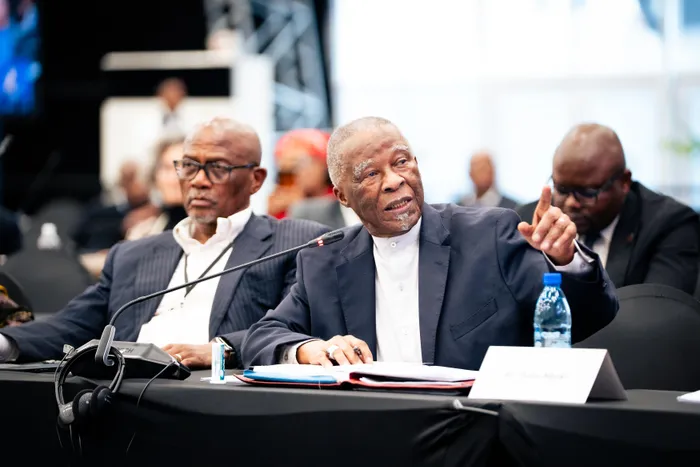
Former President Thabo Mbeki says Africa cannot achieve true progress while fragmented, calling for unity and cooperation across the continent while rejecting anti-immigrant sentiment linked to unemployment and economic frustration.
Image: Mbeki Foundation / X
Former president Thabo Mbeki has warned that anti-immigrant sentiment and South Africa’s unemployment crisis should not be blamed on foreign nationals, arguing instead that the country’s economic challenges require internal solutions and national unity.
This comes after the 16th Thabo Mbeki Annual Lecture in Cape Town.
Mbeki made the remarks during an interview with the SABC following his keynote address, where he reflected on the theme of African unity and warned against growing fragmentation on the continent.
He said Africa would not be able to play its full role globally unless it remained united, arguing that no country could achieve true sovereignty in isolation from others on the continent.
“The continent would not be able to play its proper role in terms of its own responsibility to itself and its own role globally unless the continent is properly united,” Mbeki said, warning against tendencies towards division and fragmentation.
Speaking on tensions surrounding undocumented foreign nationals, Mbeki noted that the issue had also been raised during the lecture by Nigerian guest speaker Dr Kayode Fayemi, who pointed to historical responses in other African countries as examples of approaches that had failed to resolve unemployment and had instead weakened continental cooperation.
Mbeki said such patterns had previously played out in countries including Ghana and Nigeria, where the expulsion of foreign nationals did not address underlying economic challenges.
“It solved nothing,” he said, adding that similar dynamics were now being repeated in South Africa.
He also warned that South Africa’s economy could not function in isolation from the rest of the continent, pointing to the African Continental Free Trade Area as an opportunity that could be undermined by hostility towards other African nationals.
“If the rest of the continent says we are going to boycott South African products, what happens to the South African economy?” Mbeki said, arguing that regional cooperation remained essential for economic survival.
Mbeki acknowledged concerns about unemployment and crime, saying these were legitimate issues being raised by citizens, but rejected the view that undocumented foreign nationals were the cause.
“What is not genuine is to say the reason we have high levels of unemployment in South Africa is because of foreign nationals,” he said, arguing instead that the root causes lie in domestic economic failures and governance challenges.
He said South Africa’s leadership, business sector, and government had not adequately addressed structural economic problems, and questioned the lack of what he called a “compact with business” to tackle poverty and unemployment.
Mbeki further called for a national dialogue involving government, business, labour, and civil society to address the country’s socio-economic challenges, saying such engagement was necessary to develop practical solutions.
“There is no national vision about what it is that we do practically to solve the problem of unemployment,” he said.
He argued that South Africa had previously experienced periods where unemployment levels declined, but said this trend changed after 2009, without sufficient analysis of what caused the shift.
“What changed? That matter has not been discussed,” Mbeki said, adding that proper diagnosis of the country’s economic problems was essential before solutions could be found.
Mbeki insisted that a national dialogue must take place, saying it would provide a platform to identify and address the causes of unemployment and other socio-economic challenges.
IOL Politics